 Madame Eulalie’s Rare Plums
Screenland (US), August 1930
Are you fed up with hokum comedy?
Do you hope never again to see an alleged musical movie?
Are you yearning for a fine bit of light fun which will make you laugh so hard you’ll rip open the seams in your new high-waisted, white sports frock?
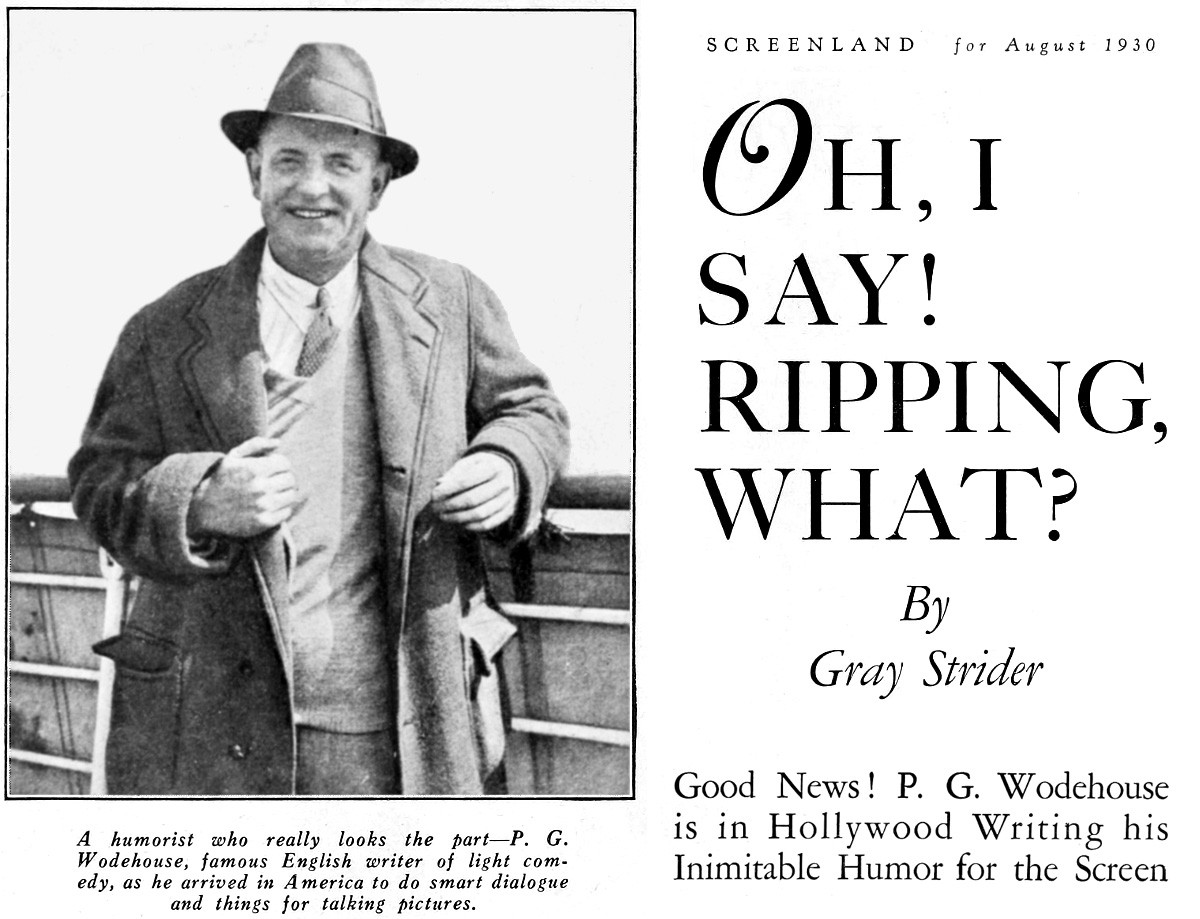
Well, cheer up. That’s just what’s going to happen to you. And soon, too. For P. G. Wodehouse, (pronounced Woodhouse, if you please) the English humorist, one of the best loved and most widely known funny men in the world, is on his way to California to write for the audible screen.
And how he loves it!
He says Hollywood is a swell place. That Americans are more intelligent than the English—(fancy that)—and a lot of other things which will make his fellow-countrymen blink their eyes and call for another sherry and bitters. Just to keep up the morale, y’ know. This younger generation is going to the dogs, y’ know. Fancy, one of our own—making such a statement! Bally rot, y’ know.
But it isn’t bally rot, for Wodehouse knows what he is talking about. America is his literary home, where he got his first real start. And he hasn’t only read about Hollywood in the fairy books, he’s actually been there. Listen to him!
“Hollywood is as sane a town as I have ever been in, at least as far as I could see when I visited there last year with my daughter.
“The whole time we were on the west coast,” Mr. Wodehouse continued, “I didn’t see a single swooning director, one temperamental star or any whoopee parties. Perhaps it was the closed season for—ah, er, temperament, but whatever the reason, I had to revise my opinions of the town, since I had always heard that it was a bizarre, fantastic, mad, glad, what-have-you sort of spot.”
Wodehouse is the sole humorist I have ever met who looks like a humorist. Instead of being a tall, thin, morose, hungry, liverish-looking gent who would scowl down his nose and emit wise-cracks—as some humorists are, and do—he is a large, pink, good-natured man, with beautiful, cheerful, easy-going manners, a soft, modest voice, and eyes which twinkle continuously.
Nor did he let fall any emeralds of humor during the interview. I suspect he was saving them up for the talkies, where they’ll be worth their weight—no, not in gold; in ambergris, which is much, much more valuable.
“I don’t believe a person can write funny stuff unless he is fairly well contented with life,” P. G. declared. “The idea of a sour individual turning out comedy doesn’t fit into the picture somehow. Most writers, I know, go through a stage where they love to turn out deep-sea tragedy, but I was spared that. My first writing at the age of ten was a set of comic verses. And I’ve stuck to comedy ever since.
“When I get to Hollywood, I don’t know just what sort of thing I shall do. Anything Mr. Thalberg wants, I rather expect. My taste in pictures runs to light comedy, for after all, amusement is the primary business of talking pictures.
“That’s why Marion Davies is almost my favorite talkie actress. I liked her very much in ‘Not So Dumb.’ Next after Miss Davies, I prefer Clara Bow, Greta Garbo, Ronald Colman, and Kathryn Carver, although we don’t see her very much now.
“I rather think the trouble with the talkies is the same trouble that the stage has always had—there aren’t really enough good stories to go around. If you take a whole theatrical season, there will scarcely be a half-dozen good stories. And the same is true of the screen. The plot and dialogue have to be turned out at such a tremendous rate of speed that the result is often—well, not what one could wish.
“Perhaps the answer is to take the best literature at our disposal and to adapt it to screen needs.
“I’m jolly glad to be here in America for I sold my first story in the United States. I started out at twenty-one, after I left Dulwich (pronounced Duledge—these droll English!) College, as assistant columnist on the Globe, a London newspaper, at a salary of twenty-five dollars a week. During my second summer there I had a five weeks’ vacation, and so decided to visit America. Here I sold my first story, to Cosmopolitan. Following this, I placed several in McClure’s and Everybody’s.
“In fact, I was getting on so well, I applied for extended leave and stayed here some months, later returning to England. But every year or so I returned to write some of Mr. Ziegfeld’s musical comedies, as well as to write for various magazines.
“The high water mark in my life, I think was in 1914, when I sold my first serial to the Saturday Evening Post. I really felt I was getting on then! Since that time I have written some thirty novels, the latest being ‘Fish Preferred,’ and many stories for Liberty and Collier’s and the Saturday Evening Post.
“In England, I contribute to the Strand Magazine, which is the publication which first printed the Sherlock Holmes stories. Although I respect this and many other British magazines highly I am forced to the conclusion that the average intelligence in America is higher than the average intelligence in Great Britain, which fact is borne out by its magazines, its movies and its advertising.
“Advertising is also behind the American standard. The whole thing is on a different scale. Perhaps it is because we are more reticent.
“And, of course, as everybody knows, our moving pictures are not in any way comparable to yours. Despite the fact that the screen is one of the best means of advertising home products abroad, England has not kept pace with the times. A few men get together, subscribe a hundred thousand dollars’ worth of stock, which after all, would be only one day’s expenditure in Hollywood, and try to make pictures. It’s done in such a provincial fashion. Exactly as if Mr. Ziegfeld were to operate his ‘Follies’ in Albany or Schenectady instead of on Broadway.
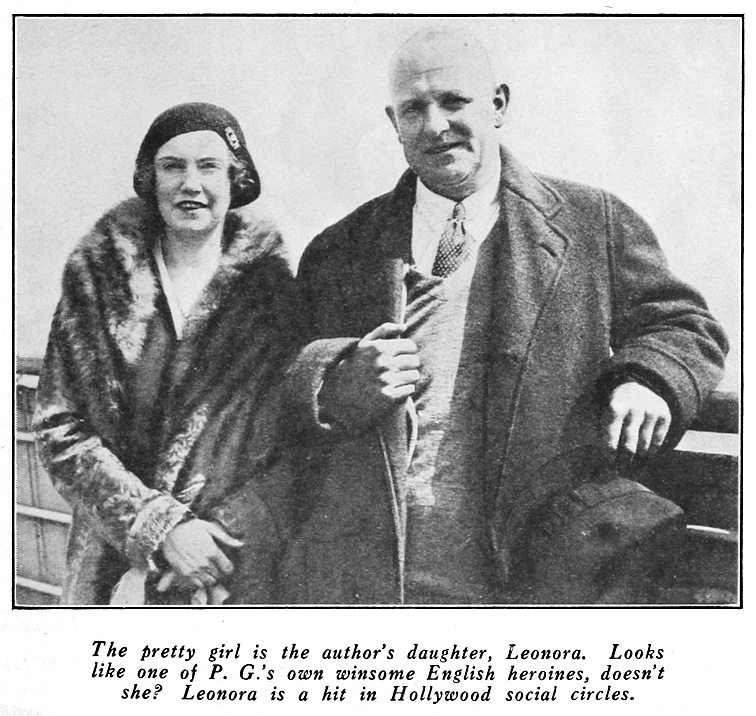
“But despite all this, there’s no place quite like England for me,” smiled Wodehouse. “I miss my home and garden very much. I never go out a lot, but depend almost entirely for my recreation on books, my garden, and my family and my friends. My wife will join me soon. My daughter is here with me. And my only worry is what I shall do in Hollywood about a home. Do you think I can find a garden there?”
To reply to that, Mr. Wodehouse, we’ll have to refer you to the Los Angeles Chamber of Commerce. For to hear them tell it, Hollywood is the prize garden of the world.
Printer’s error corrected above:
Magazine had “Dullwich” College.
Back to Menu
www.MadamEulalie.org
2026-01-17 AR/NM
Wodehouse’s writings are copyright © Trustees of the Wodehouse Estate in most countries;
material published prior to 1931 is in USA public domain, used here with permission of the Estate.
Our editorial commentary and other added material are copyright
© 2012–2026 www.MadamEulalie.org.