 Madame Eulalie’s Rare Plums
The Story Thus Far:
HAVING got himself engaged to the lovely Ann Moon, niece of T. Paterson Frisby, American financier residing in London, Godfrey, Lord Biskerton (known to his irreverent intimates as the “Biscuit”), is confronted with a serious problem. He must evade his creditors and the bailiffs until after the marriage. But how?
“Berry” Conway, his lordship’s closest friend—who, due to a paucity of funds, has become T. Paterson Frisby’s secretary—makes a grand suggestion. Why not leave London, take a house next to Mr. Conway’s in Mulberry Grove, Valley Fields, near the city, and pretend to be suffering from a severe attack of the mumps? . . . The Biscuit follows the suggestion—with joy.
Mean while the fair Kitchie Valentine, another American heiress, has appeared on the scene. Kitchie, engaged to a gentleman at whom her family turns up its nose, has been banished to England, there to do penance by visiting her uncle, the bellicose Major Flood-Smith, neighbor of Berry Conway.
Safe from the bailiffs, for the time being, in his new country residence, the Biscuit looks for excitement. He has not long to look. The lovely Kitchie is close at hand. He sees her, meets her, likes her. . . .
Let us now consider, for a moment, Mr. Conway’s affairs. He, too, has an eye for beauty. And, having seen and conversed with a most fascinating young female (name unknown to him) he is deeply, and secretly, in love. The object of his affections is none other than Godfrey, Lord Biskerton’s, fiancée—Ann Moon!
In need of ready cash, Mr. Conway seeks Mr. Frisby’s advice. He owns a copper mine—“The Dream Come True,” apparently worthless. Should he sell it? “Yes,” says Mr. Frisby, who has learned that the mine is very valuable and wants it. Whereupon the young man prepares to sell the property to one J. B. Hoke (secretly in the employ of Mr. Frisby) for the princely sum of five hundred pounds. . . .
The Biscuit’s impecunious father, Lord Hoddesdon, and Lord Hoddesdon’s sister, the stalwart Lady Vera Mace, who is Miss Moon’s chaperon, are much perturbed by the Biscuit’s antics. Mumps! Tooh! If he stays away from London much longer, he may lose his Ann. More, he may lose a fortune! . . . But what does the Biscuit care? He is quite content to remain in the country—near Kitchie.
Meanwhile has Godfrey, Lord Biskerton’s, affianced love been slowly pining away, due to his lordship’s absence? She has not! On the contrary, Miss Moon seems quite chipper. . . . For somewhere in the great city is a young man. A very nice young man. So nice, indeed, that, having conversed with him, without knowing his name, our little heroine is—well, she is hoping to meet him again. . . . Berry? Correct!
VI
IT DID not take Berry long, once the company had seated itself in the Oriental banquet-room of the Hotel Mazarin in Piccadilly, to realize which of the two alternatives mentioned by the Biscuit was to be his fate tonight. Dotards in considerable force had attended this Old Boys dinner, but they were sitting at distant tables. His own was the very heart and center of the younger set. Boisterous striplings, who all seemed to know one another intimately and to have no desire to know him at all, encompassed him on every side. And gradually, as he watched them, his mood of somber sadness deepened.
He knew now that he had made a mistake in exposing himself to this ordeal. He was in no frame of mind gladly to suffer beardless juveniles like these. Swollen with soup, they had now begun to rollick and frolic in a manner infinitely distressing to a heartbroken elder. Their infantile frivolity afflicted him more and more every moment with a sense of the passage of the years.
Once, he reflected—how long ago!—he, too, had had spirits like that. Once he, also, had lived in Arcady and thrown bread at Old Boys dinners. How far in the distant past all that sort of thing lay now.
Twenty-six next birthday! That was what he was. Twenty-bally-six, and no getting away from it.
And what had he done with his life? Nothing. Apart from being the sort of chump who, when he has the luck to meet the only girl in the world, lets her slip away from him like a dream at daybreak, what had he achieved? Nothing. If he were to pass away tonight—poisoned, let us say, by this peculiar-looking fish which, having died of some unknown complaint, had just been placed before him by an asthmatic waiter, what sort of gap would he leave? An almost invisible one. Scarcely a dimple.
WOULD that girl regret him? Most unlikely. Would she even remember that she had ever met him? Probably not. A wonderful girl like that met so many men. Why should she have continued to bear in mind so notably inferior a specimen as himself? Such a girl could take her pick of all that was best and brightest of England’s masculinity. Hers was a life spent in the center of a whirling maelstrom of handsome, dashing devils with racing cars and all the money in the world. What earthly reason had he to suppose that she had ever given him another thought? A doddering wreck like him—twenty-six next birthday. In a flash of morbid intuition he realized now why she had driven off that day and left him flat. It was because she was bored with him and had jumped at the chance of getting away while his back was turned.
He had reached this depth of self-torment and was preparing to go still deeper, when half a roll, propelled by a vigorous young hand, struck him smartly on the left ear. He leaped convulsively, and for an instant forgot all about the girl. In similar circumstances Dante would have forgotten Beatrice. The roll was one of those hard, jagged rolls, and the effect of its impact was not unlike that of a direct hit from a shell. He looked up wrathfully. And as he did so a child at the other end of the table, smirking apologetically, applied the last straw.
“Oh, sorry, sir,” cried this babe and suckling. “Frightfully sorry, sir. Most awfully sorry, sir. I was aiming at young Dogsbody.”
Berry contrived to smirk back, but with an infinite wryness, for his heart was as lead. This, he felt, was the end.
The young germ had called him “sir.”
“Sir!”
It was what he himself called T. Paterson Frisby, that genuine museum piece who could not be a day less than fifty.
Now he saw everything. Now he understood. That girl had been civil to him at first because she was a sweet, kind-hearted girl who had been taught always to be polite to age. What he had mistaken for camaraderie had been merely the tolerance demanded by his white hairs. Right from the start, no doubt, she had been saying to herself, “At the very earliest opportunity I must shake this old buster!” and at the very earliest opportunity she had done so. “Sir!” indeed! How right the Biscuit had been. He should never have been such a fool as to come to this blasted party. And the best thing he could do, having come, was to repair his blunder by oiling out immediately.
To leave a public dinner at the height of its fever is not easy, and it is to be doubted whether mere senile gloom, however profound, would have been enough to nerve Berry to the task. But at this moment his eye fell on the table at the top of the room, along which, on either side of the president, were seated some twenty of the elect: and it now flashed upon him that of these at least eight must almost certainly be intending to make speeches. And right in the middle of them, with a nasty, vicious look in his eye, sat a bishop.
Anybody who has ever attended Old Boys dinners knows that bishops are tough stuff. They take their time, these prelates. They mouth their words and shape their periods. They roam with frightful deliberation from the grave to the gay, from the manly straightforward to the whimsically jocular. Not one of them but is good for at least twenty-five minutes.
Berry hesitated no longer. The banquet had reached the petrified quail stage now, which meant that there was only the hair-oil ice cream, the embalmed sardines on toast and the arsenical coffee to go before the dam of oratory would burst. There was not an instant to be lost. He pushed his chair back and sidled furtively to the door. He reached the door and pulled it open. He slid through and closed it behind him.
HE WAS standing now in the main lobby of the hotel. Festive-looking men and women were passing through, some to the dining-room, whence strains of music emerged, others to the lifts. There seemed to be a dance or some other sort of entertainment in progress upstairs somewhere, for traffic on the lifts was heavy. Revelers were being taken up in dozens, and Berry watched them with a growing feeling of desolation and disapproval. Their lightheartedness irked him as the exuberance of his recent companions in the Oriental banquet-room had irked him. It is not pleasant, when one is face to face with one’s soul, to see a lot of fatheads enjoying themselves.
Berry had achieved by this time a frame of mind which would have qualified him to walk straight into a Tchekov play and no questions asked, and he resented all this idiotic gayety. As the crackling of thorns under a pot, he felt, so is the laughter of a fool.
An unusually large consignment was on the point of starting now. The lift was crammed with perishers of both sexes—the girls giggling and the men what-what-ing in a care-free manner that made him feel sick. So full was it that it scarcely seemed as if there would be room for the girl in the gray opera cloak who was hurrying with her escort across the lobby. But the man at the wheel contrived to squeeze them in somehow, and as the car started on its journey the girl turned to her companion and said something with a smile. And for the first time Berry saw her face.
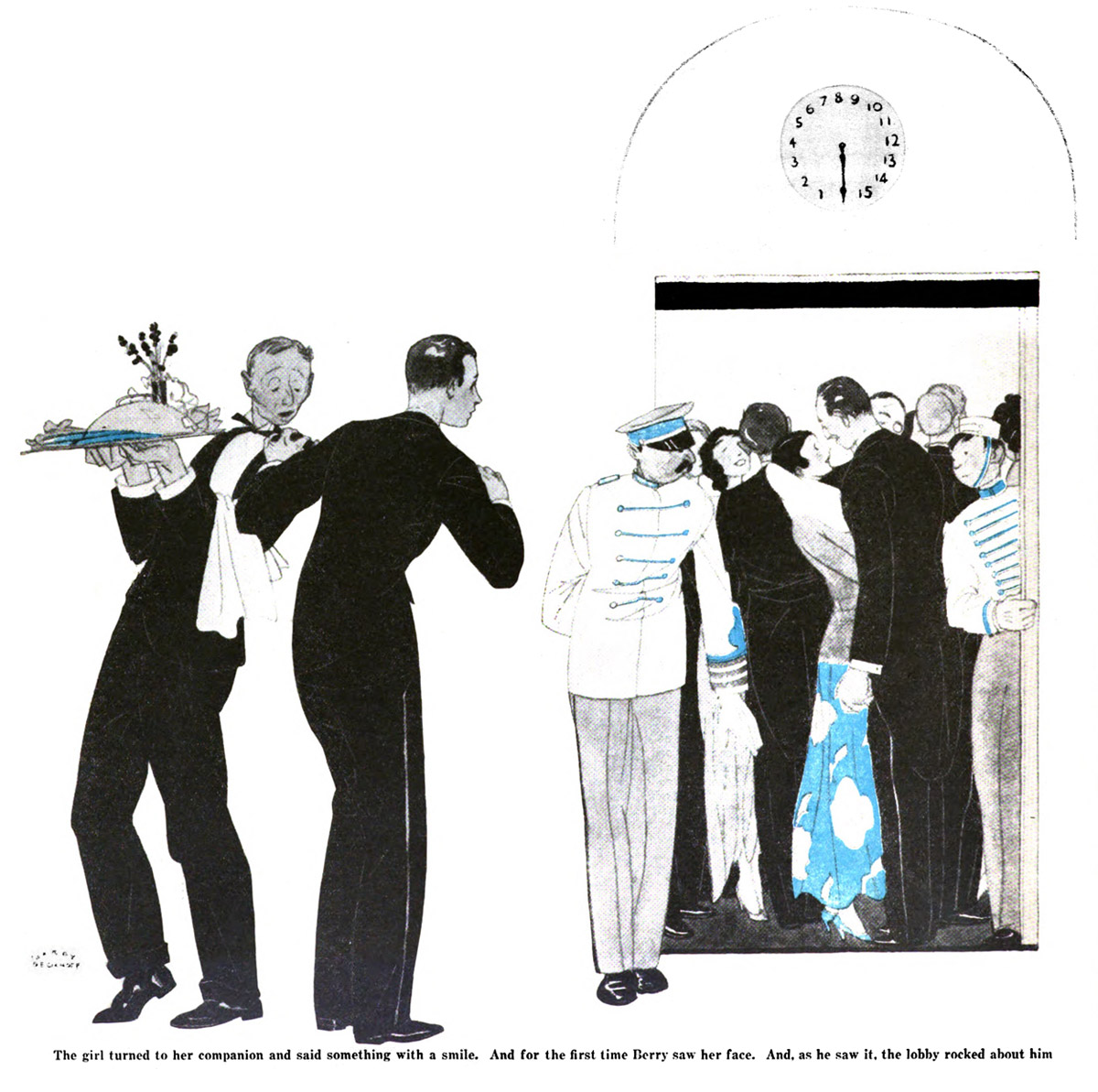
And, as he saw it, the lobby rocked about him. A wordless exclamation burst from his lips. Reeling, he clutched at a passing waiter.
“Sir?” said the waiter, courteously ceasing to pass.
Berry smiled radiantly at the man. He could only see him through a sort of mist, but he was able to realize that this was by a considerable margin the nicest-looking waiter he had ever set eyes on. And all those people in the lifts—how wrong he had been, he now saw, in thinking of them as perishers. They were in reality a most extraordinarily jolly crowd. And how capital it was to think that they were enjoying themselves so much.
“What’s going on up there?” he asked.
The waiter informed him that Sir Herbert and Lady Bassinger were giving a ball in the Crystal Room on the first floor.
“Ah!” said Berry thoughtfully. “A ball, eh?”
He handed the man half a crown, and stood for a moment gazing wistfully across the lobby. How splendid, he was thinking, it would have been if only he had been acquainted with these Bassingers. Then they might have invited him. . . .
BERRY pulled himself up with a start. He was shocked to find that for an instant he had been allowing himself to fall so far from the standard of a man of enterprise, dash, and resource as to look on a card of invitation as an essential preliminary to the enjoyment of the hospitality of Sir Herbert and Lady Bassinger. But it had been merely a passing weakness. He was himself again now, and what he felt was that any ballroom where that girl was to be found was Liberty Hall for him.
The lift had just descended, and was standing on the ground floor once more, waiting for custom. Berry walked toward it with resolute steps.
Lady Bassinger’s ball at the Hotel Mazarin was an entertainment to which Ann Moon had been looking forward with pleasurable anticipation. Toddy Malling, the young man who, in the unfortunate absence of her fiancé, Lord Biskerton, was acting as her escort, had been almost lyrical about it in the car. It promised, said Toddy, to be the jamboree of the season. Champagne, he assured her, always flowed like water where the Bassingers set up their banner.
“Old B.,” said Toddy, “is not the sort of fellow I’d care to go on a walking tour with, but at providing refreshment for man and beast he has few equals. He made about ten million quid in the clove market. And God bless cloves, say I,” he added devoutly.
On Toddy’s suggestion they had made straight for the supper-room. He held the view, for which there was much to be said, that it was silly to think of doing any hoof-shaking till they had stoked up. Having deposited Ann at a table for two, he had gone off to forage. And now she was sitting waiting for him to come back. And, as she watched the crowd, she wished that she could achieve something of the hearty party spirit which so obviously animated Sir Herbert’s and Lady Bassinger’s other guests. She was conscious of a feeling of flatness ill-attuned to the rollicking note of the festivities.
It was strange, she reflected. Her conscience assured her that the most sensible thing she had ever done in her life was to drive off in her car and leave that attractive young man to catch his Sniffers for himself. She was engaged, conscience pointed out, and girls who have plighted their troth must not hobnob with handsome secret service men. And yet, so far from experiencing the glow of satisfaction which good girls are entitled to expect, she was feeling as if she had deliberately thrown away something wonderful and precious.
IN TORTURING himself with the thought that this girl had forgotten him, Berry Conway had tortured himself unnecessarily.
“Bollinger, one bot.,” said Toddy Malling, appearing suddenly at her side. “I snaffled it off another table. Stick to it like glue and guard it with your life.”
The supper-room was looking now like a popular store during a bargain sale. The idea of taking refreshment before dancing had not occurred to Toddy alone. On every side thrustful cavaliers, like knights jousting for their ladies, were hurling themselves into the dense throng that masked the table where food and drink were being doled out. Supper at a Bassinger ball was always a test of manhood, and the lucky ones were those who had played Rugby football at school.
“Somewhere in the heart of that mob,” said Toddy, laying his precious burden on the table, “there is provender of sorts. I’ll try to get you something. I can’t guarantee what it will be, but are you more or less prepared for whatever I can snitch?”
“Anything,” said Ann. She came out of her thoughts with a little jump. “I’m not hungry.”
“You’re not?” said her escort incredulously. “Gosh! I could eat old Bassinger in person, if a spot of chutney went with him. I’ll try to hook a chicken. Amuse yourself somehow while I’m gone. And if I don’t come back, you’ll know I died game.”
He disappeared again, and Ann returned to her thoughts.
Yes, something wonderful and precious. And she had thrown it away. And its going had left life flat and monotonous.
The crowd was surging to and fro. Sharp, anguished cries rang through the room, as men balancing plates of salmon mayonnaise perceived men with plates of chicken salad backing into them. The heat and the noise combined to induce in Ann a distant dreaminess. Dimly she became aware that somebody was sitting down in the chair opposite her, and she roused herself to protect the rights of the absent Toddy.
“I’m sorry. That chair is . . .”
She broke off. She was not dreaming now. Her whole body was tingling as though fire had touched it.
“Oh!” said Ann breathlessly.
And that, for a while, was all she was able to say. Her heart was racing, and already conscience was beginning to comment on the deplorable way in which her lips had begun to tremble.
“All wrong!” said conscience rebukingly. “This man is nothing but a casual acquaintance. Treat him as such. Bow stiffly.”
Ann did not bow stiffly. She went on staring. And across the table the intruder went on staring.
A young man in spectacles, bearing treasure trove on a plate, tripped over somebody’s foot and bumped heavily into the table. Something fell squashily between them.
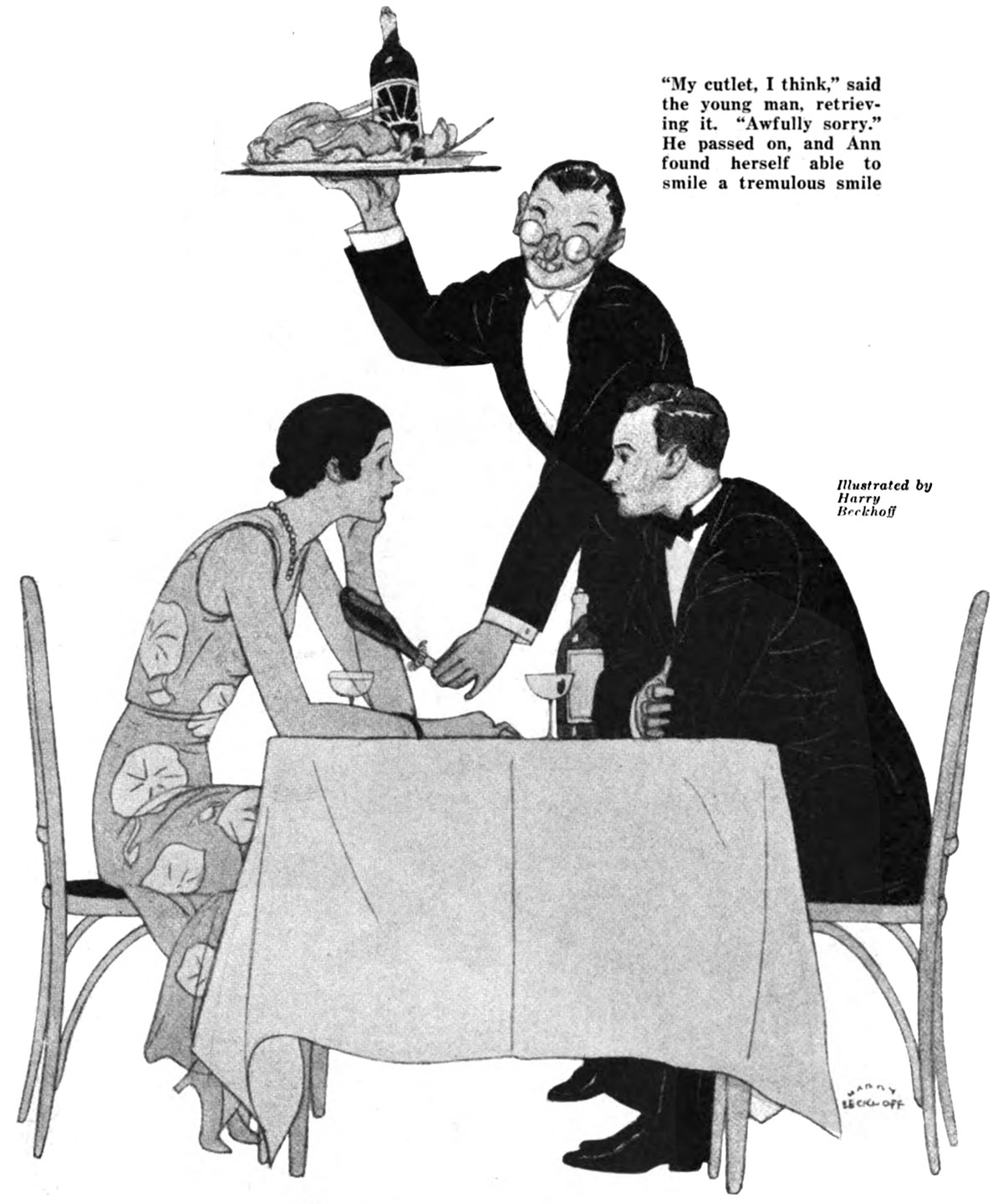
“My cutlet, I think,” said the young man, retrieving it. “Awfully sorry.”
He passed on, and Ann found herself able to smile a tremulous smile.
“Good evening!” she said.
“Good evening.”
“You do keep popping up, don’t you!” said Ann. “You always seem to appear from nowhere, out of a trap.”
Her companion did not smile. There was something forceful and urgent about him. He conveyed the impression of one who is in a hurry and in no mood for light conversation.
“Where did you get to that day?” he asked abruptly, and frowned, as if at an unpleasant memory.
Ann braced herself to be cool and quelling. She told herself that she resented his tone. He had spoken as if he supposed that he had some claim on her, regarded her as something belonging to him. This, she told herself, offended her, and rightly.
“I went home,” she said.
“Why?”
“Isn’t a woman’s place the home?”
“It was an awful shock when I came out and found you gone.”
“I’m sorry.”
“I couldn’t think where you had got to.”
“Really?”
(“The right tone?” asked Ann of her conscience. “Quite right,” replied conscience. “Admirable. Keep it up.”)
“By the way,” said Ann, “was that man The Sniffer?”
Her companion started. For the first time, the forcefulness of his manner was tempered by something that seemed almost embarrassment. A flush had come into his face, and his eyes, instead of gazing piercingly into hers, wandered away to one side.
“Look here,” he said awkwardly, “I want to tell you something. You see . . .”
He paused.
“Yes?” said Ann.
“I feel I ought to . . .”
He appeared to be hovering on the brink of a revelation of some kind.
“Well?” said Ann.
ANOTHER young man, this time without spectacles, charged breezily into the table, rocking it to its foundations.
“Frightfully sorry,” he said. “There’s an awful storm going on out there. Heaven help the poor sailors.”
He paused to scoop up a portion of chicken salad, and went out of their lives forever.
“What were you saying?” asked Ann.
Her companion seemed to have been reflecting during the recent diversion. It had sounded to Ann as though he were about to make some sort of confession, but now he appeared to have thought better of it.
“Nothing,” he said.
“You began to say something about telling me—?”
“No, it was nothing. I was going to say something, but I think I won’t.”
“You must have your secrets, I suppose. Well, was it The Sniffer?”
“No. It wasn’t.”
“I’m glad.”
“Why?”
A sudden and startling change came over Ann’s manner. Until now she had won her conscience’s complete approval by the distant coolness of her attitude. At this question she slipped lamentably. From distant coolness she lapsed into a deplorable sincerity.
“I thought you were going into the most terrible danger,” she said breathlessly. “I thought he might kill you.”
“You were worried about—me?”
“Well, it’s not very nice for a respectable young girl,” said Ann, recovering, “to be mixed up in shooting affrays. Think of the papers!”
The eager light died out of her companion’s eyes.
“Was that all you cared about?” he asked, hollowly.
“What else would there be?”
“Nothing personal in your alarm, eh?”
“Personal?” said Ann, raising her eyebrows.
“Well, I’m glad you did the prudent, sensible thing,” said her companion, speaking, however, without noticeable elation, “and got away before there was trouble.”
“But there wasn’t,” Ann pointed out.
“No,” said her companion. And there was another silence.
BETWEEN Ann and her conscience there now existed a wide cleavage of opinion. Her conscience kept telling her that she had borne herself under trying conditions in an exemplary manner. She told herself that she was behaving like an idiot. A little more of this sort of thing, and this man would get up and go away forever.
“Of course I was worried about you,” said Ann impulsively. “I only said that about the papers because. . . . Of course I was worried about you!”
A gleam like sunshine through cloud-wrack illuminated the brooding face opposite her.
“You were?”
“Of course.”
“You mean, you were?”
“Certainly.”
“You really were?”
“Of course I was.”
He leaned forward.
“Shall I tell you something?”
“What?”
“Just this,” said her companion. “I’ve . . .”
He broke off with a sharp exclamation. Something warm and wet had fallen on the back of his head.
“The fault,” said a cheerful voice behind him, “is entirely mine. I ought never to have attempted to carry soup through a mob like this. Well, all I can say is, I’m sorry. There’s just one bright spot—it’s jolly good soup.”
Berry turned savagely. A man in love can stand just so much.
“Let’s get out of this,” he said between his teeth. “There’s something I want to tell you. We can’t talk here.”
“But Mr. Malling will be back in a moment,” said Ann. She had a sense of slipping, of struggling for a foothold.
“Who’s he?”
“The man I’m with. He’s gone to get me something to eat. If I go away, what will he think?”
“If he’s anything like the rest of the men here,” said Berry, “I don’t suppose he’s capable of thinking.”
He urged her toward the door. They passed out and were in a small anteroom. From somewhere beyond came the sound of music.
Berry slammed the door behind him and turned to her.
“I’ve something I want to tell you,” he said.
He seemed to Ann to be swelling before her eyes. He looked huge and intimidating. She became conscious of feeling very small and fragile.
“You’ll think me mad, of course.”
He was very close to her now, and conscience, clucking like a hen, was urging her to draw back. She did not draw back.
He took her hand, and as he did so she saw him start, like one who has observed a snake in his path. It was her left hand that he had taken, and what he was staring at was the ring on the third finger. It was a nice ring, of diamonds and platinum, and Lord Biskerton owed a considerable sum for it, but there was no admiration in the young man’s gaze.
“You’re engaged!” he said.
THE words were hardly a question. They resembled more nearly an accusation. Ann had a fleeting, but none the less disintegrating, sensation of having been detected in some act unspeakably low and base. She felt that she wanted to explain, and it seemed so impossible to explain.
“Yes,” she said, in a small, meek, penitent voice.
“My God!” said the young man.
“Yes,” said Ann.
“Engaged!”
“Yes.”
The young man breathed heavily.
“I don’t care!” he said. “I just want to tell you . . .”
The lobby between the supper-room and the Crystal ballroom of the Hotel Mazarin on the night of a Bassinger dance is perhaps, with the exception of the supper-room, the least suitable spot in the whole of London for the conduct of a tête-à-tête. Even as he spoke the young man became aware of something male and intrusive at his elbow. This person seemed to be desirous of speech with him. He was tapping him on the arm.
“Excuse me,” he was saying.
And almost at the same instant the door of the supper-room flew open, and Ann, in her turn, found herself forced to recognize that there were more than two people in the world. The whole place had begun to take on a congested air.
“Oh, there you are!” said Toddy Malling.
Toddy was flushed and disheveled. He seemed at some point in his recent activities to have run his right eye up against something hard, for it was watery and half closed. In his left eye, which was working under its normal power, there was the light of reproach.
“Oh, there you are!” said Toddy Malling. “I couldn’t think where you had got to. I’ve been looking for you everywhere.”
A sense of being torn in half came upon Ann. She felt as she had sometimes felt when wrenched from some beautiful dream by the ringing of the telephone at her bedside. She looked over her shoulder. The young man who had something which he just wanted to tell her was standing with a dazed expression on his face, gazing down absently at someone whom she recognized as her host, Sir Herbert Bassinger. Sir Herbert appeared to be asking him some question, and the young man was plainly having a little difficulty in giving his mind to it.
“I’ve snaffled an excellent chicken,” proceeded Toddy, with the modest pride of a Crusader who has done big things among the paynim. “Also some salad of sorts. Come along.”
Ann was a kind-hearted girl, and one who hated hurting people’s feelings. Well aware of the perils to which Toddy had exposed himself in order that she might sup, she appreciated the justice of his claim on her society. For her sake he had fought and, practically, bled. She could not rebuff him now, in the very hour of his triumph. To do so would be to destroy all young Mr. Malling’s faith in woman.
“All right, Toddy,” she said. “You’re a hero. Lead on.”
“You don’t mind if young Bertie Winch puts on the nosebag with us, do you?” said Toddy anxiously, as they passed through the door. “I had to rope him in as an ally. It was imperative. I stationed him by the table and told him to look after that chicken like a baby sister. Otherwise, some of these bally pirates would infallibly have pinched it.”
Berry, meanwhile, had at last had it forced upon his senses that this voice which was babbling in his immediate neighborhood was addressing its remarks to him, and, though still distrait, he answered civilly.
“Quite,” he said. “Absolutely. No doubt.”
The voice appeared dissatisfied. And, more than dissatisfied, indignant. It rose querulously.
“I’m asking you,” it said, now undisguisedly peevish, “who the devil you are and where the devil you came from and what the devil you think you’re doing here. I don’t know you from Adam, and I’d like to see your card of invitation, if you please.”
Berry came out of his reverie. There is a time for dreaming and a time for facing the issues of life in a practical spirit. This seemed to be one of the latter occasions. Peering through the golden mists which float about a lover, he perceived a rubicund little man of middle age with a walrus mustache and two chins. The mustache was twitching, and both chins waggled in an unpleasant and hostile manner.
“I beg your pardon?” he said.
“Never mind about begging my pardon,” replied his new acquaintance. “Show me your invitation-card.”
IN GAZING at Berry as if he were an escape of sewer-gas and addressing him in a tone which a bilious warder in a prison might have used toward a convict whom he did not like very much, Sir Herbert Bassinger, Bart., undoubtedly had justice on his side. There had been this season at society functions quite an epidemic of what is technically known as gate-crashing. At a great number of balls, that is to say, a great number of London’s bright young men had put in an appearance, drunk as much champagne as they could hold without spilling over the brim, and danced till their ankles gave out, all without the formality of an invitation.
Hosts had come to dislike this practice, and Sir Herbert Bassinger, who had suffered much from it at his last big affair, given earlier in the year, had sworn a dark oath that there was going to be none of that this time. It had, accordingly, been enjoined upon the guests at the dance in the Crystal ballroom of the Mazarin Hotel that they should bring their invitation-cards with them and be prepared to show them on demand.
“Invitation-card?” said Berry musingly, as if the word was new to him.
“Invitation-card.”
“Well, the fact is . . .” said Berry.
It was a conversational gambit which told Sir Herbert all he wanted to know. Only the sinful and black of heart, he was aware, begin their remarks with that phrase. Comfortably sure now that he was not ejecting from his dance some scion of a noble house whose face he had chanced to forget—or, worse, a gossip-writer from one of the daily papers—he unmasked his batteries.
“I must request you to leave immediately.”
“But . . .”
“Get out!” said Sir Herbert, becoming terser.
“But I must speak to . . .”
The walrus mustache quivered like a cornfield in the evening breeze.
“Are you going, or shall I call a policeman?”
Berry perceived that he must be polite and winning. He was still unaware of the name and address of his goddess of the car, and this man could supply them. He forced an ingratiating smile.
It did not go well.
“Don’t grin at me!” thundered Sir Herbert Bassinger.
Even filtered through the mustache, his voice made Berry leap a couple of inches. He removed the ingratiating smile. His companion’s wish was law. Besides, it was hurting his face.
“I’ll go,” he said reassuringly. “Oh, I’ll go. Of course I’ll go. I quite understand that I have no business here. I’ll go all right. I only came because I saw somebody I wanted to speak to going up in the lift. If you will just let me go into the supper-room and have a word with . . .”
Sir Herbert Bassinger was a man who, when stirred, was accustomed to fall back on a vocabulary of his own invention. He employed it now:
“Stop this tish-tosh!”
Berry continued to be polite and winning:
“Perhaps if you would just tell me her name?”
“Enough of this bubble-and-squeak!”
“Her name?” said Berry urgently. “I must know her name. If you’ll be kind enough to tell me her name . . .”
“Will you kindly cease this tingle-tangle and get out of here?” said Sir Herbert Bassinger.
Several attendants in gay uniform had manifested themselves by now and were dotted about the room, eying Berry in that cold, severe way in which barmen eye the obstreperous in bars. Reluctantly, he realized that he could do no more. He had shot his bolt. A brawl, agreeable though it would have been to his ruffled feelings, was out of the question.
“Very well,” he said.
With no more tingle-tangle or tish-tosh, he turned and walked in silence to the stairs. His bearing was not exactly dignified, but it was as dignified as a man’s can be who is undergoing a spiritual frog’s march.
A LIGHT in the sitting-room of Peacehaven informed Berry on his return to Mulberry Grove that Lord Biskerton was still up and, no doubt, eager for a chat. He rapped on the window. It was opened hospitably, and he climbed through.
“Well?” said the Biscuit, “what sort of a time did you have?”
He eyed Berry narrowly. There seemed to him in his friend’s demeanor something strange—an unwonted sparkle in the eye, a suppressed elation as of one who on honey-dew has fed and drunk the milk of Paradise. This, the Biscuit felt, was scarcely to be accounted for by attendance at an Old Boys dinner, and he sought elsewhere for the cause.
“What’s the matter with you, reptile?” he asked. “You’re fizzing visibly. Come into money, or something?”
BERRY sat down, got up, sat down, got up, sat down again, and got up once more. His manner was feverish, and his host disapproved of it.
“Roost!” commanded the Biscuit. “Park yourself, confound you. You’re making me giddy.”
Berry balanced himself on the edge of the horsehair sofa. He did it as one not committing himself definitely to a sitting position but holding himself in readiness at any moment, should he see fit, to soar up to the ceiling.
“Now then,” said the Biscuit, “tell me all.”
“Biscuit,” said Berry, “the most extraordinary thing has happened. There’s a girl . . .”
“A girl, eh?” said the Biscuit, interested. He began to see daylight. “Who is she?”
“What?” asked Berry, whose attention had wandered.
“I said, who is she?”
“I don’t know.”
“What’s her name?”
“I don’t know.”
“Where does she live?”
“I don’t know.”
“You aren’t an encyclopedia, old boy, are you?” said the Biscuit. “Where did you meet her?”
“I saw her first across a restaurant.”
“Well?”
“We looked at each other a good deal.”
“And then?”
“Then we went on looking at each other. It was that day you were wearing that beard, Biscuit. You remember?”
“I remember.”
“I felt absolutely desperate. I knew, just by looking at her, that I had found the only girl I should ever love. . . .”
“You boys!” interjected the Biscuit tolerantly.
“And how on earth was I to get to know her? That was the problem.”
“It always is. I wish I had a quid for every time . . .”
“WHEN I came out into the street, I saw her getting into her car. And suddenly I had an inspiration. I jumped in after her, and told her to follow you.”
“Follow me? How do you mean, me? How do I come into it?”
“You were in your car just ahead.”
The Biscuit’s interest deepened.
“Do you mean all this happened the day you lunched at the Berkeley, when I was giving the old fungus a trial trip?”
“Of course. I’m telling you.”
“Then who was the girl, I wonder?” mused the Biscuit. “I don’t remember seeing anything very special in the way of girls that time. However, don’t let’s wander from the point. You jumped into her car. What happened then?”
“You drove off, and we drove after you.”
“You mean she just said, ‘Yes, sir!’ and trod on the self-starter? I should have thought she would have called a cop and two loony-doctors and had you put where you belonged.”
Berry hesitated. They had reached the only point in this romance of his on which he did not like to let his mind dwell. No lover enjoys feeling that he is deceiving the girl he loves. There had been an instant during that scene in the supper-room at the Mazarin when he had braced himself for a full confession. He had thought better of it, but, none the less, his conscience irked him.
“Well, as a matter of fact, Biscuit,” he said, “I lied to her.”
“Starting early, what?”
“I told her I was a secret service man,” said Berry.
The Biscuit gaped.
“You—what?”
“I said I was a secret service man. You see, that explained why I wanted her to follow you.”
“Why? Who did you say I was?”
“I told her you were the head of a great cocaine ring.”
The Biscuit thanked him.
“I had to give some reason for jumping into her car like that.”
“And what happened when you told her that you had been fooling her?”
“I didn’t.”
“You let her go on thinking you were a secret service man?”
“Yes.”
“God bless you, laddie! This is the best bedtime story I’ve heard for months and months and months. So she still thinks you’re a secret service man? You didn’t explain later?”
“No. What happened was this, you see: When I came out of the inn, she had gone. Her car wasn’t there. She had driven off. But tonight I met her again. There was a dance going on at the Mazarin, and I had come out from the dinner, and I saw her going up in the lift. So I went up after her, and found her in the supper-room. And we were just starting to talk when the man who was giving the dance came along and chucked me out.”
The Biscuit uttered appreciative cries.
“But before that happened I had had time to see . . . I mean,” said Berry, becoming incoherent, “there was something in her eyes. . . . The way she looked. . . . I believe if only I had had a minute longer . . . It was the way she looked, if you understand what I mean.”
“You clicked?” said the Biscuit, who liked his bedtime stories crisp.
Berry shuddered. The hideous phrase revolted him.
“I wish you wouldn’t . . .”
“Either a man clicks or he does not click,” said the Biscuit firmly. “There are no half-measures. You did?”
“I think she was—pleased to see me.”
“Ah! Well, then, of course, you proceeded to ask her name?”
“No.”
“You didn’t?”
“I hadn’t time.”
“Did you ask her where she lived?”
“No.”
“Did she ask you your name?”
“No.”
“Did she ask you where you lived?”
“No.”
“What the dickens did you talk about?” asked the Biscuit, curiously. “The situation in Russia?”
Berry clenched his hand emotionally. Then a black recollection came to him and his face clouded.
“I found out one thing about her,” he said. “She’s engaged.”
“Engaged?”
“Yes. I’m not worrying about finding her again. I know I shall find her. But if she’s engaged . . .”
He broke off dejectedly, staring at the carpet.
“You feel that a Conway should refrain from butting in and coming between this girl and some bloke unknown, who no doubt loves her devotedly?” said the Biscuit.
“Yes. All the same . . .”
“ALL the same, you jolly well mean to do it?”
“Yes.”
“Quite right, too.”
“Do you really think so?”
“Certainly,” said the Biscuit firmly. “All’s fair in love and war, isn’t it? I seem to see this other bloke. A weedy bird with a receding chin and an eyeglass. I shouldn’t give him another thought. Good heavens! One can’t stop to consider the feelings of some unknown wart at a time like this. He’s probably someone like Merwyn Flock.”
“Who’s Merwyn Flock?”
“Oh, just a fellow,” said the Biscuit. “Just a blister who happens to be a sort of acquaintance of a friend of mine. From all accounts, one of the less attractive types of human gumboil. Don’t you worry, old boy. You take my tip and charge right ahead. There are enough difficulties confronting you already without your having to bother about any vague lizard in the background.”
Berry bestowed upon his friend a look of the utmost gratitude and esteem. He had drawn much comfort from his words.
“I’m glad you feel like that about it,” he said.
“I’m glad you’re glad,” said the Biscuit courteously.