 Madame Eulalie’s Rare Plums
The Story Thus Far:
WHILE residing in London, T. Paterson Frisby receives a nerve-shattering shock.
A rich vein of copper unearthed in his Horned Toad mine has vanished, only to reappear in an adjoining property, The Dream Come True.
Mr. Frisby is much disgruntled. But not for long. To his amazement (and delight) his secretary, the impecunious Berry Conway, informs him that he—Berry Conway—owns The Dream Come True, believes it to be worthless, and is anxious to dispose of it. Whereupon, Mr. Frisby sends the young man to one J. B. Hoke (secretly on the Frisby pay roll) who seems to be mildly interested.
Meanwhile, other momentous events are occurring. Two beautiful American heiresses—Miss Ann Moon, T. Paterson Frisby’s niece, and her friend, Miss Kitchie Valentine—reach London. Kitchie goes to the country to visit her uncle, the bellicose Major Flood-Smith; while Ann remains in the city, where she promptly becomes engaged to Lord Biskerton, young, charming and close friend of Berry Conway.
Lord Biskerton—“the Biscuit,” to his intimates—is in debt. To evade a small army of extremely rude creditors until marriage makes him solvent, he flees to the country, takes a small house near Berry, and lets it be known that he is a victim of the mumps. . . . Then he meets Kitchie Valentine, a neighbor. What a girl! His lordship is badly smitten—he does not miss his bride-to-be at all! . . .
All this time Berry has not been twiddling his thumbs. He, too, is susceptible. And he is madly in love. But, strange to relate, due to a singular concatenation of circumstances, he does not even know the name of his lady-love; nor does she know his. Mr. Conway does, however, know that the beautiful creature to whom he has lost his heart is engaged; and he is at a loss as to how to conduct himself. Should he, or should he not, woo another man’s fiancée? . . . His friend the Biscuit enlightens him. “Engaged!” exclaims his lordship. “What of it? Grab her!” And Berry proceeds to act on his lordship’s advice, little dreaming the truth: that the object of his affections is none other than Godfrey, Lord Biskerton’s, bride-to-be—Ann Moon!
Mr. Conway is now in funds. He has sold The Dream Come True, for five hundred pounds. But Mr. Frisby does not get it. Oh, no! Mr. Hoke, realizing its value, purchases it for himself. . . . After which, Mr. Frisby, furious but impotent, agrees to merge the two mines and clean up on the sale of stock. . . . But does Conway know of the plot? If so—all is lost!
VIII
THE total failure of her brother George to accomplish anything constructive by his trip to Valley Fields had convinced Lady Vera Mace of the truth of the ancient proverb that if you want a thing well done you must do it yourself. Reluctantly, therefore, for she was a woman with many calls on her mind, she caught the six-thirty-four train some days later, and, arriving at the gate of Peacehaven, met her nephew, Lord Biskerton, coming out. Another moment and she would have missed him.
Had she done so, it would have been all right with the Biscuit. This sudden apparition of a totally unwanted aunt affected him much as the ghost of Banquo on a memorable occasion affected Macbeth.
“Good Lord!” he exclaimed. “What on earth are you doing down here?”
“I want to have a talk with you, Godfrey.”
“But you can’t,” protested the Biscuit. “I’m not open for being talked to.”
His emotion was understandable. He was just on his way to Castlewood to collect Miss Valentine and take her to the Bijou Palace (One Hundred Per Cent Talking), at the corner of Roxborough Road and Myrtle Avenue, the meeting-place of all that is best and fairest in Valley Fields. And, while he knew that he was doing this merely because he was sorry for a lonely little girl, a stranger in a strange land, who had few pleasures, the last thing he wanted was a prominent member of the family dodging about the place, taking notes of his movements with bulging eyes.
“I’m busy,” he said. “Occupied. Full of appointments. I’m just off to the pictures.”
“What I have to say is much more important than any pictures.”
“Not than these. They’re showing a film of the Life of a Spanish Onion. Full of educative value, with a most beautiful theme song.”
“I shan’t keep you more than a few minutes. I’ve got to catch the seven-ten train back to Victoria. I am dining with Lady Corstorphine at Mario’s.”
“AH!” SAID the Biscuit, relieved. “That puts a different complexion on the matter. Well, I’ll walk to the station with you.”
He hurried her round the corner and into the asphalt-paved, beehive-lined passage that led thither. Only when they were out of sight of Mulberry Grove did his composure return.
“How the dickens did you find out I was living here?” he asked. “It looks to me as if there had been a leakage somewhere.”
“Your father went round to your flat and made Venner tell him.”
“Ah, that explains it. How is the guv’nor? Pretty fit and insolvent? Still stealing the cat’s milk and nosing about in the street for cigar-ends?”
“His health and finances are in much the same state as usual.”
“Poor old chap!” said the Biscuit sympathetically. “Odd, how none of our family seem able to get their hooks on a bit of money.”
“He tells me he is hoping to let Edgeling to Mr. Frisby for Goodwood. I think it would be an excellent thing. But I did not come here to talk about your father. I want to speak to you about Ann.”
“Yes?” said the Biscuit. “Good old Ann? How is she?”
“She is very well.”
“Buzzing about a lot and rejoicing in her youth, I suppose? Parties, routs and revels?”
“She was at home, answering her letters of congratulation, when I left. At least, I think she was.”
“You think? Are there secrets between you?”
“It is quite possible,” said Lady Vera, “that she was writing to everybody to say that congratulations were unnecessary, as she is no longer engaged.”
The Biscuit gaped.
“Says which?”
“What do you mean by that extraordinary expression?”
“Eh? Oh,” said the Biscuit momentarily confused, “I picked it up. From a fellow next door. A man. He’s an American. An American man. One of the first families in Great Neck, New York. The phrase implies astonishment and incredulity. Why the dickens should Ann say she was no longer engaged?”
“Because she may be intending to break off the engagement.”
The Biscuit stared.
“What! Give me the push?”
“Yes.”
“You mean, actually slip me the old acid-drop?”
“Yes.”
“But what would she do that for?”
Lady Vera began to deliver the exordium she had roughed out on the train.
“Your father and I are terribly worried, Godfrey. We both think that you have made the greatest mistake in disappearing like this.”
“But I had to disappear. Didn’t the guv’nor explain? I was the hunted fox with the pack in full cry after me. I was the hart that pants for cooling streams when heated in the chase. I couldn’t go out of doors without hearing a ‘Yoicks! Hark For’ard!’ from a shirt merchant or a ‘Tantivy!’ from a bespoke tailor.”
“I KNOW all that,” said Lady Vera impatiently. “Naturally it would have been a fatal thing if you had had to appear in the county court. But whatever induced you to tell Ann you had the mumps?”
“A pal of mine suggested that. You see, I had to give some explanation of why we failed to notice among those present the young and popular Lord Biskerton. Couldn’t just disappear without a word.”
Lady Vera did not snort, for she was a woman of breeding. But she uttered a snort-like exclamation.
“It was an insane suggestion. So idiotic that I am surprised that you did not think of it yourself.”
“Harsh words,” said the Biscuit, pained. “It seemed to me a ruse that met the case most admirably. Mumps are infectious, so Ann couldn’t come calling at the flat and smoothing my pillow and noticing with surprise that the bed was empty and had not been slept in. If you don’t think it a good idea, all I can say, Aunt Vera, is that you are pretty hard to please.”
“Mumps! And Ann a girl who is so painfully romantic and idealistic.”
“What’s that got to do with it?”
“Good gracious, Godfrey! . . .”
“What a title for a musical comedy!” said the Biscuit with enthusiasm. “Good gracious, Godfrey! Can’t you see it on the . . . But I’m interrupting you,” he broke off courteously, observing in his companion some slight signs of fermentation.
“What I was about to say was this: I think—and your father thinks—that Ann accepted you—well, shall we say without quite knowing her own mind. That being so, the slightest thing may cause her to change it. And you have deliberately put yourself into a position where, every time she thinks of you, it is to picture you with a face like a watermelon.”
“You mean,” said the Biscuit incredulously, “you actually mean that a sweet girl like Ann would allow herself to be affected . . .”
“There is something so utterly ridiculous about mumps.”
“Well,” said the Biscuit bitterly, “if that is what a woman’s heart is like, then all I can say is, a pretty sex! Yes, I mean it. A pretty sex!”
“And, in addition to that, I have every reason to believe that Ann has met some other man and become dangerously attracted by him.”
The Biscuit gasped. This was news, hot off the griddle.
“You don’t mean that!”
“I do. She has been behaving in a very odd manner.”
“But, dash it, what can I do?”
“You must come back.”
“But I can’t.”
“Yes, you can. You must tell her that you haven’t got mumps, after all. And to account for your absence you must say that you have had to go over to Paris. I have been talking it over with your father, and he agrees with me that it would be a very good thing if you did go to Paris. I can afford to pay your expenses, and I think I might manage to take Ann over there for a week or two. She would like Paris.”
“But I shouldn’t,” said the Biscuit explosively. “I can’t stand Paris. I hate the place. Full of people talking French, which is a thing I bar. It always seems to me so affected.”
“It is better than talking like an idiot.”
“Besides, I want to stay here.”
Lady Vera looked at him searchingly.
“Why? What is the wonderful attraction about this extraordinary place?”
“I like it,” said the Biscuit stoutly. “It has a quiet charm. I enjoy strolling in my garden of an evening, drinking in the peace of the gloaming and plucking snails off of the young lobelias.”
“Are you flirting with some girl down here, Godfrey?” said Lady Vera tensely.
It is possible that at that moment Valley Fields was full of nephews whom an aunt’s suggestion had just outraged to the very core. But none of these could have looked half so appalled as the Biscuit.
“Me?” he cried. “Me?”
“WELL, I don’t know if you are or not, but I can tell you one thing. If you don’t want to lose Ann, you had better leave Valley Fields at once and show yourself again in civilized surroundings.”
The seven-ten train rolled into the station. Lord Biskerton assisted his aunt into a first-class carriage.
“I have it,” he said jubilantly. “Here is the solution, sizzling from the pan: Tell Ann I haven’t got the mumps, but am in reality in the secret service of my country and am away somewhere on a job the nature of which I am not empowered to reveal. That will bring the roses back to her cheeks. That will make her regard her Godfrey with admiration and esteem.”
The seven-ten rolled out of the station. It bore with it an aunt thinking poorly of her nephew. Lady Vera’s opinion of Lord Biskerton’s mentality, never high, had in the last few minutes sunk to a new low figure. She supposed that she had done something to cause Providence to afflict her with a nephew like that, but she could not recall any offense of the colossal proportions which would justify the punishment. She sighed deeply, and fell back on Woman’s only consolation in times of stress. Opening her bag, she produced a puff and began to powder her nose.
As for the Biscuit, he picked up his feet and returned to Castlewood on the run.
In Lady Vera’s flat in Davies Street, Mayfair, Ann, at the time when this conversation was taking place, had paused in the writing of her letters to have one of her heart-to-heart talks with her conscience. Ever since the night of the Bassinger ball at the Hotel Mazarin this incubus had been making itself more than ordinarily obnoxious.
“Tired?” asked Conscience, with affected solicitude.
“No.”
“Then why have you stopped writing?”
“I don’t know.”
“To think, perhaps? To muse, maybe? About that affair at the Mazarin, possibly?”
“Well, why shouldn’t I?”
“A pretty disgraceful affair, that,” said Conscience with growing severity. “A very shady bit of work, indeed, I should describe it as. I wonder you don’t try to forget it. I suppose you realize that if Toddy Malling hadn’t come along at that particular moment, that man would have kissed you?”
“Would he?”
“You know he would. And you would have liked it, too. That’s the part that sickens me. That’s the thing that makes me writhe. That’s the aspect of the matter that . . .”
“All right,” said Ann, shortly.
CONSCIENCE was not to be silenced.
“A nice girl like you! A girl who has always prided herself on her fastidiousness. A girl who could never understand how other girls in her set could make themselves cheap and let themselves be pawed about . . . Ugh!” said Conscience witheringly. “Necker!”
Ann shuddered.
“Yes! Necker! And you engaged to a delightful young man, heir to one of the finest titles in England. And a young man, what is more, who is at this very instant writhing on a bed of pain, his only consolation the thought of you. ‘This may be agony,’ he is saying to himself as the spasm catches him, ‘and I’m not pretending it isn’t. But on the other side there is this to be said—Ann loves me. Ann is true to me. Ann is not going about the place on private petting-parties with men she scarcely knows by sight.’ That’s what he is saying, this unhappy young man.”
“But he’s got mumps.”
“What of it?”
“It seems so silly.”
“Where the heart has been given, the size of the face should not matter.”
“No-o,” said Ann doubtfully.
There was a pause.
“And this other man,” resumed Conscience. “What do you know about him? Coming right down to it, how do you know he’s worthy of you?”
“He must be with a face like that.”
“Statistics show that fifty per cent of murderers and other criminals have pleasing faces. You can’t go by the face.”
“And he’s the only man I have ever met who was really romantic.”
“ROMANTIC! That’s the trouble with you,” said Conscience, snatching at the point. “Do you know what you are? A silly, sentimental schoolgirl. Yes, you are. Romance! The idea! Isn’t it romantic enough for you to be the future Countess of Hoddesdon? I’m ashamed of you.”
“I’ve got to get on with my letters,” said Ann.
She resumed her task. It was one she had found laborious of late. All these idiotic people writing to wish her happiness when they ought to have known that marrying Lord Biskerton wasn’t going to make her . . . She checked herself sternly. It was just this kind of reflection which had caused Conscience to maltreat her so much in the last few days.
“Dear Lady Corstorphine,” she wrote doggedly, “How sweet of you to . . .”
“Oh, gosh!” said Ann.
She laid down her pen. She simply couldn’t.
“?” said Conscience.
“Oh, all right,” said Ann.
She worked off the Corstorphine one. Two pages of pretty, girlish spontaneity which made her feel as if she were having teeth dragged out of her. Then she picked up the next in order from the pile:
Castlewood
Mulberry Grove
Valley Fields, S. E. 21
Dear Ann:
I suppose you have quite forgotten me . . .
Ann looked at the signature.
K. Valentine.
A sensation that was like poignant nostalgia swept over Ann Moon. Kitchie Valentine! The girl who had been such fun on the boat, coming over from America—such ages ago. Ann started guiltily. She was a girl who formed friendships with the eager impulsiveness of a kitten, and she had loved Kitchie. When they had parted at Waterloo Station, they had vowed to have all sorts of good times together. . . And here she had been in England weeks and weeks and weeks and had never once given Kitchie a thought.
These steamer friendships! . . .
READING the letter did nothing to heal her remorse. Poor Kitchie! She seemed to be having a wretched time. This uncle of hers might have been the life and soul of the officers’ mess of the Royal Loyal Worcestershires, but he was evidently proving a poor companion for a young girl. True, there was some mention of a man next door, a Mr. Smith, who appeared to be agreeable: but there was very little about him and a great deal about the absent Merwyn Flock. Merwyn, it seemed, had not written for nearly a month, and it was this that was distressing Kitchie Valentine almost more than her uncle Everard’s habit of falling asleep after lunch and making a noise like a bassoon.
Ann put down her pen. She glowed with altruistic fervor. This letter, happening to coincide with the first free evening she had had for a considerable time, decided her. Tonight, by a curious chance, she was engaged to no hostess. She could, therefore, and would, go straight down to this Valley Fields, wherever it might be, and call at Castlewood, and bring Kitchie back to the flat for dinner somewhere. And after dinner they would come back to the flat and have one of their long shipboard talks.
Her two-seater was garaged just round the corner. Ten minutes later, having been informed that the route to Valley Fields was through Sloane Square, Clapham, Brixton and Herne Hill, she was hurrying on her way. Half an hour later, she had pulled up outside Castlewood. Thirty-two minutes later, she was being informed that Miss Valentine was not at home. She had gone to the pictures, Gladys-at-Castlewood said, with Mr. Smith from Peacehaven.
“Oh? Well, tell her I called.”
Ann could not help feeling a little annoyed. She knew that she ought not to be grudging Kitchie any simple pleasures she might be able to snatch from life, but her relief expedition had undeniably fallen somewhat flat.
The gleam of water across the road caught her eye. She walked to the railings and stood looking at the swans. They had little to offer her in the way of entertainment. Twilight was falling on Mulberry Grove, and Egbert and Percy had turned in for the night. Each was floating with his head tucked under the left wing; and if there is any spectacle more devoid of dramatic interest than a swan with its head tucked under its wing, it is two swans in that position. Ann turned away, and, doing so, was aware that her sylvan solitude had been invaded. Over the gate of the house named The Nook a young man was leaning. The smoke of his tobacco floated up toward the smiling sky.
Ann started to walk to her car. There was a cozy smugness about Mulberry Grove which somehow seemed to invest the presence there of two persons of the opposite sex with the suggestion of a tête-à-tête, and she disliked this enforced intimacy. She felt almost as if she were shut up in a railway carriage alone with this young man, and had a feeling that he might at any moment open a conversation by asking her if she objected to smoking.
When he did open conversation, however, it was not to make this inquiry. She had scarcely passed him when he uttered the word “Gosh!” in a loud and startled voice. And almost simultaneously the gate slammed and he was at her side.
She stopped. She turned. She arranged her features for a withering look—a look which would say “Sir!” even if she did not say it.
She gave a little gasp. She stared. The withering look went all to pieces, and in its place there appeared one of blank astonishment.
“Oh!” said Ann sharply.
The swan Egbert, roused from his beauty sleep, uttered a crisp oath and dozed off again.
Berry Conway had come out of The Nook to lean on his gate and smoke in no idle spirit of dolce far niente. It was not the mere beauty of the summer evening that had drawn him thither. He had come because the Old Retainer had been weeping on his neck indoors and seemed likely, if he remained, to go on weeping indefinitely.
It was immediately on his return from the city that he had first perceived that this woman was not her old, placid self. She appeared to be in the grip of some powerful, though at the moment suppressed, emotion. When she spoke, it was in a low, husky voice. She sniffed once or twice. And as he went upstairs to change his clothes he could feel her eyes fixed on his back in a stare like that of some dumb animal trying to express itself.
THIS was at six-thirty. Descending the stairs at six-forty-five, he found her waiting in the hall. There could be no doubt now that something momentous had occurred. The Old Retainer was plainly in what, if he had been a cross-word puzzle enthusiast, he would have described as a state of excitement, a flurry, twitter, tremor, pulsation, ruffle, hurry of the spirits, pother, stew (colloq.) and ferment.
At six-fifty it had all come out. Sergeant Finbow, until that morning Police-Constable Finbow, had celebrated his promotion by making her an offer of marriage.
At seven-fifteen she was still saying that she would not dream of deserting Master Berry. At seven-twenty, arguing forcibly, Berry had begun to try to convince her that, even lacking her protective care, he would manage to get along somehow. At seven-thirty, the weeping had set in. And at seven-thirty-five he had broken from the clinch, lit his pipe, and come out to lean on the gate and adjust his mind to this extraordinary piece of good fortune.
He leaned on the gate, planning great things. Mulberry Grove, now that he was so near to parting from it, had taken on quite an attractive air. There was a girl across the road, inspecting the swans. The sight of her turned his thoughts to their favorite theme, and for some moments a mist hid Mulberry Grove and the rest of the world from his sight.
It cleared away, and he saw that the girl was coming toward him.
Ann was the first to speak. She was still feeling a little breathless. She had just become a convert to the doctrine of Predestination, and was finding the experience somewhat overwhelming.
She spoke with a childlike wonder.
“Is there any place where you aren’t?” she said.
BERRY continued to stare. The idea of Predestination had not yet occurred to him. His theory, as far as he was capable of evolving any theory, was that this extraordinary occurrence had something to do with will power. His tense meditations about this girl had evidently had the effect of drawing her from somewhere in the center of London to Mulberry Grove, Valley Fields. Which, considering that the distance was about seven miles, was not bad going.
“Is it really you?” he said.
Ann said it was.
“Well, I suppose all this is happening,” said Berry, “but I can’t believe it. What? . . .”
“What? . . .” said Ann, simultaneously.
“I beg your pardon.”
“Go on.”
“I was going to say, what are you doing here?”
“So was I. I came to see a friend who lives here.” Ann paused, trying to assimilate an idea. “Do you live here?” she asked, surprised. Of course, one knows that secret service men must live somewhere, but one somehow does not associate them with fragrant backwaters in the suburbs.
Berry would have given much to deny it. He glowed with shame for Mulberry Grove. Beastly smug, placid, prosaic place. Black Joe’s opium dive in Deptford was the only fitting address for the man he would have liked to be.
“Yes,” he admitted.
“But why?”
Berry was frank about it.
“They don’t pay us much in the secret service,” he said.
“What a shame!” cried Ann. “Considering all the dangerous things you have to do.”
“Oh, well!” said Berry.
There was another pause.
“What . . .” said Ann.
“What . . .” said Berry.
“I beg your pardon,” said Berry.
“Go on,” said Ann.
“No, you go on,” said Berry.
“What became of you the other night? At the dance?”
“I was ejected by a man with a walrus mustache, who seemed to be someone in authority.”
“That was your host.”
“Not mine.”
Ann’s eyes widened.
“Do you mean to say you were not invited?”
“Only to get out.”
“But why? . . .”
“To see you, of course.”
“Oh!” said Ann.
“I was in the lobby. I saw you getting into the lift.”
“The elevator?”
“The elevator,” said Berry, accepting the emendation. “They told me there was a dance going on upstairs, so I went up.”
An odd shyness had taken possession of Ann. She was annoyed to find herself trembling. A sense of something momentous about to happen was making her feel strangely weak.
To counteract this, she endeavored to keep the conversation on a light, chatty note.
“What a lot of people there were at that dance,” she said brightly.
“Only one, for me,” said Berry.
The light, chatty note seemed to have failed. And Ann began to see that, if this interview was to be kept within bounds which would meet with the approval of a rigid New England conscience, she would have to be more adroit than she had been up to the present.
“I couldn’t think what had become of you that night,” she said.
“You mean you missed me?” said Berry hungrily. “Do you mean you missed me?”
Ann’s conscience, which up till this moment had been standing aside and holding a sort of watching brief, now intruded itself upon the scene.
“I don’t want you to think I am always shoving myself forward,” said Conscience frigidly, “but I should be failing in my duty if I did not point out that you are standing at a girl’s crossroads. Everything depends on what reply you make to the very leading question which has just been put to you. I don’t know if you have been observing this young man at all closely, but I ought to inform you that there is a gleam in his eye which I don’t at all like. The slightest encouragement at this point will obviously be fatal. I would suggest some such answer as ‘Oh, no,’ or ‘What makes you think that?’ or even a wordless raising of the eyebrows. But, whatever you do, let me urge upon you with all the emphasis of which I am capable not to drop your eyes and say ‘Yes.’ ”
“Yes,” said Ann, dropping her eyes. “Of course I did.” She raised her eyes again and looked straight into his. She was a girl who was lost to all shame. “You had just begun to tell me something, you see, and naturally I wanted to know what it was.”
Berry clenched his hands. He coughed. And, having coughed, he uttered a sort of high-pitched bark. The swan Percy woke up and hissed an opprobrious epithet at him.
“It was only this,” said Berry, choking over each syllable: “I’ve loved you from the very first time I saw you.”
“I thought that was it,” said Ann.
HE WAS gazing into her eyes. He now folded her in his arms. She hung limply to him. What had become of her conscience she did not know. It appeared to be dead or unconscious. In a situation where she should have been feeling nothing but shame she felt only a happiness that seemed to be tearing her asunder.
She drew away, and gave a little sigh.
“I knew this would happen,” she said. “That’s why I ran away that day.”
Berry caught her in his arms again. The swan Egbert turned to the swan Percy and said something in an undertone. Percy nodded, and both birds then sneered audibly. Swans, like sub-editors, are temperamentally incapable of understanding love’s young dream.
“Of course, we oughtn’t to,” said Ann reflectively. “It’s all wrong. I’m engaged.” It sounded silly to her, even as she said it. Such a trifling objection.
“I love you,” said Berry.
“I love you,” said Ann.
“I knew I loved you the moment I saw you that day at the Berkeley.”
“I suppose I did, too.”
“Some day I’m going back to the Berkeley and I’m going to ask the management if I can put up a tablet on the wall. When I came out of the inn that afternoon and found you gone, I nearly died.”
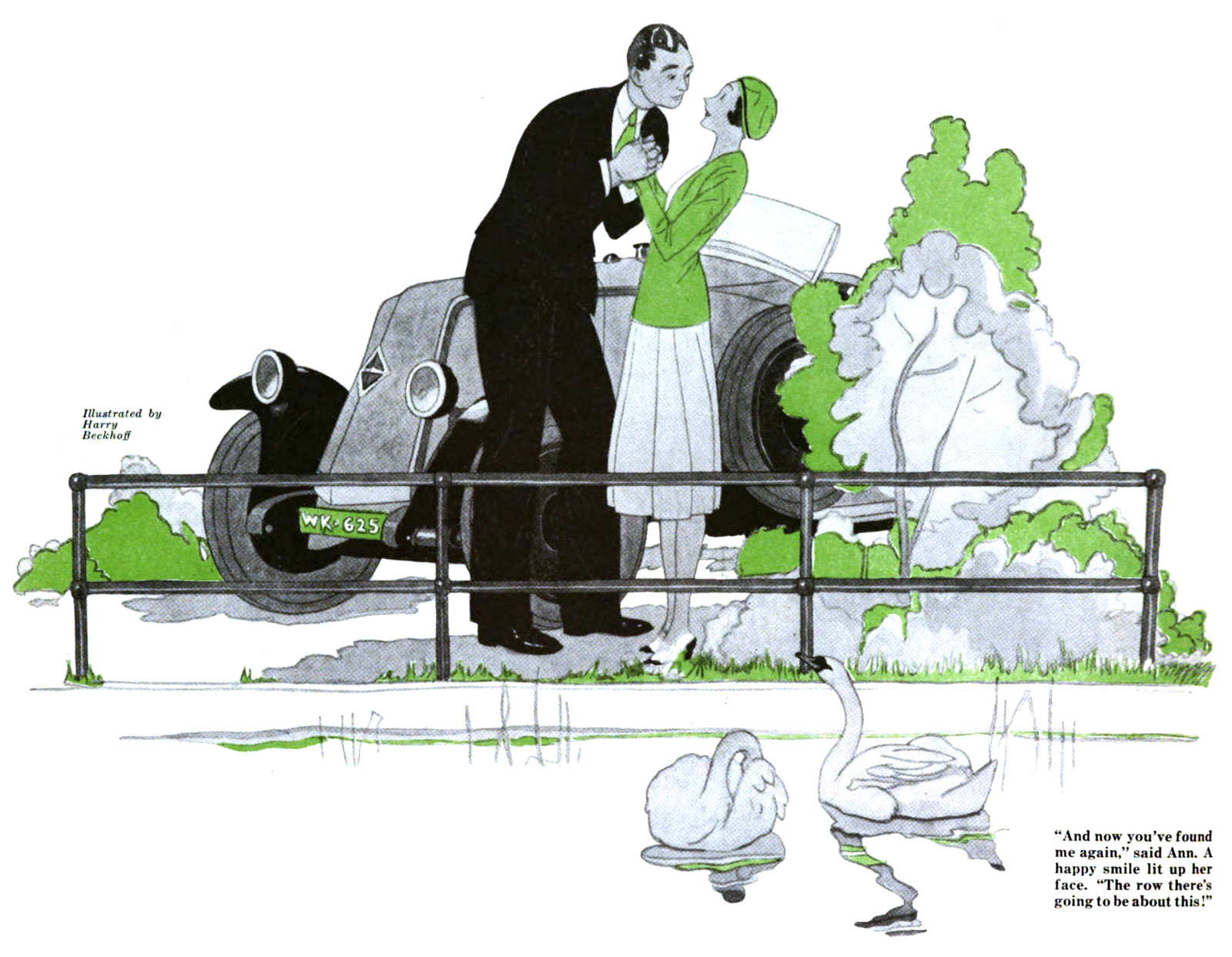
“AND now you’ve found me again, you probably will,” said Ann. A happy smile lit up her face. “The row there’s going to be about this!”
“Row?” said Berry. In his exalted mood it seemed incredible to him that the whole world would not greet this wonderful consummation of all his hopes and dreams with cheers and enthusiasm. “Do you mean,” he demanded incredulously, “that you think anyone’s going to object?”
“I do.”
“Who?”
“My fiancé, for one.”
“Oh! . . .” Berry dismissed this negligible unknown with a gesture.
“And my father. And my mother. And my uncle. And . . .”
Berry laughed scornfully.
“Let ’em!” he said.
“I knew you would say that. That’s what I love about you. How awful it would be if you were—just ordinary.”
Berry started.
“Ordinary?”
“Like all the men I’ve ever met. They work in offices and . . .”
“Work in offices,” said Berry dully. But Ann had come closer, too, and that made him forget the thunder. She was holding the lapels of his coat.
“I’ve just had an idea,” she said.
“What?”
“Why shouldn’t we tell each other our names? Think how nice it would be to know who we are.”
“My name’s Conway.”
“Well, you don’t expect me to call you Mr. Conway.”
“Beresford Conway. All my pals call me Berry.”
“All my pals call me Ann. Moon is the other name.”
“Ann Moon?”
“Ann Moon.”
Berry wrinkled his forehead.
“But it’s familiar.”
“Is it?”
“I mean I’ve heard it before somewhere.”
“Have you? Where?”
“I can’t remember. Or did I read it somewhere?”
“Perhaps.”
“Ann Moon. Moon. Moon. I know I’ve heard it before, but I can’t place it.”
“Perhaps you’re thinking of some other Moon. There are lots of us, you know. June, Oh Silvery, My California . . . dozens and dozens.”
Berry became aware that in a futile discussion of names golden moments were running to waste.
“What does it matter, anyway?” he said. “You’re you.”
“And you’re you.”
“And here we both are!”
“But we won’t stay here. I don’t like those swans.”
“I don’t like those swans,” said Berry, scrutinizing them.
“They’re sneering at us.”
“They are sneering at us.”
“WE’LL fool them. We’ll get into my car and we’ll drive up to London and we’ll have dinner somewhere—Mario’s is a good place. One needn’t dress in the balcony—and then we can talk without having a bunch of birds listening to everything we say.”
“Splendid!”
“That’ll make them feel silly.”
“It will make them feel about as silly as two swans have ever felt.”
Egbert looked at Percy. Percy looked at Egbert.
“Well!” said Egbert.
“These young couples!” said Percy. “Another minute and I should have been sick.”