 Madame Eulalie’s Rare Plums
The Strand Magazine, July 1930

A SHARP snort, plainly emanating from a soul in anguish, broke the serene silence that brooded over the bar parlour of the Anglers’ Rest. And, looking up, we perceived Miss Postlethwaite, our sensitive barmaid, dabbing at her eyes with a dishcloth.
“Sorry you were troubled,” said Miss Postlethwaite, in answer to our concerned gaze, “but he’s just gone off to India, leaving her standing tight-lipped and dry-eyed in the moonlight outside the old Manor. And her little dog has crawled up and licked her hand, as if he understood and sympathized.”
We stared at one another blankly. It was Mr. Mulliner who, with his usual clear insight, penetrated to the heart of the mystery.
“Ah,” said Mr. Mulliner, “you have been reading ‘Rue for Remembrance,’ I see. How did you like it?”
“ ’Slovely,” said Miss Postlethwaite. “It lays the soul of Woman bare as with a scalpel.”
“You do not consider that there is any falling off from the standard of its predecessors? You find it as good as ‘Parted Ways’?
“Better.”
“Oh!” said a Stout and Bitter, enlightened. “You’re reading a novel?”
“The latest work,” said Mr. Mulliner, “from the pen of the authoress of ‘Parted Ways,’ which, as no doubt you remember, made so profound a sensation some years ago. I have a particular interest in this writer’s work, as she is my niece.”
“Your niece?”
“By marriage. In private life she is Mrs. Egbert Mulliner.” He sipped his hot Scotch and lemon, and mused awhile.
“I wonder,” he said, “if you would care to hear the story of my nephew Egbert and his bride? It is a simple little story, just one of those poignant dramas of human interest which are going on in our midst every day. If Miss Postlethwaite is not too racked by emotion to replenish my glass, I shall be delighted to tell it to you.”
I WILL ask you (said Mr. Mulliner) to picture my nephew Egbert standing at the end of the pier at the picturesque little resort of Burwash Bay one night in June, trying to nerve himself to ask Evangeline Pembury the question that was so near his heart. A hundred times he had tried to ask it, and a hundred times he had lacked the courage. But to-night he was feeling in particularly good form, and he cleared his throat and spoke.
“There is something,” he said in a low, husky voice, “that I want to ask you.”
He paused. He felt strangely breathless. The girl was looking out across the moonlit water. The night was very still. From far away in the distance came the faint strains of the Town band, as it picked its way through the Star of Eve song from “Tannhäuser”—somewhat impeded by the second trombone, who had got his music sheets mixed and was playing “The Wedding of the Painted Doll.”
“Something,” said Egbert, “that I want to ask you.”
“Go on,” she whispered.
Again he paused. He was afraid. Her answer meant so much to him.
Egbert Mulliner had come to this quiet seaside village for a rest cure. By profession he was an assistant editor, attached to the staff of The Weekly Booklover; and, as every statistician knows, assistant editors of literary weeklies are ranked high up among the Dangerous Trades. The strain of interviewing female novelists takes toll of the physique of all but the very hardiest.
For six months, week in and week out, Egbert Mulliner had been listening to female novelists talking about Art and their Ideals. He had seen them in cosy corners in their boudoirs, had watched them being kind to dogs and happiest when among their flowers. And one morning the proprietor of The Booklover, finding the young man sitting at his desk with little flecks of foam about his mouth and muttering over and over again in a dull, toneless voice the words, “Aurelia McGoggin, she draws her inspiration from the scent of white lilies!” had taken him straight off to a specialist.
“Yes,” the specialist had said, after listening at Egbert’s chest for a while through a sort of telephone, and apparently finding the number engaged, “we are a little run down, are we not? We see floating spots, do we not, and are inclined occasionally to bark like a seal from pure depression of spirit? Precisely. What we need is to augment the red corpuscles in our blood-stream.”
And this augmentation of red corpuscles had been effected by his first sight of Evangeline Pembury. They had met at a picnic. As Egbert rested for a moment from the task of trying to dredge the sand from a plateful of chicken salad, his eyes had fallen on a divine girl squashing a wasp with a teaspoon. And for the first time since he had tottered out of the offices of The Weekly Booklover he had ceased to feel like something which a cat, having dragged from an ash-can, has inspected and rejected with a shake of the head as unfit for feline consumption. In an instant his interior had become a sort of Jamboree of red corpuscles. Millions of them were splashing about and calling gaily to other millions, still hesitating on the bank, “Come on in! The blood’s fine!”
Ten minutes later he had reached the conclusion that life without Evangeline Pembury would be a blank.
And yet he had hesitated before laying his heart at her feet. She looked all right. She seemed all right. Quite possibly she was all right. But before proposing he had to be sure. He had to make certain that there was no danger of her suddenly producing a manuscript fastened in the top left corner with pink silk and asking his candid opinion of it. Everyone has his pet aversion. Some dislike slugs, others cockroaches. Egbert Mulliner disliked female novelists.
And so now, as they stood together in the moonlight, he said:—
“Tell me, have you ever written a novel?”
She seemed surprised.
“A novel? No.”
“Short stories, perhaps?”
“No.”
Egbert lowered his voice.
“Poems?” he whispered, hoarsely.
“No.”
Egbert hesitated no longer. He produced his soul like a conjurer extracting a rabbit from a hat and slapped it down before her. He told her of his love, stressing its depth, purity, and lasting qualities. He begged, pleaded, rolled his eyes, and clasped her little hand in his. And when, pausing for a reply, he found that she had been doing a lot of thinking along the same lines and felt much about the same about him as he did about her, he nearly fell over backwards. It seemed to him that his cup of joy was full.
It is odd how love will affect different people. It caused Egbert next morning to go out on the links and do the first nine in one over bogey. Whereas Evangeline, finding herself filled with a strange ferment which demanded immediate outlet, sat down at a little near-Chippendale table, ate five marshmallows, and began to write a novel.
THREE weeks of the sunshine and ozone of Burwash Bay had toned up Egbert’s system to the point where his medical adviser felt that it would be safe for him to go back to London and resume his fearful trade. Evangeline followed him a month later. She arrived home at four-fifteen on a sunny afternoon, and at four-sixteen and a half Egbert shot through the door with the love-light in his eyes.
“Evangeline!”
“Egbert!”
But we will not dwell on the ecstasies of the reunited lovers. We will proceed to the point where Evangeline raised her head from Egbert’s shoulder and uttered a little giggle. One would prefer to say that she gave a light laugh. But it was not a light laugh. It was a giggle—a furtive, sinister, shamefaced giggle, which froze Egbert’s blood with a nameless fear. He stared at her, and she giggled again.
“Egbert,” she said, “I want to tell you something.”
“Yes?” said Egbert.
Evangeline giggled once more.
“I know it sounds too silly for words,” she said, “but——”
“Yes? Yes?”
“I’ve written a novel, Egbert.”
In the old Greek tragedies it was a recognized rule that any episode likely to excite the pity and terror of the audience to too great an extent must be enacted behind the scenes. Strictly speaking, therefore, this scene should be omitted. But the modern public can stand more than the ancient Greeks, so it had better remain on the records.
The room stopped swimming before Egbert Mulliner’s tortured eyes. Gradually the piano, the chairs, the pictures, and the case of stuffed birds on the mantelpiece resumed their normal positions. He found speech.
“You’ve written a novel?” he said, dully.
“Well, I’ve got to chapter twenty-four.”
“You’ve got to chapter twenty-four?”
“And the rest will be easy.”
“The rest will be easy?”
Silence fell for a space—a silence broken only by Egbert’s laboured breathing. Then Evangeline spoke impulsively.
“Oh, Egbert!” she cried. “I really do think some of it is rather good. I’ll read it to you now.”
How strange it is, when some great tragedy has come upon us, to look back at the comparatively mild beginnings of our misfortunes and remember how we thought then that Fate had done its worst. Egbert, that afternoon, fancied that he had plumbed the lowest depths of misery and anguish. Evangeline, he told himself, had fallen from the pedestal on which he had set her. She had revealed herself as a secret novel-writer. It was the limit, he felt, the extreme edge. It put the tin hat on things.
It was, alas! nothing of the kind. It bore the same resemblance to the limit that the first drop of rain bears to the thunderstorm.
The mistake was a pardonable one. The acute agony which he suffered that afternoon was more than sufficient excuse for Egbert Mulliner’s blunder in supposing that he had drained the bitter cup to the dregs. He writhed, as he listened to this thing which she had entitled “Parted Ways,” unceasingly. It tied his very soul in knots.
Evangeline’s novel was a horrible, an indecent production. Not in the sense that it would be likely to bring a blush to any cheek but his, but because she had put on paper in bald words every detail of the only romance that had ever come under her notice—her own. There it was, his entire courtship, including the first holy kiss and not omitting the quarrel which they had had within two days of the engagement. In the novel she had elaborated this quarrel, which in fact had lasted twenty-three minutes, into a ten years’ estrangement—thus justifying the title and preventing the story finishing in the first five thousand words. As for his proposal, that was inserted verbatim; and, as he listened, Egbert shuddered to think that he could have polluted the air with such frightful horse-radish.
He marvelled, as many a man has done before and will again, how women can do these things. Listening to “Parted Ways” made him, personally, feel as if he had suddenly lost his trousers while strolling along Piccadilly.
Something of these feelings he would have liked to put into words, but the Mulliners are famous for their chivalry. He would, he imagined, feel a certain shame if he ever hit Evangeline or walked on her face in thick shoes; but that shame would be as nothing to the shame he would feel if he spoke one millimetre of what he thought about “Parted Ways.”
“Great!” he croaked.
Her eyes were shining.
“Do you really think so?”
“Fine!”
He found it easier to talk in monosyllables.
“I don’t suppose any publisher would buy it,” said Evangeline.
Egbert began to feel a little better. Nothing, of course, could alter the fact that she had written a novel; but it might be possible to hush it up.
“So what I am going to do is to pay the expenses of publication.”
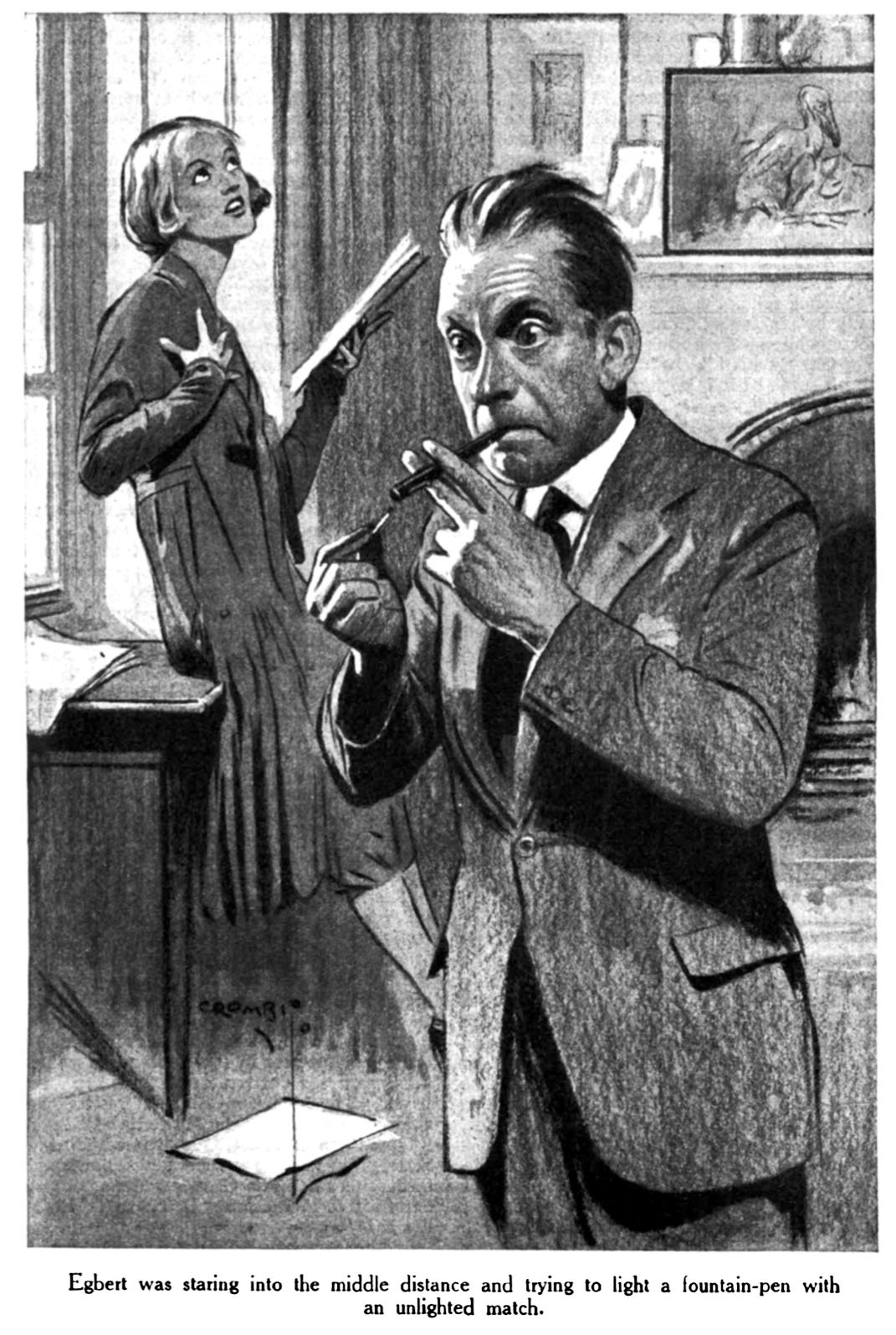
Egbert did not reply. He was staring into the middle distance and trying to light a fountain-pen with an unlighted match.
And Fate chuckled grimly, knowing that it had only just begun having fun with Egbert.
ONCE in every few publishing seasons there is an Event. For no apparent reason, the great heart of the Public gives a startled jump, and the public’s great purse is emptied to secure copies of some novel which has stolen into the world without advance advertising and whose only claim to recognition is that The Licensed Victuallers’ Gazelle has stated in a two-line review that it is “readable.”
The rising firm of Mainprice and Peabody published a first edition of three hundred copies of “Parted Ways.” And when they found, to their chagrin, that Evangeline was only going to buy twenty of these—somehow Mainprice, who was an optimist, had got the idea that she was good for a hundred (“You can sell them to your friends”)—their only interest in the matter was to keep an eye on the current quotations for waste paper. The book they were going to make their money on was Stultitia Bodwin’s “Offal,” in connection with which they had arranged in advance for a newspaper discussion on “The Growing Menace of the Sex Motive in Fiction: Is There To Be No Limit?”
Within a month “Offal” was off the map. The newspaper discussion raged before an utterly indifferent public, which had made one of its quick changes and discovered that it had had enough of Sex, and that what it wanted now was good, sweet, wholesome, tender tales of the pure love of a man for a maid, which you could leave lying about and didn’t have to shove under the cushions of the Chesterfield every time you heard your growing boys coming along. And the particular tale which it selected for its favour was Evangeline’s “Parted Ways.”
It is these swift, unheralded changes of the public mind which make publishers stick straws in their hair and powerful young novelists rush round to the wholesale grocery firms to ask if the berth of junior clerk is still open. Up to the very moment of the Great Switch, Sex had been the one safe card. Publishers’ lists were congested with scarlet tales of Men Who Did and Women Who Shouldn’t Have Done But Who Took A Pop At It. And now the bottom had dropped out of the market without a word of warning, and practically the only way in which readers could gratify their new-born taste for the pure and simple was by fighting for copies of “Parted Ways.”
They fought like tigers. The offices of Mainprice and Peabody hummed like a hive. Printing machines worked day and night. From the Butes of Kyle to the rock-bound coasts of Cornwall, a great cry went up for “Parted Ways.” In every home in Ealing West “Parted Ways” was found on the whatnot, next to the aspidistra and the family album. Clergymen preached about it, parodists parodied it, stockbrokers stayed away from Cochran’s Revue to sit at home and cry over it.
Numerous paragraphs appeared in the press concerning its probable adaptation into a play, a musical comedy, and a talking picture. Nigel Playfair was stated to have bought it for Sybil Thorndike, Sir Alfred Butt for Nellie Wallace. Laddie Cliff was reported to be planning a musical play based on it, starring Stanley Lupino and Leslie Henson. It was rumoured that Carnera was considering the part of “Percy,” the hero.
And on the crest of this wave, breathless but happy, rode Evangeline.
And Egbert? Oh, that’s Egbert, spluttering down in the trough there. We can’t be bothered about Egbert now.
EGBERT, however, found ample time to be bothered about himself. He passed the days in a frame of mind which it would be ridiculous to call bewilderment. He was stunned, overwhelmed, sandbagged. Dimly he realized that considerably more than a hundred thousand perfect strangers were gloating over the most sacred secrecies of his private life, and that the exact words of his proposal of marriage were engraven on considerably over a hundred thousand minds. But, except that it made him feel as if he were being tarred and feathered in front of a large and interested audience, he did not mind that so much. What really troubled him was the alteration in Evangeline.
The human mind adjusts itself readily to prosperity. Evangeline’s first phase, when celebrity was new and bewildering, soon passed. The stammering reception of the first reporter became a memory. At the end of two weeks she was talking to the Press with the easy nonchalance of a prominent politician, and coming back at note-book-bearing young men with words which they had to look up in the office Webster. Her Art, she told them, was rhythmical rather than architectural, and she inclined, if anything, to the school of the sur-realists.
She had soared above Egbert’s low-browed enthusiasms. When he suggested motoring out to Addington and putting in a few holes of golf, she excused herself. She had letters to answer. People would keep writing to her, saying how much “Parted Ways” had helped them, and she had to be civil to her public. Autographs, too. She really could not spare a moment.
He asked her to come with him to the Amateur Championship. She shook her head. The date, she said, clashed with her lecture to the East Dulwich Daughters Of Minerva Literary And Progress Club on Some Tendencies Of Modern Fiction.
All these things Egbert might have endured, for, despite the fact that she could speak so lightly of the Amateur Championship, he still loved her dearly. But at this point there suddenly floated into his life like a cloud of poison-gas the sinister figure of Jno. Henderson Banks.
“Who,” he asked, suspiciously, one day, as she was giving him ten minutes before hurrying off to address the Amalgamated Mothers Of Manchester on The Novel: Should It Teach?—“was that man I saw you coming down the street with?”
“That wasn’t a man,” replied Evangeline. “That was my literary agent.”
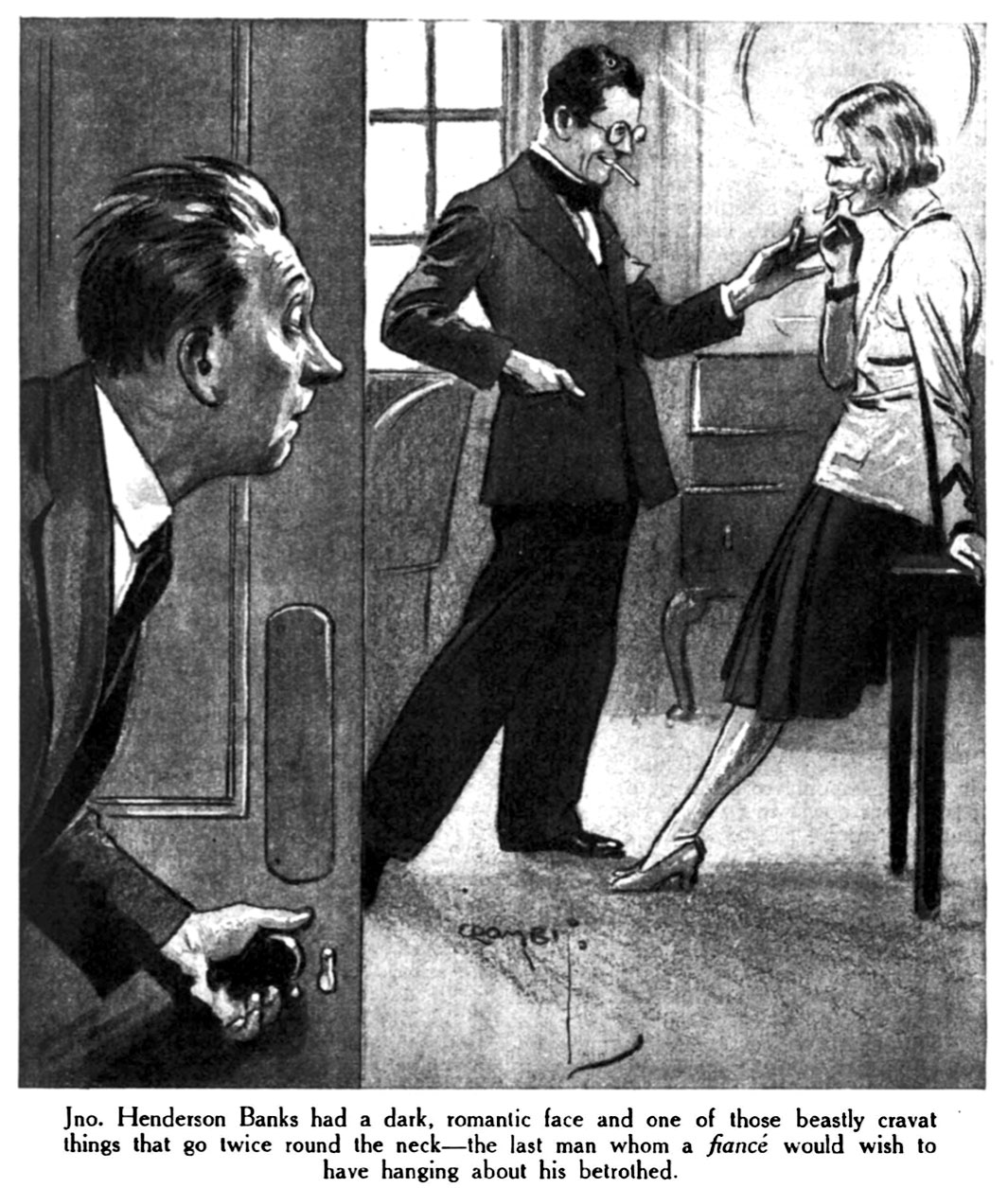
And so it proved. Jno. Henderson Banks was now in control of Evangeline’s affairs. This outstanding blot on the public weal was a sort of human charlotte russe with tortoiseshell-rimmed eyeglasses and a cooing, reverential manner towards his female clients. He had a dark, romantic face, a lissom figure, one of those beastly cravat things that go twice round the neck, and a habit of beginning his remarks with the words “Dear lady.” The last man, in short, whom a fiancé would wish to have hanging about his betrothed. If Evangeline had to have a literary agent, the sort of literary agent Egbert would have selected for her would have been one of those stout, pie-faced literary agents who chew half-smoked cigars and wheeze as they enter the editorial sanctum.
A jealous frown flitted across his face.
“Looked a bit of a Gawd-help-us to me,” he said, critically.
“Mr. Banks,” retorted Evangeline, “is a superb man of business.”
“Yeah?” said Egbert, sneering visibly.
And there for a time the matter rested.
BUT not for long. On the following Monday morning Egbert called Evangeline up on the telephone and asked her to lunch.
“I am sorry,” said Evangeline. “I am engaged to lunch with Mr. Banks.”
“Oh?” said Egbert.
“Yes,” said Evangeline.
“Ah!” said Egbert.
Two days later Egbert called Evangeline up on the telephone and invited her to dinner.
“I am sorry,” said Evangeline. “I am dining with Mr. Banks.”
“Ah?” said Egbert.
“Yes,” said Evangeline.
“Oh!” said Egbert.
Three days after that Egbert arrived at Evangeline’s flat with tickets for the theatre.
“I am sorry,” began Evangeline.
“Don’t say it,” said Egbert. “Let me guess. You are going to the theatre with Mr. Banks?”
“Yes, I am. He has seats for the first night of Tchekov’s ‘Six Corpses In Search Of An Undertaker.’ ”
“He has, has he?”
“Yes, he has.”
“He has, eh?”
“Yes, he has.”
Egbert took a couple of turns about the room, and for a space there was silence except for the sharp grinding of his teeth. Then he spoke.
“Touching lightly on this gumboil Banks,” said Egbert, “I am the last man to stand in the way of your having a literary agent. If you must write novels, that is a matter between you and your God. And, if you do see fit to write novels, I suppose you must have a literary agent. But—and this is where I want you to follow me very closely—I cannot see the necessity of employing a literary agent who looks like Lord Byron, a literary agent who coos in your left ear, a literary agent who not only addresses you as ‘Dear lady,’ but appears to find it essential to the conduct of his business to lunch, dine, and go to the theatre with you daily.”
“I——”
Egbert held up a compelling hand.
“I have not finished,” he said. “Nobody,” he proceeded, “could call me a narrow-minded man. If Jno. Henderson Banks looked a shade less like one of the great lovers of history, I would have nothing to say. If, when he talked business to a client, Jno. Henderson Banks’s mode of vocal delivery were even slightly less reminiscent of a nightingale trilling to its mate, I would remain silent. But he doesn’t, and it isn’t. And such being the case, and taking into consideration the fact that you are engaged to me, I feel it my duty to instruct you to see this drooping flower far more infrequently. In fact, I would advocate expunging altogether. If he wishes to discuss business with you, let him do it over the telephone. And I hope he gets the wrong number.”
Evangeline had risen, and was facing him with flashing eyes.
“Is that so?” she said.
“That,” said Egbert, “is so.”
“Am I a serf?” demanded Evangeline.
“A what?” said Egbert.
“A serf. A slave. A peon. A creature subservient to your lightest whim.”
Egbert considered the point.
“No,” he said. “I shouldn’t think so.”
“No,” said Evangeline. “I am not. And I refuse to allow you to dictate to me in the choice of my friends.”
Egbert stared blankly.
“You mean, after all I have said, that you intend to let this blighted chrysanthemum continue to frisk round?”
“I do.”
“You seriously propose to continue chummy with this revolting piece of cheese?”
“I do.”
“You absolutely and literally decline to give this mistake of Nature the push?”
“I do.”
“Well!” said Egbert.
A pleading note came into his voice.
“But, Evangeline, it is your Egbert who speaks.”
The haughty girl laughed a hard, bitter laugh.
“Is it?” she said. She laughed again. “Do you imagine that we are still engaged?”
“Aren’t we?”
“We certainly aren’t. You have insulted me, outraged my finest feelings, given an exhibition of malignant tyranny which makes me thankful that I have realized in time the sort of man you are. Good-bye, Mr. Mulliner!”
“But listen——” began Egbert.
“Go!” said Evangeline. “Here is your hat.”
She pointed imperiously to the door. A moment later she had banged it behind him.
It was a grim-faced Egbert Mulliner who entered the elevator, and a grimmer-faced Egbert Mulliner who strode down Sloane Street. His dream, he realized, was over. He laughed harshly as he contemplated the fallen ruins of the castle which he had built in the air.
Well, he still had his work.
In the offices of The Weekly Booklover it was whispered that a strange change had come over Egbert Mulliner. He seemed a stronger, tougher man. His editor, who since Egbert’s illness had behaved towards him with a touching humanity, allowing him to remain in the office and write paragraphs about Forthcoming Books while others, more robust, were sent off to interview the female novelists, now saw in him a right-hand man on whom he could lean.
When a column on Myrtle Bootle Among Her Books was required, it was Egbert whom he sent out into the No Man’s Land of Bloomsbury. When young Eustace Johnson, a novice who ought never to have been entrusted with such a dangerous commission, was found walking round in circles and bumping his head against the railings of Regent’s Park after twenty minutes with Laura La Motte Grindlay, the great Sex novelist, it was Egbert who was flung into the breach. And Egbert came through, wan but unscathed.
It was during this period that he interviewed Mabelle Grangerson and Mrs. Goole-Plank on the same afternoon—a feat which is still spoken of with bated breath in the offices of The Weekly Booklover. And not only in The Booklover offices. To this day “Remember Mulliner!” is the slogan with which every literary editor encourages the faint-hearted who are wincing and hanging back.
“Was Mulliner afraid?” they say. “Did Mulliner quail?”
And so it came about that when a Chat With Evangeline Pembury was needed for the big Christmas Special Number, it was of Egbert that his editor thought first. He sent for him.
“Ah, Mulliner!”
“Well, chief?”
“Stop me if you’ve heard this one before,” said the editor, “but it seems there was once an Irishman, a Scotsman, and a Jew——”
Then, the formalities inseparable from an interview between editor and assistant concluded, he came down to business.
“Mulliner,” he said, in that kind, fatherly way of his which endeared him to all his staff, “I am going to begin by saying that it is in your power to do a big thing for the dear old paper. But after that I must tell you that, if you wish, you can refuse to do it. You have been through a hard time lately, and if you feel yourself unequal to this task, I shall understand. But the fact is, we have got to have a Chat With Evangeline Pembury for our Christmas Special.”
He saw the young man wince, and nodded sympathetically.
“You think it would be too much for you? I feared as much. They say she is the worst of the lot. Rather haughty and talks about uplift. Well, never mind. I must see what I can do with young Johnson. I hear he has quite recovered now, and is anxious to re-establish himself. Quite. I will send Johnson.”
Egbert Mulliner was himself again now.
“No, chief,” he said. “I will go.”
“You will?”
“I will.”
“We shall need a column and a half.”
“You shall have a column and a half.”
The editor turned away, to hide a not unmanly emotion.
“Do it now, Mulliner,” he said, “and get it over.”
And, as the door closed, Egbert heard him whisper, “Brave lad! Brave lad!”
A STRANGE riot of emotion seethed in Egbert Mulliner’s soul as he pressed the familiar bell which he had thought never to press again. Since their estrangement he had seen Evangeline once or twice, but only in the distance. Now he was to meet her face to face. Was he glad or sorry? He could not say. He only knew he loved her still.
He was in the sitting-room. How cosy it looked, how impregnated with her presence. There was the sofa on which he had so often sat, his arm about her waist——
A footstep behind him warned him that the time had come to don the mask. Forcing his features into an interviewer’s hard smile, he turned.
“Good afternoon,” he said.
She was thinner. Either she had found Success wearing, or she had been on the eighteen-day diet. Her beautiful face seemed drawn, and, unless he was mistaken, careworn.
He fancied that for an instant her eyes had lit up at the sight of him, but he preserved the formal detachment of a stranger.
“Good afternoon, Miss Pembury,” he said. “I represent The Weekly Booklover. I understand that my editor has been in communication with you and that you have kindly consented to tell us a few things which may interest our readers regarding your art and aims.”
She bit her lip.
“Will you take a seat, Mr. ——?”
“Mulliner,” said Egbert.
“Mr. Mulliner,” said Evangeline. “Do sit down. Yes, I shall be glad to tell you anything you wish.”
Egbert sat down.
“Are you fond of dogs, Miss Pembury?” he asked.
“I adore them,” said Evangeline.
“I should like, a little later, if I may,” said Egbert, “to secure a snapshot of you being kind to a dog. Our readers appreciate these human touches, you understand.”
“Oh, quite,” said Evangeline. “I will send out for a dog. I love dogs—and flowers.”
“You are happiest among your flowers, no doubt?”
“On the whole, yes.”
“You sometimes think they are the souls of little children who have died in their innocence?”
“Frequently.”
“And now,” said Egbert, licking the tip of his pencil, “perhaps you would tell me something about your ideals. How are the ideals?”
Evangeline hesitated.
“Oh, they’re fine,” she said.
“The novel,” said Egbert, “has been described as among this age’s greatest instruments for uplift? How do you check up on that?”
“Oh, yes.”
“Of course, there are novels and novels.”
“Oh, yes.”
“Are you contemplating a successor to ‘Parted Ways’?”
“Oh, yes.”
“Would it be indiscreet, Miss Pembury, to inquire to what extent it has progressed?”
“Oh, Egbert!” said Evangeline.
There are some speeches before which dignity melts like ice in August, resentment takes the full count, and the milk of human kindness surges back into the aching heart as if the dam had burst. Of these, “Oh, Egbert!” especially when accompanied by tears, is one of the most notable.
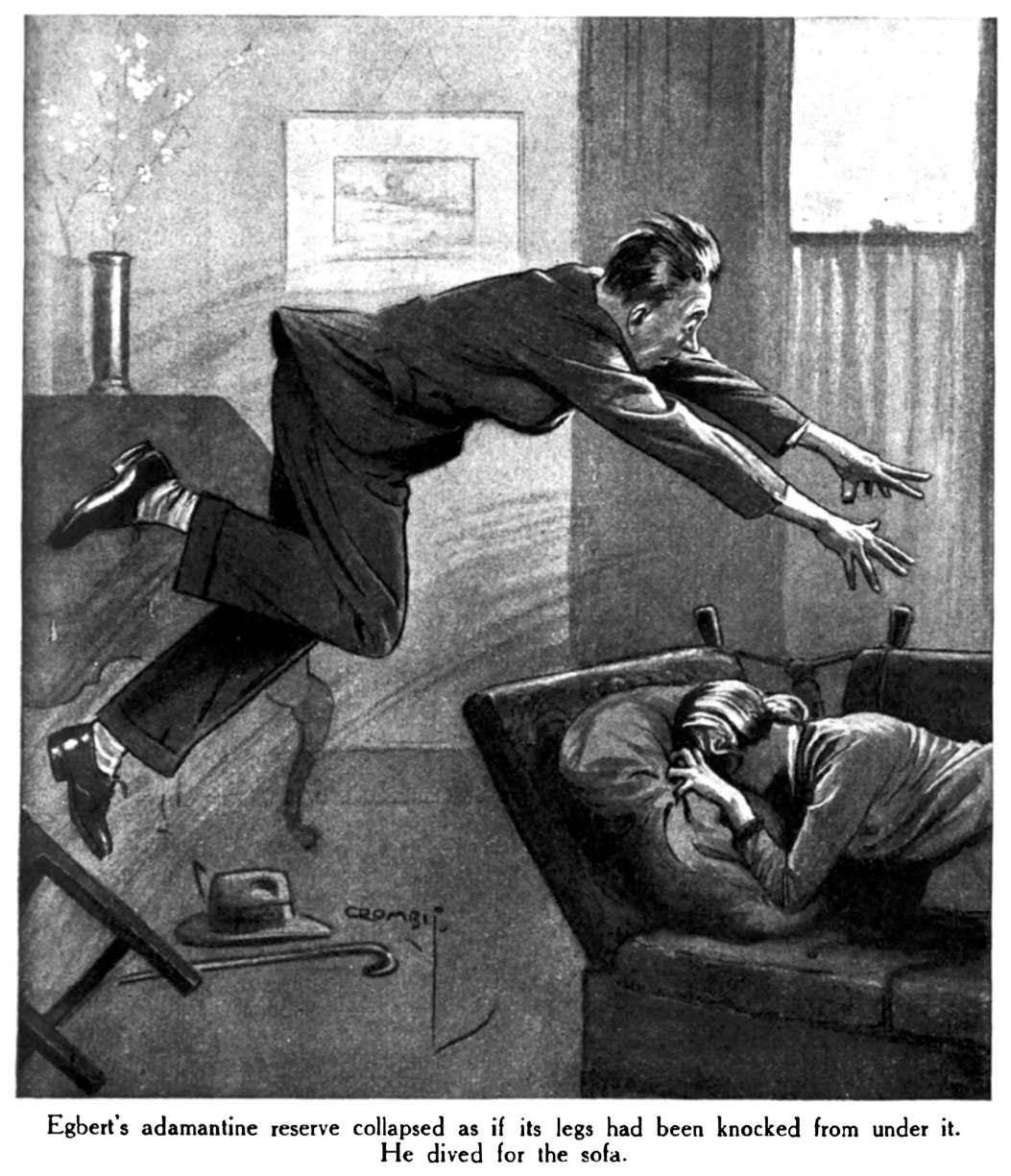
Evangeline’s “Oh, Egbert!” had been accompanied by a Niagara of tears. She had flung herself on the sofa and was now chewing the cushion in an ecstasy of grief. She gulped like a bull-pup swallowing a chunk of steak. And, on the instant, Egbert Mulliner’s adamantine reserve collapsed as if its legs had been knocked from under it. He dived for the sofa. He clasped her hand. He stroked her hair. He squeezed her waist. He patted her shoulder. He massaged her spine.
“Evangeline!”
“Oh, Egbert!”
The only flaw in Egbert Mulliner’s happiness, as he knelt beside her, babbling comforting words, was the gloomy conviction that Evangeline would certainly lift the entire scene, dialogue and all, and use it in her next novel. And it was for this reason that, when he could manage it, he censored his remarks to some extent.
But, as he warmed to his work, he forgot caution altogether. She was clinging to him, whispering his name piteously. By the time he had finished, he had committed himself to about two thousand words of a nature calculated to send Mainprice and Peabody screaming with joy about their office.
He refused to allow himself to worry about it. What of it? He had done his stuff, and if it sold a hundred thousand copies—well, let it sell a hundred thousand copies. Holding Evangeline in his arms, he did not care if he was copyrighted in every language, including the Scandinavian.
“Oh, Egbert!” said Evangeline.
“My darling!”
“Oh, Egbert, I’m in such trouble.”
“My angel! What is it?”
Evangeline sat up and tried to dry her eyes.
“It’s Mr. Banks.”
A savage frown darkened Egbert Mulliner’s face. He told himself that he might have foreseen this. A man who wore a tie that went twice round the neck was sure sooner or later to inflict some hideous insult on helpless womanhood. Add tortoiseshell-rimmed glasses, and you had what practically amounted to a fiend in human shape.
“I’ll murder him,” he said. “I ought to have done it long ago, but one keeps putting these things off. What has he done? Did he force his loathsome attentions on you? Has that tortoiseshell-rimmed satyr been trying to kiss you, or something?”
“He has been fixing me up solid.”
Egbert blinked.
“Doing what?”
“Fixing me up solid. With the magazines. He has arranged for me to write three serials and I don’t know how many short stories.”
“Getting you contracts, you mean?”
Evangeline nodded tearfully.
“Yes. He seems to have fixed me up solid with almost everybody. And they’ve been sending me cheques in advance—hundreds of them. What am I to do? Oh, what am I to do?”
“Cash them,” said Egbert.
“But afterwards?”
“Spend the money.”
“But after that?”
Egbert reflected.
“Well, it’s a nuisance, of course,” he said, “but after that I suppose you’ll have to write the stuff.”
Evangeline sobbed like a lost soul.
“But I can’t! I’ve been trying for weeks, and I can’t write anything. And I never shall be able to write anything. I don’t want to write anything. I hate writing. I don’t know what to write about. I wish I were dead.”
She clung to him.
“I got a letter from him this morning. He has just fixed me up solid with two more magazines.”
EGBERT kissed her tenderly. Before he had become an assistant editor, he, too, had been an author, and he understood. It is not the being paid money in advance that jars the sensitive artist: it is the having to work.
“What shall I do?” cried Evangeline.
“Drop the whole thing,” said Egbert. “Evangeline, do you remember your first drive at golf? I wasn’t there, but I bet it travelled about five hundred yards and you wondered what people meant when they talked about golf being a difficult game. After that, for ages, you couldn’t do anything right. And then, gradually, after years of frightful toil, you began to get the knack of it. It is just the same with writing. You’ve had your first drive, and it has been some smite. Now, if you’re going to stick to it, you’ve got to do the frightful toil. What’s the use? Drop it.”
“And return the money?”
Egbert shook his head.
“No,” he said, firmly. “There you go too far. Stick to the money like glue. Clutch it with both hands. Bury it in the garden and mark the spot with a cross.”
“But what about the stories? Who is going to write them?”
Egbert smiled a tender smile.
“I am,” he said. “Before I saw the light, I, too, used to write stearine bilge just like ‘Parted Ways.’ When we are married, I shall say to you, if I remember the book of words correctly, ‘With all my worldly goods I thee endow.’ They will include three novels I was never able to kid a publisher into printing, and at least twenty short stories no editor would accept. I give them to you freely. You can have the first of the novels to-night, and we will sit back and watch Mainprice and Peabody sell half a million copies.”
“Oh, Egbert!” said Evangeline.
“Evangeline!” said Egbert.
Notes:
A revision of the 1914 story “Parted Ways”; see the end notes following that transcription.
Compare the USA magazine version of this story, not told by Mr. Mulliner, and with significant changes to character names and setting, as noted at the end of that transcription.