 Madame Eulalie’s Rare Plums
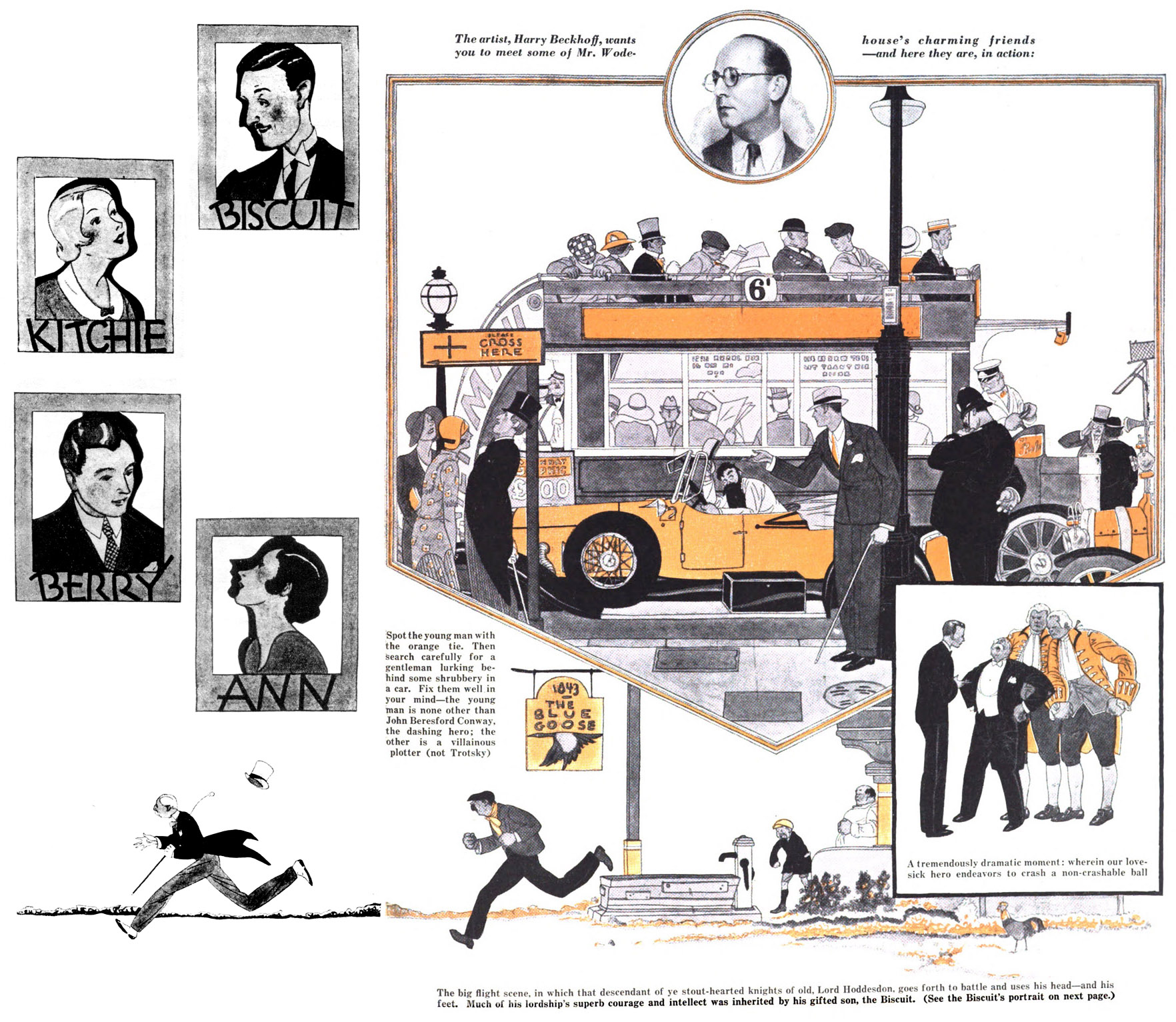
ON AN afternoon in May, at the hour when London pauses in its labors to refresh itself with a bite of lunch, there was taking place in the coffee-room of the Drones Club in Dover Street that pleasantest of functions, a reunion of old school friends. The host at the meal was Godfrey, Lord Biskerton, son and heir of the sixth Earl of Hoddesdon; the guest his one-time inseparable comrade, John Beresford Conway. Happening that morning to go down to the city to discuss with his bank manager a little matter of an overdraft, Lord Biskerton had run into Berry Conway in Cornhill. It was three years since they had last met, and in his lordship’s manner, as he gazed across the table, there was something of the affectionate reproach a conscientious trainer of performing fleas might have shown toward one of his artistes who had strayed from the fold.
“Amazing!” he said.
Lord Biskerton was a young man with red hair and what looked like a preliminary scenario for a mustache of the same striking hue. He dug into his fried sole emotionally.
“Absolutely amazing,” he repeated. “It beats me. I am mystified. Here we have two birds—you, on the one hand; I, on the other—who were once as close as the paper on the wall. Our chumminess was a silent sermon on brotherly love. And yet I’m dashed if we’ve set eyes on each other since the summer Peanut Brittle won the Jubilee Handicap. I can’t understand it.”
Berry Conway shifted a little uncomfortably in his seat. He seemed embarrassed.
“We just happened to miss each other, I suppose.”
“But how?” Lord Biskerton was resolved to probe this thing to its depths. “That’s what I want to know. How? I go everywhere. Races, restaurants, theaters, all the usual round. It seems incredible that we haven’t met before. If you ask most people, they will tell you the difficult thing is to avoid meeting me. It poisons their lives, poor devils. ‘Oh, my sainted aunt!’ they mutter, ‘you again?’ and they dash down side streets, only to bump into me coming up the other way. Then why should you have been immune?”
“Just the luck of the Conways, I expect.”
“Anyway, why haven’t you looked me up? You must have known where I was. I’m in the phone book.”
Berry fingered his bread.
“I don’t go about much these days,” he said. “I’m living in the suburbs now, down at Valley Fields.”
“You aren’t married, are you?” asked Lord Biskerton with sudden alarm. “Not got a little wife or any rot of that sort?”
“No. I live with an old family retainer. She used to be my nurse. And she seems to think she still is,” said Berry, his face darkening. “I heard her shouting after me as I left the house this morning something about had I got on my warm woollies.”
“My dear chap!” Lord Biskerton raised his eyebrows. “These intimate details. Keep the conversation clean. She fusses over you, does she? They will, these old nurses. Mine,” said Lord Biskerton, wincing at the memory, “once kissed me on the platform at Paddington Station, thereby ruining my prestige at school for the whole of one term. Why don’t you break away from this old disease? Why not pension her off?”
BERRY gave a short laugh. “Pension her off? What with? I suppose I had better tell you, Biscuit. The reason I’ve dropped out of things and am living in the suburbs and have stopped seeing my old friends lately is that I’ve come down in the world. I’ve no money now.”
The Biscuit stared.
“No money?”
“Well, that’s exaggerating, perhaps. To be absolutely accurate, I’m better off at the moment than I’ve been for two years, because I’ve just gotten a job as private secretary to Frisby, the American financier. But he only pays me a few pounds a week.”
“But doesn’t a secretary have to know shorthand and all that sort of rather revolting stuff?”
“I learned shorthand.”
“Golly!” said the Biscuit. It was as if this revelation had brought the tragedy home to him in all its stark grimness. “You must have been properly up against it.”
“I was. If an old sportsman, on whom I had absolutely no claim, hadn’t lent me two hundred pounds, I should probably have starved.”
“But what on earth has been happening?” asked the Biscuit, bewildered. “At school you were a sort of young millionaire. You jingled as you walked. A twopenny jam sandwich for self and friend was a mere nothing to you. Where’s all the money gone to? What came unstuck?”
Berry hesitated. His had been for some time a lonely existence, and the idea of confiding his troubles to a sympathetic ear was appealing.
“Do you really want to hear the story of my life, Biscuit?” he said, wistfully. “Sure it won’t bore you?”
“Bore me? My dear chap! I’m agog. Let’s have the whole thing. Start from the beginning. Childhood. . . . Early surroundings. . . . Genius probably inherited from male grandparent. . . . Push along.”
“Well, you’ve brought it on yourself, remember.”
The Biscuit mused.
“When we first met,” he said, “you were, if I recollect, about fourteen. An offensive stripling, all feet and red ears, but worth cultivating on account of your extraordinary wealth. How did you get the stuff? Honestly, I hope?”
“That came from an aunt. It was like this: I was an only child. . . .”
“And I bet one of you was ample.”
“My mother died when I was born. I never knew my father.”
“I sometimes wish I didn’t know mine,” said the Biscuit. “The sixth earl has his moments, but he can on occasion be more than a bit of a blister. Why didn’t you know your father? A pretty exclusive kid, were you?”
“HE WAS killed in a railway accident when I was three. And then this aunt adopted me. Her husband had just died, leaving her a fortune. That’s where the money came from that you used to hear jingling at school. He was in the jute business, I believe. All I remember of him is that he had whiskers.”
“What a gruesome mess you must have been at three,” said the Biscuit meditatively. “You were bad enough at fourteen. At three you must have made strong men shudder.”
“On the contrary. Hannah has often told me . . .”
“Who’s Hannah?”
“Hannah Wisdom, my old retainer.”
“I see. The one who gets worried about your woollies. I thought for the moment you were introducing a new sex motive.”
“Hannah has often told me that I looked like a little angel in my velvet suit. I had long golden curls. . . .”
“This is loathsome,” said the Biscuit austerely. “Stop it. There are certain subjects which should not be mentioned when gentlemen are present. Get on with the story. Enter rich aunt. So far, so good. What happened then?”
“She did me like a prince. Sent me to school and Cambridge and surrounded me with every circumstance of luxury and refinement, so to speak.”
The Biscuit frowned.
“Obviously,” he said, “there must be a catch somewhere. But I’m dashed if I can spot it yet. Up to now, you’ve been making my mouth water.”
“The catch,” said Berry, “was this: During all those happy, halcyon years, when you and I were throwing inked darts at each other without a care in the world, my aunt, it now appears, had been going through her capital like a drunken sailor. I don’t know if she ever endowed a scheme for getting gold out of sea water, but, if not, that’s the only one she missed. Anybody who had anything in the way of a speculation so fishy that nobody else would look at it used to come frisking up to her, waving prospectuses, and she would fall over her feet to get at her check book.”
“Women,” commented the Biscuit, “ought never to be allowed check books. I’ve often said so. Mugs, every one of them.”
“She died two years ago, leaving me everything she possessed. This consisted of about three tons of shares in bogus companies. I was right up against it.”
“From riches to rags, what?”
“Yes.”
“Scaly,” said the Biscuit. “Undeniably scaly.”
“My aunt’s lawyer, a man named Attwater, happened by a miracle to be one of those fellows who pop up every now and then just to show that there is a future for the human race, after all. He had an eye like a haddock and a face like teak, and whenever he came to dinner at our place he always snubbed me like a fine old gentleman of the old school if I dared to utter a word: but, my gosh, beneath that rough exterior! . . . He lent me two hundred pounds to keep me going—two hundred solid quid.
“THAT money just saved my life. I managed after running all over London for three months to get a sort of job. And at night I used to sweat away at learning typing and shorthand. Eventually I got taken on as secretary by a man in the import and export business. He retired about a month ago, and very decently shoved me off on to this fellow Frisby, who was a friend of his. That’s how Frisby comes to own my poor black body now. And that,” concluded Berry, “is why I am living in the suburbs and have not been mixing much of late with the Biskertons and the rest of the gilded aristocracy. And the really damnable part of it is that at the time when the crash came I was just going to buzz off round the world on a tramp steamer. I had to give that up, of course.”
The Biscuit appeared stupefied.
“You mean to tell me,” he said, “that you’ve been avoiding me just because you were hard up? You were ashamed of your honest poverty? I never heard anything so dashed driveling in my life.”
Berry flushed.
“It’s all very well to talk like that. You can’t keep up with people who are much richer than you are.”
“Who can’t?”
“Nobody can.”
“Well, I’ve been doing it all my life,” said Lord Biskerton stoutly, “and—God willing—I hope to go on doing it till I am old and gray. Do you suppose for a moment, old bag, that I’m any richer than you are? Why, I only know what money is by hearsay.”
“You don’t mean that?”
“I certainly do. If you want to see real destitution, old boy, take a look at my family. I’m broke. My guv’nor’s broke. My aunt Vera’s broke. It’s a ruddy epidemic. I owe every tradesman in London. The guv’nor hasn’t tasted meat for weeks. And, as for Aunt Vera, relict of the late Colonel Archibald Mace, C. V. O., she’s reduced to writing glad articles for the evening papers. You know—things on the back page pointing out that there’s always sunshine somewhere and that we ought to be bright, like the little birds in the trees. Why, I’ve known that woman’s circumstances to become so embarrassed that she actually made an attempt to borrow money from me. Me, old boy! Lazarus in person.”
He laughed again, tickled by the recollection. Then, helping himself to fruit salad, he became grave once more and pointed the moral earnestly.
“The fact of the matter is, laddie, there’s nothing in being an earl nowadays. It’s a mug’s game. If ever they try to make you one, punch them in the eye and run. And being an earl’s son and heir is one degree worse.”
“But I’ve always thought of you as rolling in money, Biscuit. You’ve got that enormous place in Sussex. . . .”
“That’s just what’s wrong with it. Too enormous. Eats up all the family revenues, old boy. Oh, I know how you came to be misled. The error is a common one. You see a photograph in Country Life of an earl standing in a negligent attitude outside the northeast piazza of his seat in Loamshire, and you say to yourself, ‘Lucky devil! I’ll make that bird’s acquaintance and touch him.’ Little knowing that even as the camera clicked the poor old deadbeat was wondering where on earth the money was coming from to give the piazza the lick of paint it so badly needed. What with the land tax and the income tax and the super tax and all the rest of the little taxes, there’s not much in the family sock these days, old boy.
“It all comes down to this,” said the Biscuit, summing up: “If England wants a happy, well-fed aristocracy, she mustn’t have wars. She can’t have it both ways.”
He sighed, and fell into a thoughtful silence.
“I wish I could find some way of making a bit of money,” he said, resuming his remarks. “I don’t seem able to do it racing. And I don’t seem able to do it at bridge. But there must be some method. Look at all the wealthy blighters you see running round. They’ve managed to find it. I read a book the other day where a bloke goes up to another bloke in the street—perfect stranger with a rich sort of look about him—and whispers in his ear—the first bloke does—‘A word with you, sir!’ Addressing the second bloke, you understand. ‘A word with you, sir. I know your secret!’ Upon which, the second bloke turns ashy white and supports him in luxury for the rest of his life. I thought there might be something in it.”
“About seven years, I should think.”
“Well, if I try it, I’ll let you know. And if they send me to the bastile, you can come and see me on visiting days and hand me tracts through the bars.”
HE ATE cheese, and returned to an earlier point in the conversation.
“What did you mean about buzzing off round the world on a tramp steamer?” he asked. “You said, if I remember, that when the fuse blew out that was what you were planning to do. It sounded cuckoo to me. Why buzz round the world in tramp steamers?”
“Well, that’s what I wanted to do—get off somewhere and have adventures. You know that thing of Kipling’s? ‘I’d like to roll to Rio, roll down, roll down to Rio. Oh, I’d like . . .’ ”
“Sh!” said the Biscuit, scandalized. “My dear chap! You can’t recite here. Against the club rules. Strong letter from the committee.”
“I was talking to a fellow the other day,” said Berry, with a smoldering eye, “who had just come back from Arizona. He was telling me about the Mojave Desert. He had been prospecting out there. It made me feel like a caged eagle.”
“A what?”
“Caged eagle.”
“Why?”
“Because I felt that I should never get away from Valley Fields and see anything worth seeing.”
“You’ve seen me,” said the Biscuit.
“Think of the Grand Canyon!”
Lord Biskerton closed his eyes dutifully.
“I am,” he said. “What next? Double it?”
“What chance have I of ever seeing the Grand Canyon?”
“Why not?”
Berry writhed.
“Haven’t you been listening?” he demanded.
“Certainly I’ve been listening,” replied the Biscuit, with spirit. “I haven’t missed a word. And your statement seems to me confused and rambling. As I understand you, you wish to roll to Rio. And you appear to be beefing because you can’t. Why can’t you? Rio is open for being rolled to at this season, I presume?”
“What about Attwater and that money he lent me? I can’t pay him back unless I go on earning money, can I? And how can I earn money if I chuck my job and go tramping round the world?”
“You want to pay him back?” said the Biscuit, startled.
“Of course I do.”
“In that case, there is nothing more to be said. If you intend to go through life deliberately paying back money,” said the Biscuit, a little severely, “you must be content not to roll.”
THERE was a silence. Berry’s face clouded.
“I get so damned restless sometimes,” he said, “I don’t know what to do with myself. Don’t you ever get restless?”
“Never. London’s good enough for me.”
“It isn’t for me. That man who had come from Arizona was telling me how you prospect in the Mojave.”
“A thing I wouldn’t do on a bet.”
“You tramp about under a blazing sun, and sleep under the stars and single-jack holes in the solid rock. . . .”
“How perfectly foul. And not a chance of getting a drink anywhere, I take it? Well, if that’s the sort of thing you’ve missed, you’re well out of it, my lad. Yes, dashed well out of it. No matter how much you may feel like a prawn in aspic.”
“I didn’t say I felt like a prawn in aspic. I said I felt like a caged eagle.”
“It’s the same thing.”
“It isn’t at all the same thing.”
“All right,” said the Biscuit, pacifically. “Let it go. Have it your own way. But do you mean to say you can’t raise even a couple of hundred quid? Weren’t any of these shares your aunt left you any good at all?”
“Just waste paper.”
“What were they?”
“I can’t remember them all. There were about five thousand of a thing called Federal Dye, and three thousand of another called the Something Development Company. . . . Oh, and a mine. I’d forgotten the mine.”
“What! You really own a mine? Then you’re on velvet.”
“I don’t know how you would describe it, because it hasn’t anything in it. It started out with some idea of being a copper mine, I believe. It’s called the Dream Come True, but it sounds to me more like a nightmare.”
“Berry, old boy,” said the Biscuit, “I repeat, and with all the emphasis at my command, that you are on velvet. Why people want copper, I can’t say. If you carry it in your trousers pocket, it rattles. And if you put it in your waistcoat, you feel as if you had a tumor or something. And what can you buy with it? An evening paper or a packet of butterscotch from a slot machine. Nevertheless, it is an established fact that people do tumble over themselves to buy copper mines. What you must do—and instantly—is to sell this thing, pay old Attwater his money (if you really are resolved on that mad project), lend me what you may see fit of the remainder, and then you would be free to go anywhere and do what you jolly well liked.”
“But I keep telling you the Dream Come True hasn’t any copper in it.”
“Well, there are always mugs in the world, aren’t there? It will be a sorry day for old England,” said Lord Biskerton, “when one can’t find some boob to buy a mine, however dud.”
“Do you really think so?”
“Of course I do.”
Berry’s eyes were glowing.
“If I could find somebody who would give me enough to pay back old Attwater’s loan, I wouldn’t stay here a day. I’d get on the first boat to America and push west. I can just picture it, Biscuit. Miles of desert, with mountain ranges that seem to change their shape as you look at them. Wagon tracks. Red porphyry cliffs. People going about in sombreros and blue overalls.”
“Probably fearful bounders, all of them,” said the Biscuit. “Keep well away, is my advice. You’re not leaving me?” he asked, as Berry rose.
“I must, I’m afraid. I’ve got to get back to work.”
“Already?”
“I’m only supposed to take an hour for lunch, and today isn’t a good day for breaking rules. Old Frisby’s got dyspepsia again and is a bit edgy.”
“Well, push off, if you must,” said the Biscuit resignedly. “And don’t forget what I said about that mine. I wish I had had an aunt who had left me something like that. There have only been two aunts in my life. One is Vera, on whom I have already touched. The other, Caroline, passed on some years ago, respected by all, owing me two-and-sixpence for a cab fare.”
AT ABOUT the moment when Berry Conway, having reluctantly torn himself away from his old school friend, entered the underground train which was to take him back to the city and the resumption of the daily round of toil, T. Paterson Frisby, his employer, was seated in his office at 6 Pudding Lane, E. C. 4, talking to his sister Josephine on the telephone.
T. Paterson Frisby was a little man who looked as if he had been constructed of some leathern material and subsequently pickled in brine. His expression, as he took up the instrument, was one of acute exasperation. His sister always irritated him, especially on the telephone, when her natural tendency to babble became intensified; and he was also suffering severely from those pangs of indigestion to which Berry had alluded in his conversation with Lord Biskerton.
The fact that he had been expecting these pangs did nothing to mitigate them. Indeed, it added to the physical anguish a spiritual remorse which was almost as unpleasant. A whole medical college of doctors had told Mr. Frisby to avoid roast duck, and as a rule he was strong enough to do so. But last night the craving had been too much for him.
“ ’Lo?” said Mr. Frisby, and the word was like a cry from the pit.
HE TOOK a pepsin tablet from the bottle on the desk and tossed it into his mouth—not in the gay, dashing manner of some debonair monarch flinging largess to the multitude but sullenly, with the air of one reluctantly compelled to lend money to an importunate cadger.
“ ’Lo?” said Mr. Frisby.
A clear soprano answered him.
“Paterson!”
“Ugh?”
“Is that you?”
“Ugh.”
“Listen.”
“I’m listening.”
“Well, listen, then.”
“I am listening, I tell you. Get to the point. And talk quick, darn it. Remember, it’s costing forty-five bucks every three minutes.”
For Mrs. Moon was speaking from her apartment on Park Avenue, New York. And though it was the woman who would pay, waste even of other people’s money was agony to Mr. Frisby. He possessed twenty million dollars himself, and loved every cent of them.
“Paterson! Listen.”
“What is it?”
“Can you hear?”
“Of course I can hear.”
“Well, listen. I’m going to Japan next week with the Henry Bessemers.”
A low moan escaped Mr. Frisby. His face, which was rather like that of a horse, twisted in pain. Of the broad principle of his sister going to Japan he approved, Japan being farther away than New York. What rived his very soul was that she should be squandering her cash to tell him so. A picture postcard from Tokyo, with a cross and a ‘This is my room’ against one of the windows of a hotel, would so easily have met the case.
“Is that,” he asked in a strained voice, “all you called up to say?”
“No. Listen.”
“I AM listening.”
“It’s about Ann.”
“Oh, Ann?” said Mr. Frisby, grunting to suggest that he found this a little better. His interest in his sister’s affairs was tepid, but her daughter he rather liked. He had not seen her for some years, for the shifting of the center of his business operations had taken him away from his native land, but he remembered her as a pretty girl with a pleasingly vivacious manner.
“Really, Paterson, I am at my wits’ end about Ann.”
Mr. Frisby grunted again, this time to indicate the opinion that she had not had to travel far.
“Paterson!”
“Well?”
“Listen.”
“I am. . . .”
“I said I was at my wits’ end about Ann.”
“I heard you.”
“Do you know what she did last week?”
“How the devil should I know what she did last week? Do you think I’m a clairvoyant?”
“She refused Clarence Dumphry, the son of Mortimer J. Dumphry. She said he was a stiff. And Clarence is the nicest young fellow. He doesn’t drink or smoke, and he will have millions some day. And do you know what she said to the Burwash boy?”
“Who is the Burwash boy?”
“Twombley Burwash. You know. The Dwight N. Burwashes. She told him she would marry him if he would hit a policeman.”
“Do what?”
“Hit a policeman.”
“What policeman?”
“Any policeman. She said he could choose his policeman. Naturally Twombley refused. He would not do anything like that. And it’s that sort of thing all the time. I am in despair about getting her married and settled down, and I’m always in a state of the greatest alarm lest she may run off with someone impossible. She is so appallingly romantic. The ordinary young man isn’t good enough for her, it seems. Oh, dear, no! I asked her the other day what she did want, and she said something like a mixture of Gene Tunney and T. E. Lawrence and Lindbergh would do, if he looked like Ronald Colman. So, as I am going to Japan, it seems an excellent opportunity to send her over to England for the summer. Perhaps if she has a London season she may meet someone nice.”
Mr. Frisby choked.
“LISTEN!” he said tensely, reckless of plagiarism. “If you think you’re going to plant her on me . . .”
“Of course not. A bachelor establishment like yours would be most unsuitable. She must have every chance of meeting the right people. I want you to put an advertisement in the papers, asking for a lady of title to chaperon her. Somebody she can live with and go around with.”
“Ah!” said Mr. Frisby, relieved.
“And be careful what sort of a title you choose. Mrs. Henry Bessemer was telling me about a friend of hers who advertised and got a Lady Something, and she turned out to be merely the widow of a man who had been knighted for being mayor of some town in Lancashire where the king opened a city hall or something. Remember that the best kind always have a Christian name—Lady Agatha This or Lady Agatha That. That means that they’re related to a duke or an earl.”
“All right.”
“It’s very confusing, of course, but there seems nothing to be done about it. How is your lumbago?”
“I don’t get it.”
“Don’t be so silly. You know you’re a martyr to it.”
“I mean I can’t hear what you’re talking about. Spell it.”
“How is your L for lizard, U for union, M for mayonnaise, B for . . .”
“Good Heavens!” cried Mr. Frisby, deeply moved. “Are you spending solid money to ask after that? It’s better.”
“What?”
“Better—better—BETTER! B for blasted, E for extravagance, T for telephone, T for toll, E for extravagance again, and R for ruin. For heaven’s sake, woman, hang up that receiver before you have to go over the hill to the poorhouse.”
For some minutes after the tumult and the shouting had died Mr. Frisby sat brooding and inactive. Then he reached out a hand to where a pair of detachable cuffs stood stacked beside the inkpot. A sloppy dresser, who aimed at comfort rather than elegance, he was in the habit of removing these before settling down to the day’s work. And, as always happened with him in times of mental stress, their glistening surface invited literary composition. What his tablets are to the poet, his cuffs were to T. Paterson Frisby.
HE PICKED up one of the horrible objects, and in a scrawling hand wrote the following pensée:
Josephine is a pest
The contemplation of this seemed to soothe him somewhat. And he was not altogether satisfied. He licked his pencil, and between the words “a” and “pest” inserted the addendum:
gosh-darned
It made the thing ever so much better. Stronger. More striking.
Content at last that he had given of his best, he hitched his chair forward a couple of inches and returned to his work.
He had been working for what seemed to him about a quarter of an hour, when he was informed that New York wanted him on the telephone again. And presently, across three thousand miles of land and water, there floated to his ears the musical voice of a young girl.
“Hello! Uncle Paterson?”
“Ugh.”
“Hello, there, Uncle Paterson. This is Ann.”
“I know it.”
“Isn’t it funny how distinctly you can hear!” said the voice chattily. “It’s just as if . . .”
“. . . You were sitting in the next room,” said Mr. Frisby, sighing. “I know. Get on. What is it?”
“What is what?”
Mr. Frisby groaned quietly.
“What is it you want to say?”
Ann laughed happily.
“Oh, nothing special,” she said. “I just came for the ride, so to speak. I’m simply talking. This is a treat for me. I’ve never called anyone up on the transatlantic phone before. Isn’t it fascinating to think that this is costing Mother about ten dollars a syllable? Uncle Paterson!”
“Ugh?”
“How’s your lumbago?”
“Curse my lumbago!”
“I suppose you do,” said his niece sympathetically. “But how is it?”
“Better.”
“That’s fine. Has Mother been speaking to you?”
“Ugh.”
“Golly! What a bill there’s going to be! Did she tell you she was sending me over to London?”
“Ugh.”
“I’m sailing on the Mauretania on Friday.”
“Ugh.”
“What’s it like in London?”
“Punk.”
“Why?”
“Why not?”
“Well, it’s going to look to me like my blue heaven,” said Ann decidedly. “I never seem to meet anyone over here whose father isn’t a multi-millionaire, and, I don’t know why it is, rich men’s sons are always the worst lemons in creation. Stiffs, every one of them. Besides, I’ve known them all since we were children together. I don’t see how you can expect a girl to get warm and confused about somebody she’s seen grow up from a sticky-faced kid in a Lord Fauntleroy suit. I want to meet someone different. I want romance. There must be romance somewhere in the world. Don’t you think so, Uncle Paterson?”
“No!”
“Well, I do. What I’m looking for is one of those men you read about in books who meet a girl for the first time and gaze into her eyes and cry ‘My mate!’ and fold her in their arms. And I shan’t care if he’s a stevedore and hasn’t a penny in the world. Oh, by the way, Uncle Paterson, Mother says that if I marry anyone unsuitable while I’m in England, she will hold you strictly responsible. I thought you’d like to know.”
“Ring off!” cried Mr. Frisby with extraordinary vehemence.
He replaced the receiver with a bang, looked at his cuffs as if contemplating a short character sketch of his niece, felt unequal to the effort, and took another pepsin tablet instead. He cupped his chin in his hands, and stared before him into a future that was now darker than ever.
He remembered bitterly that when his sister had married he had been glad. He had put on an infernally uncomfortable suit of clothes and a stiff collar and had given her away at the altar. And he had been glad when the child Ann had been born. He had paid ungrudgingly for a silver christening mug. And now the years had passed, and this had happened!
He knew the interpretation his sister would place on those words “strictly responsible” and “unsuitable.” And he knew how her displeasure would manifest itself should her daughter, while ostensibly in his charge, contract a matrimonial alliance of which she did not approve. She would rush over to London and cluck at him. . . .
SOMETHING went off in his ear like a bomb. The telephone had selected this most unsuitable moment to ring again. Mr. Frisby shied like a startled horse, and came up from the depths.
“ ’Lo?” he gasped.
“Are you they-ah?” asked a voice. It was a female voice, and Mr. Frisby, with some lingering remnants of chivalry, suppressed his customary answer to this question. Brought up in a land of civilized hellos, he had never been able to take kindly to being asked if he was there.
“Mr. Frisby speaking,” he said curtly.
“Oh?” said the voice. “Good morning, sir. I wonder if you could tell me if Master Berry is wearing his warm woollies?”
The financier gulped painfully.
“Could I—what did you say?”
“Isn’t that Mr. Frisby that Mr. Conway works for?”
“I have a secretary named Conway.”
“Well, would it be troubling you too much to ask him if he is wearing his warm woollies? You see, there’s quite a snap in the air for the time of year, and he was always so delicate as a child.”
If the prophet Job had entered the room at that moment, T. Paterson Frisby would have shaken his hand and said, “Old man, I know just how you must have felt.”
“Hold the line,” he said, in a low, strained voice.
He touched a button on the desk. This produced, first, a buzzing sound and, shortly afterward, his private secretary, who advanced into the room, looking bronzed and fit.
FEW people would have taken Berry Conway for anyone’s private secretary. He did not look the part. Of course, it is not easy to lay down hard and fast rules as to just what a secretary’s appearance should be, but one may at least expect it to be—broadly—secretarial.
Berry Conway fell very short of the ideal. He was lean and athletic-looking. He had the appearance of a welterweight boxer who takes a cold bath every morning and sings in it. His face was clean-cut, and his figure slim and muscular. And Mr. Frisby, even when not feeling as dyspeptic as he did at the present moment, had always in a nebulous sort of way resented this. It subconsciously offended him that anyone circling in his orbit should look so beastly strong and well. Berry was obviously hard stuff. He could have taken Mr. Frisby up in one hand and eaten him at his leisure. And sometimes of an evening, when the day’s work was over, he regretted not having done so, for Mr. Frisby could make himself unpleasant.
He made himself unpleasant now.
“You!” he snapped. “What do you mean, having your friends call you up here? Some female lunatic wants you on the phone. Answer it.”
The conversation that ensued was not a long one. The unseen lunatic spoke—urgently, if the humming of the wire was any evidence—and Berry, a dusky red in the face and a more vivid red about the ears, replied, “Of course I’m not. . . . It’s quite a warm day. . . . I’m all right. . . . I’m all right, I tell you!” and put down the instrument. He looked at his employer with shame written on every feature.
“I’m very sorry, sir,” he said. “It was an old nurse of mine.”
“Nurse?”
“She used to be my nurse, and she has never been able to get it into her head that I’m not still a child.”
Mr. Frisby gulped.
“She asked me—she asked me if you were wearing your warm woollies.”
“I know.” Berry blushed hotly. “It shan’t occur again.”
“Are you?” asked Mr. Frisby, with pardonable curiosity.
“No,” said Berry shortly.
“Woof!” said Mr. Frisby.
“Sir?”
“It’s this darned indigestion,” explained the financier. “Have you ever had indigestion?”
“No, sir.”
Mr. Frisby eyed him malevolently.
“Oh! You haven’t, haven’t you? Well, I hope you get it—you and your nurse, too. Take a note. Niece. Lady of title. Papers.”
“I beg your pardon, sir?”
“Can’t you understand plain English?” said Mr. Frisby. “My niece is coming over from America for the London season, and her mother wants me to put an advertisement in the papers for a lady of title to chaperon her. Can’t see what’s hard to grasp about that. Should have thought that would have been intelligible to anyone with an ounce of sense in his head. Put it in the Times and Morning Post and so on. Word it how you like.”
“Yes, sir.”
“Right. That’s all.”
BERRY turned to the door. As he reached it, he paused. An idea had occurred to him.
“Might I make a suggestion, sir?”
“No,” said Mr. Frisby.
Berry was not to be discouraged.
“I only thought that what you require might be somebody like Lady Vera Mace.”
“Who?”
“Lady Vera Mace.”
“Who’s she?”
“Lord Hoddesdon’s sister. She married a man named Mace in the Coldstream Guards.”
“How do you come to know anything about her?”
“I was at school with her nephew, Lord Biskerton.”
Mr. Frisby regarded his employee curiously.
“I don’t understand you,” he said. “You seem to mix with the Four Hundred, go to school with their nephews, and all that, and here you are working in my office on a . . .”
“Ridiculously small salary, sir? Very true. It’s rather a sad story. I was adopted by a rich aunt, and she suddenly turned into a poor aunt.”
“Too bad,” said Mr. Frisby, taking a pepsin tablet.
“If,” suggested Berry, “you would care to make some practical demonstration of your sympathy, a small raise . . .”
“Changing the subject,” said Mr. Frisby, “go to the devil.”
“Very good, sir. And about Lady Vera Mace?”
“Do you know her?”
“I met her once. She came down to the school one Saturday and stood us a feed. Coffee, doughnuts, raspberry vinegar, two kinds of jam, two kinds of cake, ice cream and sausages and mashed potatoes,” said Berry, in whose memory the episode had never ceased to be green.
It was not so green as Mr. Frisby. His sensitive stomach had turned four powerful handsprings and come to rest, quivering.
“Don’t talk of such things,” he said, shuddering strongly. “Don’t mention them in my presence.”
“Very good, sir. But shall I tell Lady Vera to apply?”
“If you like. No harm in seeing her.”
“Thank you very much, sir,” said Berry.
HE WENT immediately to the telephone in the passage, and rang up the Drones Club. As he had supposed, Lord Biskerton was still on the premises.
“Hullo?” said the Biscuit.
“This is Berry.”
“Say on, old boy,” said the Biscuit. “I’m with you. Talk quick, because you’re interrupting a rather tense game of snooker. What’s the trouble?”
“Biscuit, I think I can put you in the way of making a bit of money.”
The wire hummed emotionally.
“You can!”
“I think so.”
The Biscuit seemed to ponder.
“What do I have to do?” he asked. “I’m not much good at murder, and I’m not sure if I can forge. I’ve never tried. But I’ll do my best.”
“Old Frisby’s niece is coming over from America for the season. He wants someone to chaperon her.”
“Oh?” said the Biscuit disappointedly. “And where do I come in? I suppose I apply for the job, cunningly disguised as a dowager duchess? I wish you wouldn’t interrupt a busy man with this sort of drip, Berry. It isn’t fair to raise a bloke’s hopes, only to dash . . .”
“You poor ass, I was thinking that this was just the sort of thing that would suit your aunt.”
“Ah!” The Biscuit’s tone changed. “I begin to follow. I begin to see the idea. A job for Aunt Vera, eh? This sounds good. I take it there’s money in this chaperoning, what?”
“Of course there is. Pots of money.”
“And she could do with it, poor, broken blossom!” said Lord Biskerton. “It’ll be like manna in the wilderness.”
“Well, ring her up and tell her about it. If it comes off, she may give you a bit of the proceeds.”
“May?” said the Biscuit. “How do you mean, may? I shall naturally insist on an exceedingly stiff commission, which you and I will, of course, split fifty-fifty—you having provided the commercial opening and I the aunt.”
“Not me,” said Berry. I’m not in on this. I’m just Santa Claus.”
Lord Biskerton seemed stunned.
“Berry! This is noble. That’s what it is. Noble. It’s the sort of thing boy scouts do. What a pal! Tell me, how do the chances look of the relative landing this extraordinarily cushy job?”
“Great, if she can apply early and get in ahead of the field.”
“I’ll have her panting on the mat in half an hour.”
“Tell her to call at 6 Pudding Lane and ask for Mr. Frisby.”
“I will. And may heaven reward you, boy, for what you have done this day. It’s the first bit of joss that’s come the family’s way for years and years and years. I shall celebrate this. Eggs for tea tonight, my bucko!”
Annotations to this novel are in process of preparation; the initial notes are on this site.
Compare the British serialization in the Strand magazine.