 Madame Eulalie’s Rare Plums
The Story Thus Far:
TO HIS amazement and delight, T. Paterson Frisby, American financier residing in London, is informed by his secretary, young Berry Conway, that he—the penniless Berry Conway—is the owner of The Dream Come True, a copper mine which, because he regards it as worthless, he is anxious to sell.
The Dream Come True adjoins Mr. Frisby’s Horned Toad mine; and, as Mr. Frisby is well aware, it is worth millions. Hoping to secure it for a small sum, he sends the young owner to a “possible buyer”—one J. B. Hoke (secretly on the Frisby pay roll), who promptly purchases the mine—for himself!
Much shocked when he hears the news, Mr. Frisby still sees a chance to make money. He consents to a merger of the two mines—and plans to clean up on the sale of stock. . . .
Ann Moon, American heiress and niece of T. Paterson Frisby, arrives in London: likewise, Kitchie Valentine, one of her friends. Ann promptly gets herself engaged to the penniless, but dashing, Lord Biskerton (the “Biscuit,” to his intimates), whose aunt—the tight-jawed, penniless Lady Vera Mace—is her chaperon. Kitchie goes to Valley Fields, a suburb, to visit her uncle, Major Flood-Smith. And the excitement begins!
Lord Biskerton is being hounded by his creditors. How can he evade them until he is married—and in funds? He seeks the advice of his dearest friend, Berry Conway.
“Simple!” says Mr. Conway. “Say you have the mumps, change your name to Smith, and take a house near mine at Valley Fields until the storm’s over!” His lordship acts on the suggestion instantly. And then—
He meets the lovely Kitchie Valentine, a neighbor, falls in love with her, proposes—and is accepted! . . . Meanwhile, Miss Moon has not been inactive. And presently, following a series of strange adventures, she finds herself in love with—and actually engaged to—a fascinating young man who says he is a member of the romantic Secret Service. . . . The young man’s name is Berry Conway!
When Lord Biskerton hears the news—from Mr. Conway, who does not dream that the Biscuit and Ann know each other—he is delighted. “Take her, my boy!” he yodels. “I want Kitchie! . . .” But Lord Hoddesdon, the Biscuit’s father, and Lady Vera Mace are shocked. They decide to have Mr. Frisby buy off this adventurer that Ann wants to marry.
X
ALTHOUGH the little luncheon arranged by Lord Biskerton and his friend Berry Conway had been designed primarily as a celebration of their joint felicity, they had scarcely settled themselves at the table before it lost this care-free aspect and became undisguisedly a discussion of ways and means. The peculiar complexity of their position had escaped neither of them. Each had been doing solid thinking overnight, and the business note was struck almost immediately.
“What it all boils down to,” said the Biscuit, when the waiter had left them and it was possible to deal with matters more intimate than the bill of fare, “is, Where do we go from here?”
Berry nodded. This was, he recognized, the problem.
“I am not saying,” proceeded the Biscuit, “that this isn’t the maddest, merriest day of all the glad new year, because it is. We love. Excellent. We are loved. Capital. Nothing could be sweeter. But now the question arises, How the dickens are we going to collect enough cash to push the thing through to a happy conclusion? We must not fail to realize that between us we have got just about enough to pay for one marriage ceremony. And we shall need a couple.”
Berry nodded again. He had not failed to realize this.
“Because,” said the Biscuit, “there is none of that one-portion-between-two stuff with clergymen. Each time the firing squad assembles, even though it be on the same morning and with a breathing space of only a few minutes, the vicar wants his little envelope. So we are faced with the eternal problem of money and how to get it. Who,” he asked, looking across the room, “is the red-faced bird who has just waved a paternal hand at us? I don’t know him. One of your city friends?”
Berry followed his gaze. At a table near the door a stout and florid man was sitting, obviously doing himself well. J. B. Hoke, that obese double-dealer, always made of his lunch almost a holy rite, and as a temple in which to perform it he usually selected this particular restaurant. For here he could get soup that was soup, a steak that was a steak, and in addition that whole-hearted affection which restaurateurs bestow on clients who come regularly and are restrained from giving of their best neither by parsimony nor by any of these modern diet fads.
J. B. Hoke had never dieted in his life. Nor was there at the present point in his career any reason for him to stint himself from motives of economy. Things were going well with Mr. Hoke. He had unloaded all his Horned Toad Copper at four shillings, and the Financial News informed him this morning that it was down to one shilling and sixpence. At his leisure he proposed to buy it in again, possibly when it had sunk to a shilling, and then the information of the discovery of the new reef would be made public and he would have nothing to do but sit pretty and watch her shoot skyward. The future looked to Mr. Hoke as rosy as his face.
HE REGARDED Berry with eyes that bulged with greed and good will. The thought that he was about to make a large fortune out of a property for which he had paid this young man five hundred pounds diverted Mr. Hoke. He bestowed upon his steak a look that was somehow deeper and more reverent than that which he usually accorded to steaks, though his manner toward them was always respectful. He was pleased to see that today the white-aproned chef had excelled himself. J. B. Hoke had chosen that steak in person after a good deal of careful thought, and justice had been done to it in the cooking.
“That,” said Berry, “is Hoke. The fellow who bought my mine.”
“Is it?” The Biscuit scrutinized the philanthropist with interest. “Bought the mine, did he? Odd. He doesn’t look like a mug. You don’t think it’s possible . . .”
“What?”
“I was just wondering whether that mine was quite such a dud as you thought it. I don’t like Hoke’s looks. I suspect the man. He has the air of one who would be pretty rough with the widow and the orphan if he got a chance. What’s become of this mine? Is he using it as a summer camp or something?”
“I believe it has been absorbed into a thing old Frisby owns—Horned Toad Copper.”
“How does Frisby get mixed up with it?”
“Hoke’s a friend of his.”
“Is he?” The Biscuit snorted. “Well, that damns him properly. What honest man would be a friend of old Frisby? A bounder,” said the Biscuit bitterly, “whose only niece gets engaged to an admirable young man of good family and who, in spite of being given every opportunity of coming across with a small gift, sits tight and does nothing. You take it from me, Berry, these hounds have done you down.”
“Well, it’s too late to worry about it now.”
“I suppose it is.”
“What we had better think about is how we are going to raise a bit of money.”
The Biscuit frowned.
“Money!” he said. “Yes. You’re right. What a rotten thing this business of money is. Half the best chaps in the world are crippled for want of it. And the fellows who have got it haven’t a notion what to do with it. Take old Frisby, for instance. Worth millions.”
“I suppose so.”
“And is a bloke with a face like a horse and a spending capacity of about twopence a day. On the other hand, take me. You know me, Berry, old man. Young, enthusiastic, dripping with joie de vivre, only needing a balance at the bank to go out and scatter light and sweetness and—mark you—scatter them good. If I had money, I could increase the sum of human happiness a hundredfold.”
“How?”
“By flinging purses of gold to the deserving, old boy. That’s how. And here I am, broke. And there is your foul boss, simply stagnant with the stuff. All wrong.”
“Well, don’t blame me.”
“WHAT ought to happen,” said the Biscuit, “is this: If I had the management of this country, there would be public examinations held twice a year, at which these old crumbs with their hoarded wealth would be brought up and subjected to a very severe inquisition. ‘You!’ the examiner would say, looking pretty sharply at Frisby. ‘How much have you got? Indeed? Really? As much as that, eh? Well, kindly inform this court what you do with it.’
“The wretched man, who seems to feel his position acutely, snuffles a bit. ‘Come on, now!’ says the examiner, rapping the table. ‘No subterfuge. No evasion. How do you employ this very decent slice of the needful?’ ‘Well, as a matter of fact,’ mumbles old Frisby, trying to avoid his eye, ‘I shove it away behind a brick and go out and get some more.’ ‘Is that so?’ says the examiner. ‘Well, upon my Sam! I never heard anything so disgraceful in my living puff. It’s a crying outrage. A bally scandal. Take ten million away from this miserable louse and hand it over to excellent old Biskerton, who will make a proper use of it. And then go and ask Berry Conway how much he wants.’ We’d get somewhere then.”
He contemplated dreamily for a while the utopia he had conjured up. Then he looked across the room again and clicked his tongue disapprovingly.
“I’ll swear Hoke swindled you over that mine,” he said. “I can see it in his eye.”
“There must be dozens of ways of making money,” said Berry reflectively. “Can’t you suggest anything?”
The Biscuit withdrew his gaze from Mr. Hoke and gave his mind to the problem.
“How about winning the Calcutta Sweep?” he asked.
“Fine!” said Berry. “Or the Stock Exchange Sweep.”
“Why not both?”
“All right. Both, if you like.”
“STILL,” said the Biscuit, pointing out the objection frankly, for he was not a man to allow himself to build castles in the air, “we shan’t be able to do that for about another ten months or so, and what we need is cash down and on the nail. We will earmark the Calcutta and Stock Exchange sweeps for a future date, but in the meantime we must be thinking of something else—something that will bring the brass in quick. Any ideas?”
“Invent a substitute for petrol.”
“Yes. We might do that. It would be simpler, though, to save some old man from being run over by a truck. He would turn out to be a millionaire and would leave us a fortune.”
“That would mean waiting,” Berry pointed out.
“So it would. Possibly for years. I had overlooked that. It seems to me that every avenue is closed. We might try the old secret game, of course.”
“I don’t know that.”
“Yes, you do. I recollect telling you. The two blokes—Bloke A and Bloke B. Bloke A goes up to Bloke B and says ‘I know your secret!’ And Bloke B . . .”
“I remember now. But suppose your second bloke hasn’t got a secret?”
“My dear old boy, everybody has a secret. It’s one of the laws of Nature. When you get back to the office, try it on old Frisby and watch him wilt. Become a gentlemanly blackmailer and earn while you learn.”
“TALKING of Frisby,” said Berry, looking at his watch, “I suppose I ought to be getting along. He’s had another of his dyspeptic attacks and didn’t come to the office this morning. He phoned to say he wanted me to bring the mail up to his flat in Grosvenor House. Rather convenient.”
“Why convenient?”
“Well, for one thing, I want to see him, to tell him I’m chucking my job. And then,” said Berry, “I shall be near the Park. I promised to meet Ann at the tea house. We’re going to feed the ducks on the Serpentine.”
“My God!”
“Well, we are,” said Berry doggedly. “And if you don’t like it, try to do something about it. Are you coming along?”
“No. I shall sit here and think. I must think. I must think . . . think. How the dickens, with your whole future clouded with the most delicate financial problems, you can waste your time feeding ducks . . .”
“I don’t look on it as a waste of time,” said Berry. “Well, so long. See you tonight.”
He walked to the door, and was hailed in passing by Mr. Hoke.
“And how’s Mr. Conway?” asked Mr. Hoke.
“I’m all right, thanks,” said Berry.
“Who’s your friend?”
“Man who lives next door to me down at Valley Fields.”
“What were you talking about so earnestly?”
Berry wanted to hurry on.
“Oh, various things. The Dream Come True, among others.”
“The Dream Come True, eh?”
“Yes. He seemed interested in it. Well, I must rush.”
“Pleased to have seen you,” said Mr. Hoke.
He returned to his steak, and for some moments became absorbed in it. Then a shadow fell on the table, and, looking up, he perceived his old friend, Captain Kelly.
MR. HOKE was not glad to see Captain Kelly. Indeed, he had been going to some little trouble of late to avoid him. But his mood was too radiant to allow him to be depressed by this encounter.
“ ’Lo, Captain,” he said amiably.
Captain Kelly pulled a chair back and lowered himself into it with a tight-trousered man’s slow caution.
“Want a word with you,” said Captain Kelly.
J. B. Hoke cut off a generous piece of steak, dipped it in salt, smeared it with mustard, bathed it in Worcester sauce, placed a portion of potato on it, added cabbage and horse-radish, and raised the complete edifice to his mouth. Only when it was safely inside did he reply, and then only briefly.
“Yeah?” he said.
The captain continued to eye him fixedly.
“Begin by saying,” he went on, “that of all the dirty, swindling hounds I’ve ever met you’re the worst.”
Hard words never broke Mr. Hoke’s bones. He smiled indulgently.
“What did you have for breakfast, Captain?”
“Never you mind what I had for breakfast. I had a brandy and soda, if you want to know.”
“I guess it disagreed with you,” said Mr. Hoke, detaching another portion of steak and occupying himself once more with the building operations.
Captain Kelly was plainly in no mood for persiflage.
“You know what I’m talking about,” he said. “What about that mine?”
“What mine?”
“The Dream Come True, I’m talking about.”
“What about the Dream Come True?”
“Yes, what about it?” said the captain.
Mr. Hoke engulfed his mouthful, and sat champing placidly. The spectacle appeared to infuriate his friend.
“See here,” said Captain Kelly, his face, educated by a thousand poker games, still expressionless save for a little vein below the temple which swelled and throbbed, “wasn’t the agreement that you and I should buy that mine together? Wasn’t it? And didn’t you go off and buy it for yourself? It’s no use trying to deny it. Bellamy was there when you did it, and he told me. You Jonah!”
“Judas,” corrected Mr. Hoke. He liked to get these things right.
He smeared mustard amiably.
“Bless your heart,” he said, with gentle amusement, “I’m not trying to deny it.”
“Ah,” said Captain Kelly.
“Say ‘Ah’ just as often as ever you like,” said Mr. Hoke, generously. “It won’t make any difference.” He swallowed another mouthful of steak. “I’m sorry for you, Captain. If it’s any consolation to you to know it, I’m sorry for you. You’ve let yourself be outsmarted. It’s the fortune of war. That’s all there is to it. Happens all the time. You today, me tomorrow.”
CAPTAIN KELLY crumbled bread. It was Mr. Hoke’s bread, but its owner made no complaint. A man in his position could afford to take the big, broad view about bread.
“What do you expect to make out of this deal?” asked the captain.
Mr. Hoke had no objection to answering that question.
“Thousands and thousands,” he said. “And thousands.”
“And I might have had half,” sighed Captain Kelly.
“And you,” agreed Mr. Hoke, “might have had half.”
The captain sighed again. There was a long silence.
“I could have done with a bit of money just now,” said the captain.
“I bet you could,” said Mr. Hoke cordially.
“I’ve a lot of expenses just at present.”
“We all have,” said Mr. Hoke.
“You see, it costs money to entertain these fellows,” said the captain pensively.
Mr. Hoke cut steak.
“What fellows?” he asked.
“A couple of lads from Chicago have come over with a letter of introduction from a friend of mine in America. You’d be surprised what a lot it runs into, taking these fellows around London and showing them the sights. The best is none too good for them. Three times to Madame Tussaud’s in the last week.”
“Ah,” said Mr. Hoke. “They live high, those boys.”
“Of course, there’s the other side. They’re grateful to me. They look on me like an elder brother. They said yesterday that there wasn’t anything in the world they wouldn’t do for me.”
“That’s fine,” said Mr. Hoke heartily. “A nice spirit.”
“You’d have laughed if you had heard what their idea of doing something for me was,” proceeded the captain. “They asked me if there wasn’t anybody I wanted bumped off. If there was, they said, they would be proud and happy to do it for me free of charge, just to show their gratitude and keep their hand in.”
Mr. Hoke may have laughed, but, if so, he did it inaudibly. He was in the act of raising another portion of steak; but though his mouth now opened slowly, as if to receive the bonne bouche, he did not insert it. He lowered his fork, and gazed at his companion in a rather strained way.
“Bumped off?” he said, in a thin voice.
“Bumped off,” said the captain. “Didn’t I mention,” he went on, with a glance of mild surprise at his companion’s drooping jaw, “that they were gunmen?”
“Gug?” said Mr. Hoke.
“YES. And rather well-known, I believe, over on the other side. What they call Chicago gorillas. Extraordinary chaps!” said the captain, reflectively. “Children of Nature, you might say. Just a couple of great, big, happy schoolboys. Fancy wanting to repay hospitality by coshing somebody who had done your host a bad turn. It amused me.”
He chuckled, to show that he still found the pretty fancy entertaining. He had a curious way of chuckling. His mouth lifted itself slightly on one side, the lips remaining tightly closed. His eyes during the performance retained their normal aspect, which was that of a couple of bits of light blue steel. Mr. Hoke found it interesting, but not attractive.
“Well, I mustn’t waste the whole day talking to you,” said Captain Kelly, rising.
“Hey!” said Mr. Hoke. “Wait a minute!”
“Something you want to say?” asked the captain, resuming his seat.
Mr. Hoke swallowed painfully.
“Guys like that ought to be in gaol,” he said, with feeling. “In gaol, that’s where they ought to be.”
Captain Kelly nodded lightly.
“They were for a day or two,” he said, “that time they shot Joe Frascati in Chicago. They let them out, though. Still, they had to come here till it blew over.”
“Shush-shot him?” quavered Mr. Hoke.
“Bless you,” said the captain, “that’s nothing in Chicago. You ought to know that, coming from the other side. Well, as I was saying, they wanted to oblige me, and by a bit of bad luck I happened to mention the way you had done me down. You never saw two fellows so worked up. Big-hearted, that’s what they are. You can say what you like about these gunmen, but they stick up for their friends. You were one of the things they wanted to stick up,” said Captain Kelly, chuckling at the pleasantry. His spirits seemed to have improved.
Mr. Hoke became vociferous:
“Stick me up? What for? I’ve not done anything. You don’t suppose I was really planning to do you down, do you—an old friend like you? I was just kidding you, Captain, to get your goat. I wanted to see how you’d take it.”
“Well, you saw,” said the captain briefly. “And now I really must be going. I promised to meet those two at the club.”
“Wait!” said Mr. Hoke. “Wait! Wait!”
He gulped.
“You get your half share all right,” he said. “I’ll give you a letter to that effect, if you like. Write it now, if you want me to.”
Something that was very near to being a pleased smile flitted across the captain’s face.
“I do,” he said. “I know it would please those boys. The waiter will bring you ink and paper.”
“I’ve a fountain-pen,” said Mr. Hoke thickly. “And here’s a bit of paper that will do.”
He scribbled feverishly. Captain Kelly examined the document, seemed contented with it, and put it carefully away in his pocket.
“I’ll be at the club all the afternoon,” he said, rising. “Only to look in at Somerset House to get this stamped.”
He walked in a leisurely manner to the door. And Mr. Hoke, his appetite no longer what it had been, stopped eating steak and called for coffee and a double brandy.
Then, lighting a large cigar, he gave himself up to meditation. The sunshine which so recently had bathed his world had vanished. There had been a total eclipse.
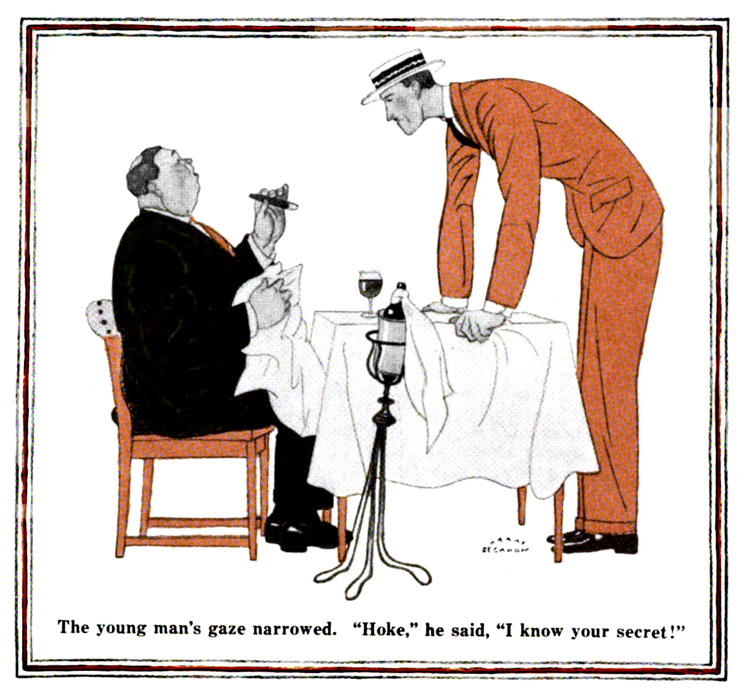 It was as he reached the point in his cigar where a good smoker permits himself the first breaking of the ash that J. B. Hoke became aware that his privacy had once more been invaded. Standing beside his table was the young man who had been lunching with Berry Conway. This young man was eyeing him meaningly.
It disturbed Mr. Hoke.
Mentally, at this moment, J. B. Hoke was a little below par. His nervous system had lost tone. He was in the state where men start at sudden noises and read into other people’s glances a sinister significance which at a happier time they would not attribute to them. And, as he met the Biscuit’s eye, there came to him abruptly the recollection that this was the man who, according to young Conway, had shown such an interest in the Dream Come True.
“Well?” said Mr. Hoke belligerently. He found the other’s scrutiny irritating. “Well?”
The young man’s gaze narrowed.
“Hoke,” he said in a low, steady voice, “I know your secret!”
PRONE on the sofa in his palatial apartment on the second floor of Grosvenor House, T. Paterson Frisby lay and stared at the ceiling. It seemed to him that they had been painting it yellow. The walls were yellow, too; and some minutes previously, when he had risen with the idea of easing his agony by pacing the floor, he had noticed this same gamboge motif in the sky. The fact is, extraordinary things were happening inside Mr. Frisby. He had been eating roast duck again.
What was going on in T. Paterson’s interior resembled in some degree a stormy shareholders’ meeting. Nasty questions were being asked. Voices were being raised. At times it seemed as though actual violence had broken out. And the pepsin tablets which he kept swallowing so hopefully were accomplishing nothing more than might on such an occasion the bleating “Gentlemen, please!” of an inefficient chairman.
“Ouch!” said Mr. Frisby, as a new spasm racked him.
He had but one consolation. In all the dark cloud-rack there was only one small patch of blue sky. At any moment now his secretary would be arriving with the mail, and he looked forward with something approaching contentment to the thought of working off some of his venom on him. Minus roast duck, he was not an unkindly man: but under its influence his whole nature changed, and he became one of those employers who regard a private secretary as a spiritual punching-bag.
It was in this unpromising frame of mind that Berry found him.
Berry was feeling a little disturbed himself. The pleasure of the Biscuit’s society had caused him to prolong his luncheon beyond its customary limits; and on his return to the office there had been a succession of visitors, anxious to see Mr. Frisby. These he had had to deal with, and it had taken time. There was only another fifteen minutes before the hour of his tryst with Ann at the Hyde Park tea house. As he entered the room he was looking fussily at his watch.
“WELL . . .” began Mr. Frisby, half rising from his bed of pain.
It had been his intention to continue the speech at some length. What it was in his mind to say was that when he telephoned to the office for his mail to be brought to Grosvenor House after lunch, he meant after lunch and not five minutes before dinner-time. He would have gone on to inquire of Berry if he had lost his way, or if he had been entertaining himself between Pudding Lane and Grosvenor House by rolling a peanut along the sidewalk with a toothpick. To this he would have added that if Berry supposed that he paid him a weekly salary simply because he admired his looks and liked having something ornamental about the office, he, Berry, was gravely mistaken.
For Mr. Frisby, as we have seen, could, when moved, be terribly sarcastic.
All these things the stricken financier would have said, and many more; and the saying of them would undoubtedly have brought him much relief. But even as he uttered that “Well . . .” his visitor spoke.
“I can only give you a minute,” he said.
It affords a striking proof of the superiority of mind over matter that at these words Mr. Frisby completely forgot that he was a sick man. A sudden lull fell on that shareholders’ meeting inside him. So great was his emotion that he sprang from the sofa like a jumping bean.
Mr. Frisby had once had a secretary who had startled him by coming into the office one afternoon in a state of smiling intoxication and falling over a chair and trying to take dictation with his head in a waste-paper basket. And until this moment this had always seemed to him to constitute what might be called the farthest north of secretarial eccentricity. But now that episode paled into insignificance.
“I’m sorry,” said Berry, “but I’ve promised to go and feed the ducks on the Serpentine.”
It was undoubtedly that fatal word “ducks” that struck Mr. Frisby dumb. Nothing else could have withheld him from the most eloquent address that had ever scorched a private secretary’s ears. The shareholders’ meeting was on once more in all its pristine violence.
Mr. Frisby sank back on to the sofa, and reached feebly for the pepsin bottle.
“As a matter of fact,” proceeded Berry, “I only looked in to tell you that I was resigning my position. But you will be all right,” he added kindly. “You can phone to an agency to send you up a stenographer to attend to these letters, and you can always get another secretary in half an hour. And now,” he said. “I’m afraid I really must rush. I’ve got to be at the tea house in the park in five minutes.”
He hurried out, feeling that he had conducted the delicate business of resignation in a tactful and considerate manner. In a way, he was fond of Mr. Frisby, and wished that he had had more time to spare him; but the necessity of being punctual at the tryst was imperative. He raced for the door of the suite, and reached it just as it was being opened by Mr. Frisby’s man for the admittance of a new visitor.
The new arrival was no stranger to him, though he supposed he was to her. It was Lady Vera Mace. Berry was never quite sure how he stood with Lady Vera in the matter of bowing or smiling or other forms of intimacy. Eleven years ago she had visited her nephew, Lord Biskerton, at school, and he, Berry, as the Biscuit’s best friend, had been included in the subsequent festivities; but, though in his own memory this affair still remained green, the party of the second part had evidently forgotten it entirely. On the one occasion when they had met since that distant date, in Mr. Frisby’s outer office when she had called to discuss the chaperoning of Ann, she had given no sign of recognition.
So now he claimed no acquaintance. He did not bow, but stood to one side in a courtly manner, to allow her to pass. And as she passed her eyes fell on him, and he was surprised to see them light up suddenly, as if in recognition. And what surprised him more was that the light in those eyes was not merely that of recognition but of fear and dislike. Why, if Lady Vera remembered him at all, she should remember him as something obnoxious, Berry could not understand. At the age of fifteen he had probably not been exactly fascinating, but he was astonished to find that he had been so repulsive as to cause this woman, eleven years later, to shudder at the sight of him.
IT WAS rather saddening, in a way. But he had no time to worry himself about it now. Lady Vera had passed on and was entering the room where Mr. Frisby and his interior organism were conducting their silent battle. Berry dismissed the matter from his mind, and ran down the corridor to the stairs. All he was thinking of now was that in another five minutes he would be meeting Ann again. A man with a thing like that before him had no time to worry about his unpopularity with the sisters of earls.
Lady Vera Mace was a dignified woman; and, like all women who are careful of their dignity, she seldom hurried. But such was the emotion with which the sight of Berry had filled her that, as she crossed the threshold of Mr. Frisby’s sitting-room, she was positively running. The desire to receive some explanation of the presence in the financier’s suite of one whom she had come to look upon as London’s leading adventurer accelerated her movements to an extraordinary degree. And she was just about to pour forth a rain of questions when she perceived that her host was sitting doubled up in a chair, uttering sounds as of one in pain.
Lady Vera stopped, concerned. Accustomed to making up her mind quickly, at a very early date in their acquaintance she had decided quite definitely that later on she would marry T. Paterson Frisby. At their very first meeting she had recognized him as one who needed a woman to look after him and when, in the course of their conversation, she had discovered that the post was vacant she had determined to fill it.
So now she gazed upon him with something stronger than the detached womanly pity which she would have bestowed on a mere stranger whom she had found tying himself into knots.
“Whatever is the matter?” she asked.
“Ouch!” said Mr. Frisby.
LADY VERA had that splendid faculty which only great women possess of going instantly to the heart of a problem. At their first encounter this man had been in very much the same condition, and he had confided to her then his hidden secret.
“Have you been eating duck again?” she asked keenly.
She saw him writhe, and knew that her diagnosis had been correct.
“Wait!” she said.
A woman of acute perception, she realized that this was no time for advising the patient to think beautiful thoughts, to recommend him to fancy himself a bird upon a tree and to seek relief in song. The thing had gone too far for that. Cruder and swifter remedies were indicated.
She went to the telephone and was almost immediately in communication with the druggist on the main floor of the building. She spoke authoritatively and as one having knowledge; and presently there was a ring at the bell and a small boy appeared, bearing a brimming glass full of some grayish liquid.
“Drink this,” said Lady Vera.
Mr. Frisby drank, and instantly it was as if some strong man had risen in the meeting of shareholders, dominating all. The shouts died to whispers, the whispers to silence. Peace reigned. And T. Paterson Frisby, licking his lips, spoke in a low, awed voice:
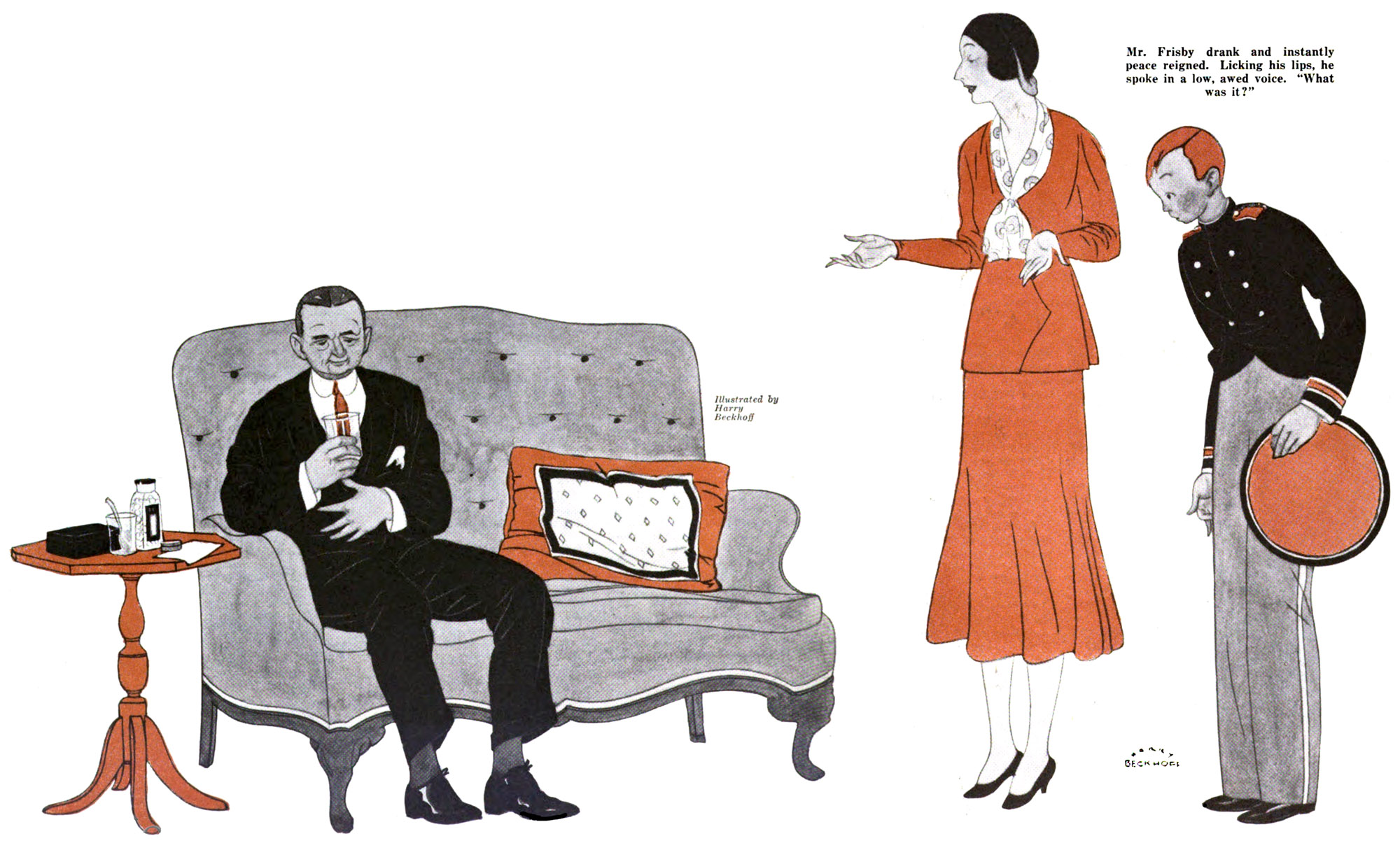
“What was it?”
“It is something my husband used to recommend. He suffered as you do. But after lobster. He said it was infallible.”
“It is,” said Mr. Frisby. “Have you ever tried it on a corpse? I should say it would work.”
A great surge of emotion had risen within him. He looked at Lady Vera Mace with glowing eyes, and a voice seemed to whisper to him that now was the moment for which he had been waiting so long.
He cleared his throat. What there had been in that stuff which he had just swallowed he could not say; but its effect had been to bring him to the top of his form. He felt confident. And he would undoubtedly have expressed himself in a series of telling phrases, calculated to win the heart of any woman, had not Lady Vera abruptly remembered that ten minutes ago she had hurried into this room in a spirit of research and inquiry. Even as Mr. Frisby was shaping his opening sentence she shattered his whole scheme of thought with an agitated exclamation.
“That man!” she cried.
“Eh?” said Mr. Frisby.
“What was that man doing here?”
Regretfully, T. Paterson Frisby recognized that the golden moment had passed. The subject had been definitely changed.
“Man?” he said. “What man?”
“The man I met as I came in. What was he doing here?”
Mr. Frisby was puzzled. She seemed to be referring to his late secretary.
“He came to bring me my mail,” he said.
“Your mail?” Lady Vera’s eyes widened. “Do you know him?”
A warm gleam came into Mr. Frisby’s eye. Subsequent occurrences had dimmed the memory of that remarkable interview with Berry Conway, but now it came back to him. He quivered a little.
“I thought I did,” he said. “Yes, sir! But he certainly surprised me just now. The young hound! ‘I can only give you a minute!’ He said that. To me! And off he went to feed ducks!”
Mr. Frisby paused, wrestling with a strong emotion.
“But who is he?”
“He is—was—my secretary.”
“Your secretary?”
“That’s right. His name’s Conway. And until today I’d always found him an ordinary, respectful . . .”
Lady Vera uttered an exclamation. She saw all.
“So that’s how he came to know Ann!”
Mr. Frisby found himself puzzled again.
“Ann? My niece Ann? He doesn’t know Ann.”
Lady Vera hesitated. It seemed cruel to let the thing descend on this man suddenly, like an avalanche.
“He does,” she said.
“I don’t think so,” said Mr. Frisby.
“I saw them dining together last night. Mr. Frisby,” said Lady Vera, unequal to the task of breaking the news gently, “I have had a talk with Ann. An awful thing has happened. She has broken off her engagement with my nephew, and says she is resolved to marry this man Conway. That is why I came here this afternoon to see you. We must decide what to do about it.”
Mr. Frisby uttered an exclamation.
“So that’s why he was so fresh!”
There was something not unlike satisfaction in his voice. All he could think of for the moment was that a mystery had been solved which might have vexed him to his dying day. Then, like an icy finger on his spine, came the realization of what this meant.
“Marry him?” he gasped. “Did you say marry him?”
“She said she intended to marry him.”
“But she can’t!” wailed Mr. Frisby. “My sister Josephine would never give me a second’s peace for the rest of my life.”
HE STARED at his visitor, appalled, and was stunned to perceive a soft smile upon her face. What anyone could find to smile at in a world where his sister Josephine’s daughter was going about marrying penniless ex-secretaries was more than Mr. Frisby could understand.
“Why, of course!” said Lady Vera. “How foolish of me not to have seen it directly you told me.”
“Eh?”
“Everything is going to be quite simple,” said Lady Vera. “If this man Conway is really your secretary, the problem solves itself.”
“Eh?” said Mr. Frisby again.
“But I didn’t tell you, did I? You see, Mr. Frisby, what has happened is this: This man, as far as I can gather from her story, seems to have swept Ann off her feet by telling her a lot of romantic stories about himself. Well, surely, when she finds that he has been lying to her and is nothing but a miserable secretary, she will realize the sort of man he is and will give him up of her own accord.”
Mr. Frisby looked doubtful.
“Told her romantic stories, did he?”
“He said he was a secret service man. You can imagine the effect that that would have on an impressionable girl like Ann. But when she finds out . . .”
Mr. Frisby shook his head.
“A bird as smooth as that,” he said, “is going to be smooth enough to jolly her along even when she does find out.”
“Then what you must do,” said Lady Vera with decision, “is simply to send your lawyer down to his house to offer him money to give Ann up.”
“But would he give her up?” Mr. Frisby drooped despondently. He could see the flaw in the idea. “Why would he take money to give her up, when he could get more money by standing pat?”
Lady Vera overruled the objection.
“When your lawyer explains to him that Ann will be sent back to America immediately, out of his reach, if he refuses to come to terms, I am sure that he will be only too glad to take whatever you offer.”
The gloom passed from Mr. Frisby’s face. He gazed reverently at this woman of infinite sagacity.
“You’re dead right,” he said. “I’ll get Robbins on the phone right away.”
“Yes, do.”
“I’ll tell him to start the bidding at a thousand pounds.”
“Or two?”
“Yes, two. You’re right again. He’ll drop sure for two thousand. Two thousand is big money.”
“What I would have done without you,” said Lady Vera, “I don’t know. Some men in your position would have ruined everything by being niggardly.”
MR. FRISBY glowed and expanded beneath her approbation. Once more that voice seemed to be whispering in his ear that it would be well to go to it. He simply needed an opening. The emotion was there, all ready to be poured out. All he required was a cue.
“Nothing niggardly about me,” he said, with modest pride.
“No.”
“I’m fond of money—I don’t deny it—but . . .”
“Isn’t everybody?”
“What?”
“Fond of money.”
“Are you?”
“Of course I am.”
“Have mine,” said Mr. Frisby.
He strode to the telephone, unhooked the receiver, and barked into it to cover a certain not unnatural confusion. If his cheeks had not been made of the most durable leather, they would have been blushing. What he had said was not what he had been intending to say. He had planned something on tenderer and more romantic lines. Still, that was the way it had come out. The proposition had been placed on the agenda, and let it lay, was Mr. Frisby’s view.
“Chancery 9632? Robbins? Come right round to Grosvenor House, Robbins. Yes, at once. Want to see you.”
Lady Vera was contemplating his rigid back with a kindly smile. She was experienced in the matter of inarticulate proposals. The late Colonel Archibald Mace had grabbed her hand at Hurlingham one summer afternoon, turned purple, and said “Eh, what?” Compared with him, Mr. Frisby had been eloquent.
“Well?” said T. Paterson Frisby, replacing the receiver and turning.
“You go with it, I suppose?” said Lady Vera.
Mr. Frisby nodded curtly.
“There is that objection,” he said.
Lady Vera smiled.
“I don’t consider it an objection.”
“Vera!” said Mr. Frisby.
“Paterson!” said Lady Vera.
“Don’t call me Paterson,” said Mr. Frisby, breathing devoutly down the back of her neck. “It’s a thing I wouldn’t mention to anyone but you, and I hope you won’t let it get about, but my first name’s Torquil.”
Printer’s error corrected above:
Magazine, p. 48b, had “His spirits semed”