 Madame Eulalie’s Rare Plums
The Story Thus Far:
YOUNG Berry Conway and his bosom friend, the Biscuit (known to the public as Lord Biskerton), are penniless. Berry gets a job as secretary for one T. Paterson Frisby, an American financier residing in London, while his lordship grabs the hand and heart of T. Paterson’s rich niece, the fair Ann Moon, marriage to whom will solve his financial problems.
To evade a small army of creditors until after his nuptials, his lordship flees to Valley Fields, a suburb, where, as “Mr. Smith,” he takes a house near Berry. After which he meets a beautiful neighbor—Kitchie Valentine, wealthy American—and promptly becomes engaged to her, little suspecting the sad truth: that Kitchie and the lovely Ann Moon are friends! . . .
Berry, too, has creditor trouble. Acting on the advice of Mr. Frisby, he sells a “worthless” copper mine he happens to own—the Dream Come True, which is located next to Mr. Frisby’s mine, the Horned Toad, and which Mr. Frisby knows to be worth millions—to one J. B. Hoke (agent for Mr. Frisby). Whereupon, much to the disgust of one Captain Kelly, who was to have been in on the deal, and the estimable T. Paterson Frisby, it is learned that the astute Mr. Hoke has purchased the mine—for himself! Decidedly disgruntled, but still seeing golden possibilities, Frisby agrees to a merger of the two mines, and plans to make a fortune on the sale of the stock, after the good news leaks out; while Captain Kelly, an elemental gentleman, becomes a partner through the use of weird threats.
Meanwhile, Berry has been having a grand adventure. He has met a beautiful girl (about whom he knows nothing other than that she is marvelous), has informed her that he is a member of the romantic secret service and has become engaged to her.
His lordship is much interested in the news. “What’s the unfortunate’s name?” he asks. “Ann Moon,” says Berry. . . . Is his lordship shocked? He is not. He loves Kitchie. But, obviously, they have quite a problem before them; also, having learned of the big copper deal, they must circumvent the conspirators—if possible. . . . Berry chucks his job, and Frisby learns of the Moon-Conway affair. Shocked, he sends Mr. Robbins, his attorney, to buy off Mr. Conway. Mr. Robbins meets the Biscuit, mistakes him for Berry, and offers him a large check to break off the engagement. His lordship grabs the check! . . . Lord Hoddesdon, the Biscuit’s father, calls on Berry to discuss the shocking situation. Mr. Hoke—having been sent by Captain Kelly to keep Berry and the Biscuit at home, so that they cannot make a coup in Horned Toad stock, at a very low price—arrives. He is drunk. Very drunk. Pie-eyed.
Mr. Hoke presents a large revolver.
“Hands up!” he yodels.
Conclusion
IN THE sitting-room of Peacehaven, meanwhile, separated from the sitting-room of The Nook only by a thin partition, events had been taking place which demand the historian’s attention. It is to Lord Biskerton and his affairs that the chronicler must now turn his all-embracing eye.
At about the moment when Mr. Hoke was climbing over the dining-room window sill of The Nook, intent on ham and whisky, the Biscuit, seated in an armchair next door, had begun to gaze at a photograph of Miss Valentine on the mantelpiece, thinking the while those long sweet thoughts which come to a young man with love in his heart and a check for two thousand pounds in his pocket. The burst of song in which he had indulged on returning home after the departure of Mr. Robbins had continued for the space of perhaps ten minutes. At the end of that period he had abated the nuisance and turned to silent musing.
He gazed at the photograph of Kitchie. To have won the love of a girl constructed on those lines might have been considered luck enough for any ordinary man. But not for Godfrey Edward Winstanley Brent, Lord Biskerton, fortune’s favorite. To him had been vouchsafed in addition one of the red-hottest tips that ever emanated from the stock market and, as if that were not sufficient, a miraculous shower of gold which would enable him to profit by it.
From his earliest years the Biscuit had nourished an unwavering conviction that Providence was saving up something particularly juicy in the way of rewards for him, and that it was only a question of time before it came across and delivered the goods. He based this belief on the fact that he had always tried to be a reasonably bonhomous sort of bird and was one who, like Abou ben Adhem, loved his fellow men. Abou had clicked, and Lord Biskerton expected to click. But not in his most sanguine moments, not even after a Bump Supper at Oxford or the celebration of somebody’s birthday at the Drones, had he ever expected to click on this colossal scale. It just showed that when Providence knew it had got hold of a good man the sky was the limit.
Furthermore, while benefiting him, Providence would also put good old Berry on Easy Street. Lavish. That is what the Biscuit considered it. Lavish. Nestling in his chair, he felt almost dizzy. Joybells seemed to be ringing in a world where everything, after a rocky start, had suddenly come abso-bally-right.
PRESENTLY, as he sat, there came to him the realization that on one point he had made a slight and pardonable error. Those were not joybells. What was ringing was the one at the front door. A caller had apparently come to share with him this hour of ecstasy. Hoping that it was Berry, fearing that it might be the vicar, he went to the door and opened it. And, having opened it, he stood on the mat, staring with a wild surmise.
He had been prepared for Berry. He had been prepared for the vicar. He had even been prepared for somebody selling brooms, cane-bottomed chairs, or aspidistras. What he had not been prepared for was his late fiancée, Ann Moon.
“Hul-lo!” said the Biscuit, blinking.
She was gazing at him with large eyes, and she seemed a little breathless. Her face was flushed, and her lips were parted. Extraordinarily pretty—not that it mattered, of course—it made her look, the Biscuit felt.
“Hullo!” he said blankly.
“Hullo,” said Ann.
“You!” said the Biscuit.
“Yes,” said Ann. “May I come in?”
“Come in?”
“Yes.”
“Oh, rather,” said the Biscuit, roused to the necessity of playing the host. “Of course. Certainly.”
Still stunned, he led the way to the sitting-room.
“Would you like to take a seat, or anything of that sort?”
“May I?”
“Certainly,” said the Biscuit. “Of course. Oh, rather.”
Ann sat down, and there followed a pause of some length. It is not easy for a girl who has broken her engagement with a man and who has called at his house to suggest that, her outlook on things having altered, that engagement shall be resumed, to know exactly how to start.
Ann’s mind, like that of her host, was in a distinctly disordered condition. She had come here on one of those sudden impulses on which she was too prone to act. She told herself that she hated and despised Berry, and this had led to a conviction that she had treated the Biscuit very badly and must make amends. But it was not easy to open the subject.
“Cigarette?” said the Biscuit.
“No, thanks.”
What made it so particularly difficult was that her mind was divided against itself. It was all very well for her to tell herself that she hated and despised Berry. So she did. But how long would this attitude last after the first spasm of righteous indignation had ceased to hold control? At present she was still in the full grip of that burning fury which comes to every girl who has been made a fool of and who is compelled to face the sickening fact that Mother—or, at least, her chaperon—was right. Lady Vera had said that Berry was a mercenary impostor, and a mercenary impostor he had proved.
So far, as the Biscuit would have said, so good.
But all the while there was something deep down in her which was whispering that, impostor or not, he was the man she loved and always would love. For years she had been plagued by a meddling and interfering conscience; and, now that at last she seemed to be acting on lines of which conscience approved, up popped an inconvenient subconscious self to make her uneasy. Look at it as you liked, it was a pretty tough world for a girl.
She forced herself to crush down this new assailant.
“Godfrey,” she said.
“Hullo?”
“I want to speak to you.”
“Shoot,” said the Biscuit.
“I . . .” said Ann.
She stopped. It was even more difficult than she had thought it would be.
Silence fell again. The Biscuit raked his mind for conversational material. He had always been fond of Ann, but he was bound to admit that he had liked her better before she contracted this lockjaw or aphasia or whatever it was. Put it this way. A merry, prattling girl—excellent. A girl apparently suffering from the dumb staggers—no good to a fellow whatever. If Ann had come all the way to Valley Fields merely to gulp at him, he wished she would go.
As a matter of fact, he wished she would go, anyway. He was an engaged man, and an engaged man cannot be too careful. Kitchie might resent—and very properly resent—this entertaining of attractive females in his home.
HOWEVER, he had to be courteous. It being impossible to take her by the scruff of the neck and bung her out, something in the nature of polite chit-chat was indicated.
“How are you?” he said.
“I’m all right.”
“Pretty well?”
“Yes, thanks.”
“You’re looking well.”
“You’re looking well.”
“Oh, I’m all right.”
“So am I.”
“That’s good,” said the Biscuit. “I wonder if you’d mind if I took a small snort? The old brain feels as if it had come a bit unstuck at the seams.”
“Go ahead.”
“Thanks. You?”
“No, thanks.”
“Well, best o’ luck,” said the Biscuit, imbibing.
He felt more composed now. It occurred to him that a major mystery still remained unsolved.
“How did you know I was living here?” he asked.
“Lady Vera told me.”
“Ah!” said the Biscuit. “I see. She told you?”
“Yes. By the way, did she tell you?”
“That I live here?”
“About her engagement.”
The Biscuit goggled.
“Her engagement?”
“She’s going to marry my uncle.”
“What! Old Pop Frisby?”
“Yes.”
“My . . . stars!”
“I was surprised, too. I hadn’t thought of Uncle Paterson as a marrying man.”
“ANY man’s a marrying man that a woman like my Aunt Vera gets her hooks on,” said the Biscuit profoundly. “Well, I’m dashed! So my family is keeping your family in the family, after all. Knock me down with a feather, that’s what you could do.”
He mused a while. Things were growing clearer.
“So that’s why you came down here?”
“No.”
“How do you mean, no?”
“I mean, no.”
“You mean, you didn’t come here just to tell me this bit of news?”
“No.”
“Then why,” demanded the Biscuit, putting his finger squarely on the center of this perplexing matter, “did you come? Always glad to see you, of course,” he added, gallantly. “Drop in any time you’re passing, and all that. Still, why did you come?”
Ann felt that the moment had arrived. With a slight tingling of the spinal cord and other evidences of embarrassment in the form of the glowing cheek and the foot drawing patterns on the floor, she braced herself to speak.
“Godfrey,” she said.
“Carry on,” said the Biscuit encouragingly, after an adequate pause.
“Godfrey,” said Ann, “you got a letter from me, didn’t you?”
“Breaking the engagement? Rather.”
“I came here,” said Ann, “to tell you I was sorry I wrote it.”
The Biscuit was insufferably hearty.
“Not at all. A very well-expressed letter. Thought so at the time and think so still. Full of good stuff.”
“I . . .”
The Biscuit clicked his tongue remorsefully.
“By the way,” he said, “can’t think what I was doing, not touching on the topic before, but wish you happiness, and all that sort of rot. Berry Conway told me you and he had signed up.”
“Do you know him?” cried Ann, astonished.
“Of course I know him. And I ought to have extended felicitations and so forth long ago. What with life being tolerably full, and one thing and another, I overlooked it. Dashed sensible of you both, I consider. There’s no one I would rather see you engaged to than old Berry.”
“We are not engaged.”
“Not?”
“No.”
“Then,” said the Biscuit, aggrieved, “I have been misinformed. My leg has been pulled, and—what makes it worse—by a usually reliable source.”
“I’ve broken it off,” said Ann shortly.
The Biscuit stared.
“Broken it off?”
“Yes.”
“Why?”
“Never mind why.”
“My dear old soul,” said the Biscuit paternally, “I would be the last man to butt in on other people’s affairs, but honestly, don’t you think you’re rather overdoing this breaking-off business? I mean to say, twice in under a week. Goodish going, you must admit. I don’t know what the European record for engagement-breaking is, but I should say you hold it. Twice! Great Scott!”
Ann clenched her hands.
“It needn’t be twice,” she said, speaking with difficulty, “unless you like.”
“Eh?”
“I came here,” said Ann, “to suggest that, if you felt the same, we might consider that letter of mine not written.”
The Biscuit gasped. They were coming off the bat too quick for him today. First Hoke, then old Robbins, and now this. He began to feel slightly delirious.
“Do you mean,” he asked, “that you’re suggesting that you and I . . . ?”
“Yes.”
“That our engagement . . .”
“Yes.”
“That we shall . . . ?”
“Oh, yes, yes, yes!” said Ann.
There was a long silence. The Biscuit walked to the window and looked out. There was nothing to see, but he remained there, looking, for some considerable time. He perceived that all his tact and address would be needed to handle this situation.
“Well?” said Ann.
The Biscuit turned. He had found the right words.
“Look here, old soul,” he said apologetically, “I’m afraid I’ve a rather nasty knock for you, and, if you take my advice, you’ll have a drink to brace yourself. I’d do anything in my power to oblige, but the fact is, I can only be a sister to you.”
With a sorrowful jerk of the thumb, he indicated the mantelpiece.
“Like Dykes, Dykes and Pinweed,” he said, “I’m bespoke.”
Ann caught her breath in sharply.
“Oh!” she said.
SHE got up. Never since the day when, a child of eleven, she had been pushed on to the platform to assist a conjurer at a children’s party had she felt so supremely foolish; but she held her head high. She went to the mantelpiece and examined the photograph thoughtfully.
“She’s pretty,” she said.
“She is pretty,” agreed the Biscuit.
“Why, I know her!” exclaimed Ann.
“You do?”
“It’s Kitchie Valentine. I came over in the boat with her.”
The Biscuit had half a mind to say something about this bringing them all very close together, but he was not quite sure how it would go. It might go well, or it might not go well. He decided to keep it back.
“She lives next door, doesn’t she?” said Ann. “I had forgotten.”
“That’s right,” said the Biscuit. “Next door. We did most of our coo-and-billing across the fence.”
“I see. Well, I hope you’ll be very happy.”
“Oh, I shall,” the Biscuit assured her.
“I think I’ll be going,” said Ann.
The Biscuit held up a compelling hand.
“Wait!” he said. “Just one moment. I want to get to the bottom of this business of old Berry.”
“I don’t want to talk about him.”
“This lovers’ tiff. . . .”
“It wasn’t a lovers’ tiff.”
“Then what was it? Good heavens!” said the Biscuit, warming to his subject. “If ever there were a couple of birds made for each other, it’s you and Berry. I mean to say, you’re one of the sweetest things on earth, and he’s a corker. ‘His life was gentle, and the elements so mixed in him that Nature might stand up and say to all the world: “This was a man!” ’ I always remember that bit,” said the Biscuit. “Had to write it out a hundred times at school for bunging an orange at a contemporary and catching my form master squarely in the eyeball, he happening to come unexpectedly into the room at the moment. If you’ve really gone and given old Berry the push, you must be cuckoo. It’s no good telling yourself that there’ll be another one along in a minute, because there won’t. You won’t find another fellow like Berry in a million years. He’s all right. And what they think of him in the secret service!” added the Biscuit, belatedly remembering. “The blokes up top have got their eye on him all right, I can tell you!”
Ann laughed shortly.
“Secret service!”
“Why,” asked the Biscuit, “do you say ‘secret service’ in that nasty, tinkling voice?”
“I know all about him, thanks,” said Ann. “There’s no need for you to lie to me. He did all of that that was necessary.”
“Oh?” said the Biscuit reflectively. “Oh, ah! Ah! Oh!”
He began to understand.
“He’s my uncle’s secretary,” said Ann, with scorn.
“In a measure,” admitted the Biscuit reluctantly, “yes. But,” he went on, brightening, “what of it?”
“What of it?”
“What difference does it make?”
Ann’s eyes blazed.
“YOU don’t think it makes any difference? You don’t think that a girl’s feelings are likely to change towards a man when she finds he has been lying to her and making a fool of her and pretending to be fond of her just because . . .” She choked. “. . . just because she happens to be rich?”
The Biscuit was shocked.
“My dear young prune,” he said, “you aren’t asking me to believe that you think that a fellow like Berry was after your money?”
“Yes, I am. Lady Vera said he was.”
“Admitting,” said the Biscuit, “that what my Aunt Vera doesn’t know about cash chivying isn’t worth knowing, I deny it in toto. Aunt Vera was talking through her hat. Listen, you poor mutt. I was at school with old Berry for a matter of five years, and I know him from caviar to coffee. He’s the squarest bird on earth. And that’s official. You don’t suppose a man can be mistaken about another man after five years at school with him, do you? Berry’s all right.”
“Then why did he lie to me?”
“I’ll tell you about that,” said the Biscuit. “Give you a good laugh, this will. He saw you at the Berkeley that day and fell in love with you, and then he saw you in your car, and the only way he could think of to get to know you was to jump in and say he was a secret service man. That’s the sort of chap he is. Weak in the head, but fizzing with romance. And in re his being your uncle’s secretary: You don’t imagine he stuck on as secretary to old Pop Frisby because he enjoyed it, do you? He was left without a penny in the world, and some lawyer cove lent him a couple of hundred quid to give him a start, and he had to get a job and hold it down till he had paid the stuff back. And all the time he was yearning to roll to Rio or go to Arizona and do something or other to rocks—he told me what it was, but I’ve forgotten. Blackjacking, it sounded like. And, talking of Arizona, let me tell you something, and you’ll see what a young muttonhead you’ve been to think that it was your money he was after. He’s got money himself, thousands and thousands of pounds of it. Or he will have tomorrow. Me, too. We’ve come into a fortune.”
ANN was silent. Then she drew her breath in with a long sigh.
“I see,” she said.
“It’s no good saying you see. What are you going to do about it?”
“I’ve made a fool of myself,” said Ann.
“You’ve made a gosh-awful fool of yourself,” agreed the Biscuit enthusiastically. “You’ve acted like a pipsqueak. What steps, then, do you propose to take?”
“Shall I write to him?”
“Not a bad idea.”
“I’ll go home and do it now.”
“Excellent.”
“Well, I’ll be going, Godfrey.”
“Perhaps it would be as well,” said the Biscuit. “I mean, delighted you were able to come, and so on, but you know how it is.”
“I suppose I ought to try to thank you,” said Ann, at the front door.
“Not a bit necessary. Only too pleased if any little thing I may have said has been instrumental . . .”
“Well, good-by.”
“Good-by,” said the Biscuit. “I shall watch your future career with considerable interest. Hullo, who’s this bird?”
The bird alluded to was the redoubtable Captain Kelly, who had suddenly manifested himself out of the darkness.
“Just a moment,” said Captain Kelly.
Ann stared at him, alarmed. With his hat pulled down over his eyes, the captain was a disquieting figure.
“All hawkers, bottles, and street criers should go round to the back door,” said the Biscuit, with a householder’s austerity. “Unless, by any chance,” he said, an alternative theory crossing his mind, “you’re the vicar?”
“I’m not the vicar.”
“Then who are you?”
“Never mind who I am,” said Captain Kelly shortly. “All I want to say is that you don’t leave here tonight, and this young lady doesn’t leave here tonight.”
“What!” cried the Biscuit.
“What!” cried Ann.
“See this?” said the captain.
The light from the hall shone on a businesslike-looking revolver. Ann and the Biscuit gazed at it, fascinated.
“I’ll be waiting outside if you try any funny business,” said Captain Kelly.
“But what’s it all about?” demanded the Biscuit.
“You know what it’s all about,” said the captain briefly. “In you get now, and don’t you try to come out, unless you want the top of your head blown off. I mean it.”
Inside the hall, the Biscuit stared at the closed door as if he were trying to see through it.
“The suburbs for excitement!” he said.
Ann uttered an exclamation.
“But I can’t stay here all night!” she cried.
The Biscuit quivered as if an electric shock had passed through him.
“You jolly well bet you can’t!” he agreed vehemently. “I don’t know if you happen to know it, but poor little Kitchie’s faith in man is pretty wobbly these days. She had a bad shock not long ago, administered by a worm of the name of Merwyn Flock. If she finds that you and I have been camping out here . . . My gosh!” groaned the Biscuit, “all will be over. No wedding bells for me. She’s as likely as not to go into a convent or something.”
“But what’s to be done? Who is that man?”
“I don’t know. No pal of mine.”
“He must be mad.”
“He’s absolutely potty. But that doesn’t make it any better.”
“Well, what are you going to do?”
“Take another small snort.”
“What’s the good of that?”
“I’ll tell you what’s the good of it,” said the Biscuit. “It will clear my mind, enable me to grapple more freely with a problem to which as yet I can see no answer. I’m a pretty quick fellow, as a rule, but when it comes to homicidal lunatics in the front garden, I am not ashamed to confess myself temporarily baffled. The one thing certain is that somehow or other, by what means I cannot say, you have got to be eased out of here as soon as possible.”
He led the way back to the sitting-room, and reached abstractedly for the decanter. He was thinking . . . thinking.
IN a prosaic age like the one in which we live anything that seems to border on eccentricity is always judged harshly. We look askance at it, and draw damaging conclusions. Deviate ever so little from the normal behavior of the ordinary man, and you meet inevitably with head-shakings and suspicion from a censorious world.
The actions of both Captain Kelly and J. B. Hoke had been, as we have seen, dictated by careful and reasonable reflection. They were based on solid common sense. Yet, just as Ann and the Biscuit, in the sitting-room of Peacehaven, had come to the conclusion that the captain was unbalanced and even potty, so now did Berry and Lord Hoddesdon, on the other side of the partition, take a snap judgment and condemn Mr. Hoke on the same grounds.
Lord Hoddesdon was the first to clothe this thought in words. He had been watching Mr. Hoke’s pistol with a fascinated eye and a sagging jaw, and now he spoke.
“Who is this lunatic?” he asked.
Berry was more soothing.
“It’s quite all right, Mr. Hoke,” he said. “You’re among friends. You remember me, don’t you? Conway?”
“The man’s a raving madman,” proceeded Lord Hoddesdon. “Keep your dashed finger off that trigger, sir, confound you!” he added, with growing concern.
“Hands up,” said Mr. Hoke muzzily.
“Our hands are up,” said Berry, still with that same elder-brotherly sweetness. “You can see they’re up, can’t you? Look! Right up here.”
And, to emphasize the point, he twiddled his fingers. Mr. Hoke stared at them, with an air of dislike, blinked, and rose to a point of order.
“Hey!” he observed. “Quit that!”
“Quit what?”
“That twiddling,” said Mr. Hoke. “I don’t like it.”
It reminded him somehow of spiders, and he did not wish to think of spiders.
“I’ll tell you what,” said Berry. “Put that pistol away and just sit back quite quietly, and I’ll go and make you a nice cup of tea.”
“Tea?”
“A nice, hot, strong cup of tea. And then we’ll sit down and have a good talk, and you shall tell us what it is that’s on your mind.”
Mr. Hoke regarded him owlishly. He seemed to be considering the suggestion.
“I had a mother once,” he said.
“You did?” said Berry.
“Yes, sir!” said Mr. Hoke. “That’s just what I had. A mother.”
“The man’s a dashed, driveling, raving, raging lunatic,” said Lord Hoddesdon.
Mr. Hoke started. Something in his lordship’s words had caused a monstrous suspicion to form itself in his clouded mind. It seemed to him, if he had interpreted them rightly, that Lord Hoddesdon was casting doubts on his sanity. He resented this. He would have been the first to admit that he had taken perhaps one over the eight and that his mental powers had lost, in consequence, something of their usual keen edge; but he was deeply wounded to think that anyone should consider him non compos.
“Think I’m crazy?” he said.
“Not crazy,” said Berry. “Just . . .”
“He’s as mad as a hatter,” insisted Lord Hoddesdon, who objected to paltering with facts and liked to call a spade a spade. “Will you stop fingering that trigger, sir? Do you want a double murder on your hands?”
“I’m not crazy,” said Mr. Hoke. “No, sir.”
“I’m sure you’re not,” said Berry. “Just the tiniest bit overexcited. Why not lay that pistol down—look, there’s a table where it would go nicely—and tell us all about your mother?”
Mr. Hoke’s mind was still occupied with his grievance. He objected to this attempted side-tracking of the conversation to the topic of mothers. Plenty of time, he felt, to talk about mothers when he had proved to these skeptics that he was as sane as anybody. He proceeded to give his proofs.
“You want to know why I’m acting this way?” he said. “You don’t know, do you? Oh, no, you don’t know. Can’t imagine, can you? That red-headed pal of yours hasn’t been telling you what I told him about the Dream Come True, has he? Oh, no. He hasn’t come and handed you the dope, has he? Oh, no. You and your mothers! Don’t try to put me off by talking about your mother, because I know what I’m doing, and if your mother doesn’t like it, she can do the other thing.”
TO Lord Hoddesdon, chafing impotently, these strong remarks on the subject of dreams and mothers seemed but further evidence, if such were needed, that he stood in the presence of one of the most pronounced lunatics who ever qualified for the restraint of a padded cell. Gibbering, pure and simple, his lordship considered Mr. Hoke’s last speech. But to Berry there came dimly, as through a fog, a sort of meaning.
“What about the Dream Come True?” he asked.
“You don’t know, do you?” asked Mr. Hoke witheringly.
He moved cautiously across the room, the better to keep his eye upon his prisoners, and sat with his back against the wall, surveying them keenly.
“You don’t know, do you?” he said. “That red-head didn’t tell you, did he? And you weren’t listening outside old Frisby’s door that day, when him and me were talking about keeping it under our hats that there had been a new reef located? Well, if you think you’re going to get up to London tomorrow and start in buying Horned Toad stock, you’ve got another guess coming. You’re going to stay right here, that’s what you’re going to do.”
He turned a glazing eye on Lord Hoddesdon.
“And that goes for you, too, Oil,” he said.
BERRY uttered a sharp cry. It was as if a great light had shone upon him.
“So you knew there was copper there?” he cried.
“Knew it all along,” said Mr. Hoke. “And I’m going to clean up big. You’ll see Horned Toad up in the hundreds before the end of the week.”
A whistling sigh escaped Lord Hoddesdon. His arms were aching, and this meaningless exchange of remarks was making his head ache still more. Dreams and mothers, and now horned toads. . . . It was too much for a nobleman of limited intellect to be expected to endure with composure.
Berry’s hands had begun twitching again, and Mr. Hoke commented on the fact.
“Don’t twiddle!” he said.
He leaned against the wall, and endeavored to steady his faithful gat. He did not like the expression on Berry’s face. For the matter of that, he did not like the expression on Lord Hoddesdon’s face. And he was about to say as much, when without any warning there was a loud, splintering crash and quite a lot of the wall fell on top of his head.
“Hell!” cried Mr. Hoke, mystified.
There is always a reason for the most perplexing occurrences. To J. B. Hoke this sudden dissolution of what had appeared to be a solid wall seemed to step straight into the miracle class. He thought, as far as he was capable of thinking at all, of earthquakes. His mind also toyed for an instant with the theory that possibly this was the end of the world. And all it was, in reality, was Berry’s next-door neighbor, Lord Biskerton, endeavoring to take a short cut from Peacehaven to The Nook.
We left the Biscuit, it will be recalled, in the act of thinking. A brain of that caliber cannot go on thinking long without some solid result. Scarcely had the Biscuit swallowed one stiffish whisky-and-soda and begun another, rather milder, when the solution of the problem with which he was confronted flashed upon him. Suddenly a thought came like a full-blown rose, flushing his brow; and, charging downstairs to the cellar, he came racing up again, armed now with the pickax used by suburban householders for breaking coal.
His train of thought may be readily followed. The more he caught the eye of the photograph of his betrothed on the mantelpiece, the more clearly did he perceive that something must be done to dissolve this enforced tête-à-tête between Ann and himself on the premises of Peacehaven. Captain Kelly’s strongly expressed views had shown him that it was impossible for her to leave by the ordinary route, and so he had adopted the only alternative one. Let him get through into Berry’s sitting-room, he felt, and the thing would at least become a threesome. Good enough, was the Biscuit’s verdict.
HE SWUNG his weapon vigorously, and was delighted to find that it met with little resistance. Architects of suburban semi-detached villas do not build party walls with an eye to this sort of treatment. Encouraged, he redoubled his efforts.
Lord Biskerton, as we have said, was delighted. But it is rarely in this world that we find everybody happy at the same time, and it would be idle to pretend that his exhilaration was shared by Mr. Hoke. What he was going to do about it, beyond uttering a reproving “Hey!” Mr. Hoke did not know, but he knew that he did not like it.
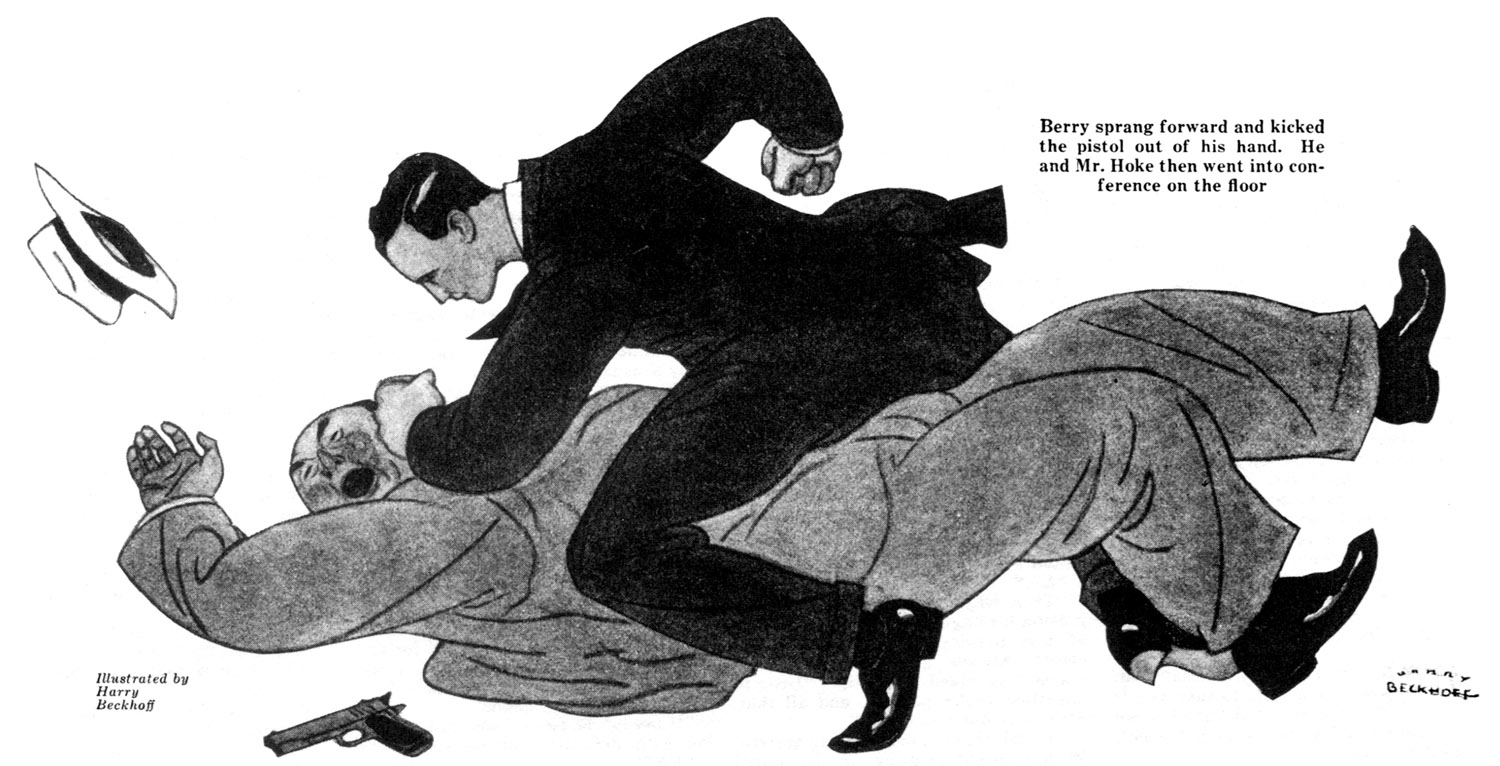
He backed away from the center of disturbance with a pop-eyed stare of concern, and it was at this moment that Berry, grateful for the opportunity, sprang forward and with a dexterous flick of the foot kicked the pistol out of his hand. He and Mr. Hoke then went into conference on the floor.
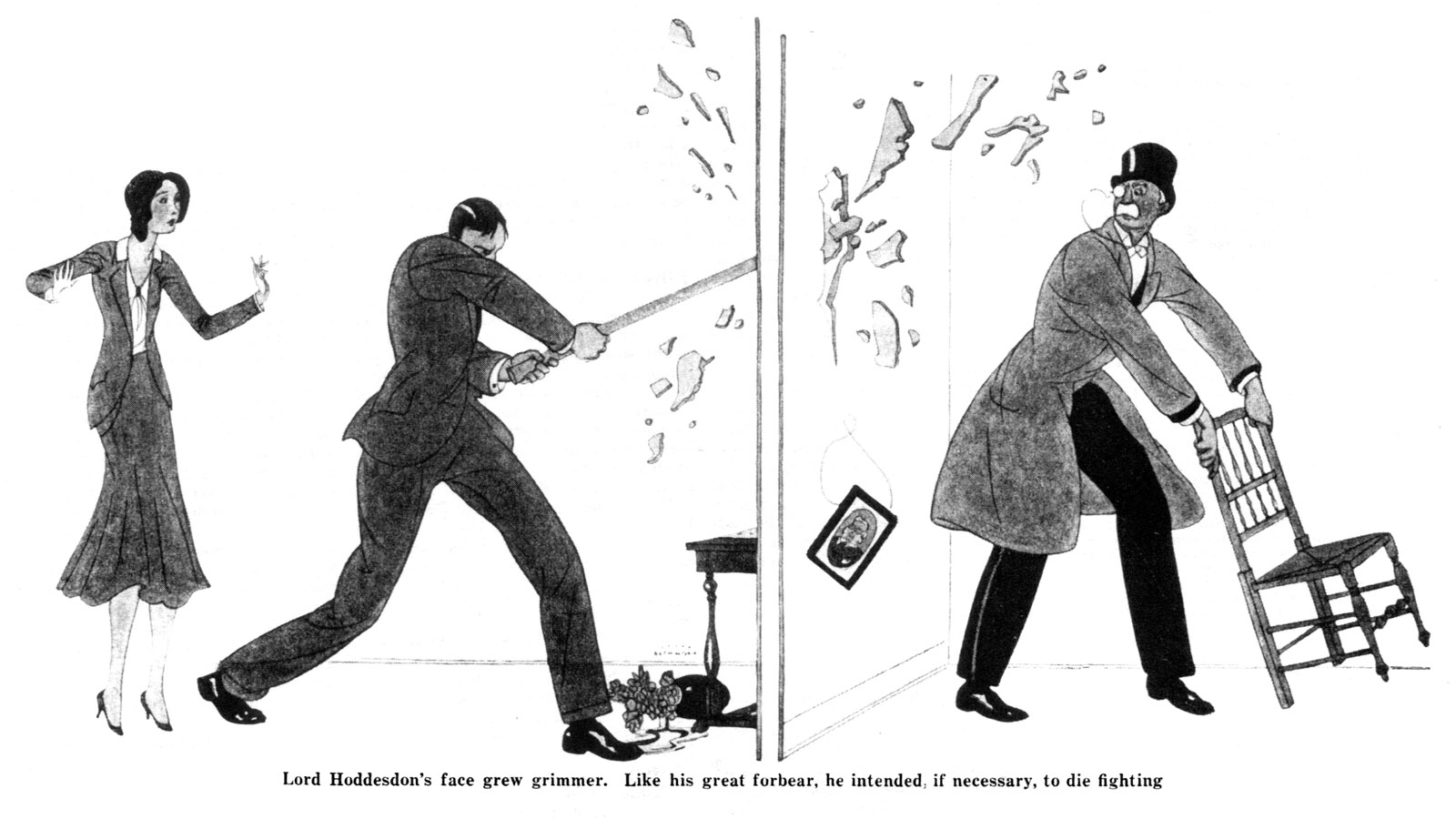
Lord Hoddesdon, lowering his aching arms, possessed himself of a stout chair and stood by the rapidly widening hiatus in the wall, awaiting developments. He was feeling warlike, but not surprised. The rigors of life in the suburbs, experienced first by day and now by night, had hardened Lord Hoddesdon’s soul.
The gap in the wall widened, and Lord Hoddesdon’s face grew grimmer. Like his great forbear who had done as well at the Battle of Agincourt, he intended, if necessary, to die fighting.
ROUND and about the imitation Axminster carpet, meanwhile, the catch-as-catch-can struggle between Berry and his visitor was proceeding briskly and with considerable spirit. J. B. Hoke might have been injudicious in the matter of refreshment that day; he might, during his retirement in London, have allowed the enervating conditions of a peaceful life to spoil his figure and impair his wind; but in his hot youth he had been a pretty formidable bar-room scrapper, with an impressive record of victories from the Barbary Coast of San Francisco to the Tenderloin district of New York; and much of the ancient skill still lingered. You could tell by the way he kicked Berry on the shin and attempted to get a tooth-hold on his left ear that this was no novice who sprawled and wriggled on the floor.
Berry perceived this himself, and he put his whole soul into the fray. And for a space the issue hung doubtful. Then Mr. Hoke made the grave strategic blunder of rising to his feet.
It was not a thing his best friends would have advised. Where, on the ground, he had seemed all feet and teeth, he became revealed now as the possessor of a stomach. Berry saw this. He hit Mr. Hoke twice, solidly, in the midriff. And Mr. Hoke, with a defeated gurgle, folded up like an Arab tent and lay prone. And Berry, jumping for the gat which had been the gage of battle, picked it up and stood, panting.
He was attempting to recover some of the breath of which the recent struggle had deprived him, when a crash from behind, followed by a sharp howl, caused him to turn.
His old friend Lord Biskerton was sitting on the floor, nursing a wounded wrist, while his old friend’s father, Battling Hoddesdon, stood gazing at his handiwork with surprise and concern.
“Godfrey!”
“Hullo, guv’nor. You here?”
“Godfrey,” cried Lord Hoddesdon. “I’ve hurt you, my boy!”
“Guv’nor,” replied the Biscuit, “you never spoke a truer word. If I hadn’t happened to get an arm up in time, the peerage would never have descended through the direct line.”
At this moment, Ann stepped through the hole in the wall.
“Come right in, Ann,” said the Biscuit cordially. “And thank your stars it wasn’t a case of ladies first. Otherwise you would have caught it on the napper properly. The guv’nor’s just doing his big tent-pegging act.”
This was only Ann’s third visit to Valley Fields, and she had, in consequence, but a slight acquaintance with the wholesome give and take of life in the suburbs of London. Lord Hoddesdon, entering a sitting-room in Valley Fields and finding two bodies on the floor, would have accepted the phenomenon with philosophic resignation as a perfectly normal and ordinary manifestation of suburban activity. Ann, on the other hand, was surprised.
“What has been happening?” she gasped.
Lord Hoddesdon answered the question with the stolidity of an old habitué.
“Lunatic,” he explained. “Dangerous. Mr. Conway overpowered him.”
Ann gazed at Berry emotionally. Her heart was throbbing with all the old love and esteem. One of his eyes was closed, as eyes will close when smartly jabbed by an elbow, and there was blood trickling down his cheek; but she stared at him as at a beautiful picture.
“Why, it’s Hoke,” said the Biscuit, interested. “When did old Hoke go off his onion? He seemed sane enough at lunch.”
Berry laughed unpleasantly.
“He isn’t off his head, Biscuit,” he said. “He knows what he’s doing. Biscuit, you were right. He did do me down over that mine. He’s just been telling me all about it.”
“Yes, he told me, too. Do you realize what this means, Berry?”
“Are you hurt, Berry darling?” said Ann.
Berry stared at her.
“What did you say?”
“I said, are you hurt?”
“You said ‘darling.’ ”
“Well, of course,” said Ann.
“But . . .”
“Sweethearts still,” explained the Biscuit. “Recent remarks on her part re never wanting to see you again were made under a misapprehension. The scales have fallen from her eyes.”
“Ann!” said Berry.
“Come here,” said Ann, “and let Mother kiss the place and make it well.”
“But . . . here . . . dash it!”
It was Lord Hoddesdon who spoke. Affairs of greater urgency had caused him to forget for a while the mission which had brought him down to this house, but he remembered it now, and he gazed with consternation at the horrid picture of Ann—the heiress—old Frisby’s niece—so obviously going out of the family. He looked piteously round at his son, as if seeking support, but the Biscuit had other things on his mind.
“Just a moment,” said the Biscuit. “Are you aware, Berry, that Horned Toad Copper, now quoted at one-and-six or something like that, is going to shoot up shortly into the hundreds?”
“I am,” said Berry bitterly. “Hoke told me. That’s why he came here. He sat and held me up with a gun, to prevent my getting to London to buy the stock. Not knowing, poor chump, that I couldn’t have bought the stock if he’d sent a motor to fetch me.”
“Why couldn’t you?”
“I haven’t any money.”
“Yes, you have. You’ve got two thousand quid, and here it is. Check requires endorsement.”
BERRY regarded the slip of paper, astounded.
“How did you get this?”
“Never mind. I have my methods.”
“It’s signed by Frisby’s lawyer.”
“Never mind who it’s signed by, so long as he’s good for the stuff. Endorse it, and lend me half. A vast fortune stares us in the eye, laddie. Guv’nor,” said the Biscuit, “if you’ve any means of collecting a bit of money tomorrow or the next day, bung it into Horned Toad Copper and clean up.”
Lord Hoddesdon gulped.
“Frisby gave me a check for six hundred pounds only yesterday!”
“He did? One of the most pleasing aspects of this whole binge,” said the Biscuit, “is that that old buccaneer seems to be financing our little venture. Seething the kid in its mother’s milk, is what I call it.” He paused, and a look of despairing gloom came into his face. “Oh, golly!” he moaned.
“What’s the matter?”
The Biscuit’s exuberance had vanished.
“Berry, old man,” he said, “I hate to break it to you, old bird, but in the excitement of the moment I forgot.”
“What?”
“We can’t get out of here. We’re cornered.”
“Why?”
“Hoke’s pal’s waiting outside.”
Berry snorted.
“I’ll soon fix him!”
“But he’s got a gun.”
“So have I.”
“Ah,” said Mr. Hoke, making his first contribution to the conversation, “but it isn’t loaded.”
“What?”
Berry tested the statement, and found it correct.
“Knew all along,” said Mr. Hoke, “there was something I’d forgotten. And that was it.”
“Tie that blighter up, guv’nor,” said the Biscuit severely, “and bung him in the cellar. And I hope the mice eat him.”
He regarded Mr. Hoke with growing disapproval. Thanks to his slipshod methods, the garrison of The Nook was helpless. The curse of the age, the Biscuit felt, was this sloppy, careless way of doing things. You would have expected something better from a business man like J. B. Hoke, even if he had been getting steadily plastered all the afternoon. That was how the Biscuit felt, and the thought depressed him.
In the mind of Mr. Hoke, on the other hand, there was nothing but sunshine. All, he realized, was not lost. In fact, nothing was. He himself had been put out of action, but there still remained his excellent friend Captain Kelly, and Captain Kelly could handle the situation nicely.
“That’s all right about tying me up,” he said. “What good’s that going to do you?”
Berry was making for the door.
“Berry!” cried Ann. “Where are you going?”
Berry stopped.
“Where am I going?” he repeated. “I’m going to knock the stuffing out of that fellow.”
“And I’d join you,” said the Biscuit warmly, “only the guv’nor’s gone and smashed my arm. Perhaps you’d care to go along, guv’nor, and lend a hand?”
LORD HODDESDON thought not. The old Crécy spirit had begun to ebb.
“It’s young man’s work,” he said.
“Berry!” cried Ann.
But Berry had gone.
In the pause that followed, little of note was said, except by Mr. Hoke. Mr. Hoke, in spite of the Biscuit’s well-meant efforts to repress him by kicking him in the ribs, struck an almost lyrical vein on the subject of his partner.
“He’s a gorilla,” said Mr. Hoke. “He never misses.”
He subsided for a moment into a thoughtful silence.
“It seems a pity,” he said. “A nice young fellow like that.”
A scuffling sound outside broke in on his meditations.
“Ah,” said Mr. Hoke pensively. “This’ll be the body coming back.”
Through the doorway came Berry. He was not alone. Resting on his shoulder was the form of Captain Kelly.
The captain appeared to have sustained a wound from some blunt instrument.
“Now,” said Berry, “put these two fellows in the cellar, and don’t let them out till we’ve done our bit of business tomorrow.”
“I’ll guard them,” said Lord Hoddesdon.
“How did you manage it, old man?” cried the Biscuit.
Berry was silent for a moment. He seemed to be thinking.
“I have my methods,” he said.
“Berry!” cried Ann.
Berry regarded her fondly. He had only one eye with which to do it, but it was an eye that did the work of two.
“Shall I see you to your car?” he said.
“Yes, do.”
“Want me to come along?” asked the Biscuit.
“No,” said Berry.
“DARLING,” said Berry.
“Yes, darling?” said Ann.
She was seated at the wheel of her car and he stood leaning on the side. Mulberry Grove was dark and scented and silent.
“Ann,” said Berry, “I’ve something I want to tell you.”
“That you love me?”
“Something else.”
“But you do?”
“I do.”
“In spite of all the beastly things I said to you in the park?”
“You were quite right.”
“I wasn’t.”
“I did lie to you.”
“Well, never mind.”
“But I do mind. Ann—”
“Yes?”
“I’ve something I want to tell you.”
“Well, go on.”
Berry looked past her at the ornamental water.
“It’s about that fellow.”
“What fellow?”
“Hoke’s friend.”
“What about him?”
“You’ve been saying how brave I was.”
“So you were. It was the bravest thing I ever heard of.”
“You’re looking on me as a sort of hero.”
“Of course I am.”
“Ann,” said Berry, “I’ve something I want to tell you. Do you know what happened when I got out?”
“You jumped on him and stunned him.”
“No,” corrected Berry, “I did not. When I got out, I found him lying on the ground with his head in a laurel bush.”
“What!”
“Yes.”
“But . . .”
“Wait! I’ll tell you. You remember my housekeeper, Mrs. Wisdom?”
“Well, what about Mrs. Wisdom?”
“I’ll tell you. She is engaged to a local policeman, a man named Finbow.”
“Well?”
“She and Finbow had been to the movies in Brixton.”
“Well?”
“She came back,” proceeded Berry doggedly, “and she found a strange man lurking in our front garden.”
“Well?”
“She thought he was a burglar.”
“Well?”
“So,” said Berry, “she hit him on the head with her umbrella and knocked him out and all I had to do was carry him in. Now you know.”
There was a silence. Then Ann leaned quickly over the side of the car and kissed the top of his head.
“And you thought I would mind?”
“I thought you would wish you hadn’t made quite such a fuss over my reckless courage.”
“But still you told me?”
“Yes.”
Ann kissed the top of his head again.
“Quite right,” she said. “Mother always wants her little man to tell her the truth.”
The End
Printer’s error corrected above:
Magazine, p. 62a, omitted comma after ‘further evidence’ as in all other sources.