 Madame Eulalie’s Rare Plums
Radio Digest, June 1930
“WHAT they need, of course,” said Clowes, “is exercise.”
“Right ho,” Trevor agreed. “But they get out of all that with their beastly doctor’s certificate.”
“That’s the worst of this place, Trevor, old devil. Any slacker who wants to shirk his athletic duties to the house goes to some rotten doctor during the holidays, swears he’s got a weak heart or something, and you can’t get him.”
“What’s to be done about it?”
“I swear Bellwood and Davies would both make good enough forwards if one could get them onto the field. They’re heavy enough.”
“Fairly bulge with bloody ballast, both of them. And is it any wonder, considering the way they eat! But, I say, what’s to be done about it?”
Study Sixteen at Donaldson House of Wrykyn was under discussion again. Bellwood and Davies, the current possessors, had not improved the evil reputation of the room. This fact was a double thorn in Trevor’s side since he had become captain of football. He assumed his responsibilities seriously.
“There must be some mangy microbe infesting the place to turn out such shiftless fellows as you always find in Study Sixteen,” said Clowes, stretching himself and picking up a book from the table.
“A mouthful of gospel truth,” Trevor answered. He leaned back in a chair and rested his heels on the desk. “It’s positively rummy. It’s always been like that. I believe anybody who’s a slacker or bad lot naturally drifts to Study Sixteen guided by the unseen hand of fate.”
“Do you remember when we first came to the house Blencoe and Jones had it?”
“They got sacked at the end of the first term.”
“Yes, and after that it was Grant and Pollock. They didn’t get sacked, but they ought to have been. Now it’s these two and here’s hoping they get turfed out without further ado.”
Clowes began thumbing the book he had picked up. His attention was arrested by the contents.
“Oh, I say, Trevor, let me take your Agamemnon.”
“That’s the only one I have. You can take it if you will return it to me at half past nine sharp.”
“No, it’s all right, thanks. I’ll borrow one from Dixon. He’s sure to have one. I believe he’s got every Greek play ever written.”
Clowes went off to Dixon’s study. Dixon was a mild, spectacled youth who did an astonishing amount of work. He was nervous and anxious to oblige when he was not in a haze of his own thoughts. He lifted his face from between the covers of a book and frowned as he heard someone rattle his door. Clowes came in.
“It’s rather shaky,” said Dixon as Clowes entered and continued to rattle the door on its hinges.
“Wobbly, I should say,” said Clowes, “what have you been doing to it?”
“Some fellows have been running against it.”
“Indeed! Running against it? And what did you do?”
“I—er—well, the fact is, I didn’t do anything. You see, it was an accident. They told me themselves that it was.”
“It only happened once then? Must have been a good strong chap to rush a door off its hinges at one shot.”
“No. They stumbled against it rather often.”
“Stumbled is good,” said Clowes. “I suppose they didn’t say how they came to stumble? Who are the unlucky trippers?”
“Well, I don’t know that I ought to say, but I suppose it will be all right. They were Davies and Bellwood.”
“So I should have thought,” said Clowes. “How do you find that sort of thing affects your work?”
“I must confess,” Dixon replied, nervously twisting a pencil between his fingers and nibbling at the end of it, “I do find it a little hard to concentrate myself when I am constantly interrupted by bangs on the door.”
“So should I.” Clowes tested the door on its hinges again.
“You see how it is,” said Dixon. “I wonder what could be done about it.”
“Now, why did you ask that particular question, old man?”
“I’m sure, I don’t know. Why do you ask?”
“It strikes me the question seems to be getting to a point where it requires a definite answer. By the way, I popped in just to see whether you would mind lending me your Agamemnon?”
“Oh, certainly, I’ll be more than glad to. Splendid play, isn’t it?”
“Not bad. I prefer ‘Charlie’s Aunt’ myself. Matter of taste, though. Thanks. I’ll return it before I go to bed.”
And he went back to his own study.
IT WAS in the afternoons, after school, that Bellwood and his companion Davies found time hang so heavily on their hands. To lounge in one’s study and about the passages was pleasant for a while, but it was apt to pall in time, and then it was difficult to know how to fill in the hours.
On the afternoon following Clowes’ conversation with Dixon, Bellwood found things particularly slow. In ordinary circumstances he and Davies would have been at the school shop eating a heavy, crumpety tea. But today an unfortunate passage of arms with his form-master had led to that youth’s detention after school; and he was not yet out. Bellwood was one of those people who do not like to tea alone.
Besides, it was Davies’ turn to pay; and to go and have a meal at his own expense would have been so much dead loss.
So Bellwood haunted the house, feeling very much out of humor.
After wandering up and down the passage a few times and reading all the notices on the house notice board, it occurred to him that the half hour before the return of Davies might be well spent by ragging Dixon. It was for the purpose of keeping their betters from becoming dull that people like Dixon were put into the world; and Dixon would in all probability be working—which would add a spice to the amusement.
He collected half-a-dozen football boots from the senior day-room. The rule of the house being that football boots were not to be brought into that room, there was always a generous supply there. Then he lounged off to Dixon’s room.
The door, as he had expected, was closed. He took a boot and flung it with accurate aim at one of the panels. There was a loud bang, and he grinned as he heard a chair pushed back inside the study and somebody jump up. Dixon was in.
HE WAS stooping to pick up another missile, when the door opened. It was only when the second boot got home on the shin of the person who stood in the doorway that he recognized in that person not Dixon, but Trevor! It was just here that he wished he had tried some other form of amusement that afternoon.
And, indeed, the situation was about as unpleasant as it could be. Even in moments of calm, Trevor was a cause of uneasiness to Bellwood. Here he was unmistakably angry! It so happened that Bellwood’s boot had found its billet on the exact spot on which a muscular forward from Trinity College, Cambridge, had kicked Trevor in the match of the previous Saturday.
“Oh, I say, sorry,” gasped Bellwood.
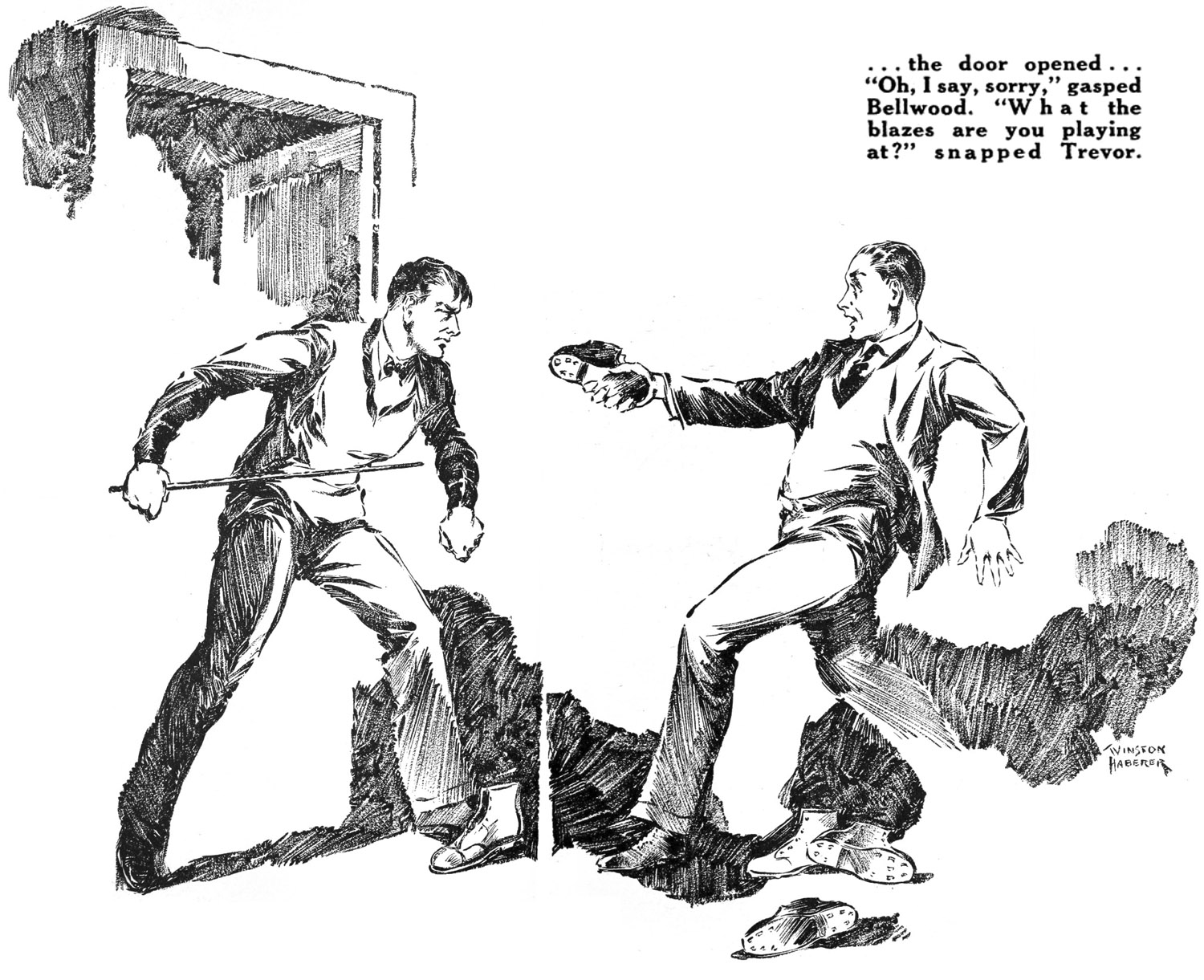
“What the blazes are you playing at?” asked Trevor.
“I’m frightfully sorry,” said the demoralized Bellwood; “I thought you were Dixon.”
“And why should you fling boots at Dixon?”
Bellwood, not feeling equal to the explanation that it was the mission in life of people like Dixon to have football boots thrown at them, remained silent; and Trevor, having summed up Bellwood’s character in an address in which the words, “skunk, worm” and “disgrace to the house” occurred with what seemed to the recipient of the terms unnecessary frequency, dragged him into the study, produced a stick, and taught him in two minutes more about the folly of throwing football boots at other people’s doors than he would have learned in a month of verbal tuition.
BELLWOOD slunk away down the passage, and halfway to his own study met Davies, released from the form-room and full of his grievances.
To judge from his remarks, Davies did not think highly of Mr. Grey, his form-master. Mr. Grey, in his opinion, was a person of the manners-none-and-customs-horrid type. He had a jolly good mind, had Davies, to go to the headmaster about it.
In a word, Davies was savage. Bellwood, eyeing his wrathful friend, was struck with an idea. Trevor’s stick had stung like an adder.
“Beastly shame,” he agreed, as Davies paused for breath. “It was jolly slow for me, too. I’ve been putting in the time having a lark with old Dixon. I can’t get him to come out, though I’ve been flinging boots. And his door won’t open. I believe he’s locked it.”
“Has he, by Jove!” muttered Davies; “we’ll soon see about that. Stand out of the way.”
He retired a few paces and charged towards the door. Bellwood took cover in study twelve, the owner of which happened to be out, and listened.
He heard the scuffle of Davies’ feet as he dashed down the passage. Then there was a crash as if the house had fallen. He peeped out. Davies’ rush had taken the crazy door off its hinges, and he had gone with it into the study. He had a fleeting view of an infuriated Trevor springing from the ruins. Then, with Davies’ howl of anguish ringing in his ears, he closed the door of study twelve softly, and sat down to wait till the storm should have passed by.
AT THE end of a couple of minutes somebody limped past the door. The remnants of Davies, he guessed. He gave him a few moments in which to settle down. Then he followed, and found him in a dishevelled state in their study.
“Hullo,” he said artlessly, “what’s up? What happened? Did you get the door open?”
Davies glared suspiciously, scenting sarcasm, but Bellwood’s look of astonishment disarmed him.
“Where did you go to?” he inquired.
“Oh, I strolled off. What happened?”
Davies sat down, only to spring up again with a cry of pain. Bellwood recognized the symptoms, and felt better.
“I took the beastly door clean off its hinges. I’d no idea the thing was so wobbly.”
“Well, we ragged it a bit the other night, you remember. It was a little rocky then. Was Dixon sick?”
“Dixon! Why, Dixon wasn’t in there at all. It was Trevor—of all people! What the dickens was he doing there, I should like to know?”
Bellwood’s look of amazement could not have been improved upon.
“Trevor!” he exclaimed. “Are you sure?”
“Am I sure! Oh, you—!” words failed Davies.
“But what was he doing there?”
“That’s what I should like to know.”
IT WAS really quite simple. Clowes had told the head of the house of Dixon’s painful case, and suggested that if he wished to catch Bellwood and his friend “on the hop,” as he phrased it, an excellent idea would be to change studies secretly with Dixon. This Trevor had done, with instant and satisfactory results. The ambush had trapped its victims on the first afternoon.
Study Sixteen continued to brood over its misfortunes.
“Beastly low trick changing studies like that,” said Davies querulously.
“Beastly,” agreed Bellwood.
“That worm Dixon must have been in it. He probably suggested it to Trevor. And now he’ll be grinning over it.”
This suspicion was quite unfounded. Dixon had probably never grinned in his life.
“I tell you what,” said Bellwood suddenly, “if they’ve changed studies, Dixon must be in Trevor’s den now. He’s always in the house at this time. He starts swotting directly after school. What’s the matter with going and routing him out and ragging him now? He wants it taken out of him for letting us down like that. Come on.”
“We’ll heave books at him,” said Davies with enthusiasm.
And the punitive expedition started.
TREVOR’S study was in the next passage. They advanced stealthily to the door and listened. Somebody coughed inside the room. That was Dixon. They recognized the cough.
“Now,” whispered Davies, “when I count three!”
Bellwood nodded, and shifted a Hall and Knight’s algebra from his left hand to his right.
“One, two, three.”
He turned the handle sharply and flung open the door. At the same moment Bellwood heaved his algebra. It was a snapshot, but Dixon, sitting at the table outlined against the window, made a fine mark.
“Oh, I say!” cried Dixon, as the corner of the projectile took him on the ear.
“Go on,” shouted Davies from behind the door, as Bellwood paused with Victor Hugo’s “Quatrevingt-treize” poised. “Sling it in!”
But Bellwood did not throw. The book dropped heavily to the floor. Just as his first shot found its mark he had caught sight of Trevor, seated in a deck chair by the window, reading a novel.
Finding Dixon’s study somewhat uncomfortable after Davies had removed the door, he had taken his book to his own den, where he could read in peace (so he thought) without disturbing Dixon’s work.
This third attack was the last straw. The matter had become too serious for summary treatment. He must think out a punishment that would fit the crime.
It flashed upon him almost immediately.
“LOOK here,” he said, “this is getting a bit too thick. You two chaps think you can do just as you like in the house. You’re going to find that you can’t. You’re no good to Donaldson’s. You shirk games. You do nothing but eat like pigs and make bally nuisances of yourselves. So you can just choose. I’m going out for a run in a few minutes. You can either come, too, and get into training and play for the house second against Seymour’s, or you can take a touching-up in front of the whole house after tea.”
Davies and Bellwood looked blankly at one another. Could these things be? For three years they had grown up together like two lilies of the field; they had toiled not, neither had they spun. For three years the only form of exercise they had known had been the daily walk to the school shop. And here was Trevor offering them, as the sole alternative to a house licking, a beastly, violent run. And Trevor was celebrated for the length of his runs when he trained, and also for the rapidity of the same. The thing was impossible. It couldn’t be done at any price. Davies bethought him of the excuse which had stood by him so well for the past three years. This was just one of those emergencies for which it had been especially designed. But even as he spoke he could not help feeling that Trevor was not in just the proper frame of mind for medical gossip.
“But,” said Davies, “our doctor’s certificates. We aren’t allowed to play footer.”
“Doctor’s certificates! Rot! You’d better burn them. Well, are you coming for the run?”
Bellwood clutched at a straw.
“But we’ve no footer clothes,” he said.
“You’d better borrow some, then. If you aren’t back in this study, changed, by half past five, you’ll get beans. Now get out.”
At ten minutes past five a tentative knock sounded on the door. Trevor opened it. There stood the tenants of study sixteen garbed in borrowed football shirts and shorts.
OF THE details of that run no record remains. The trio started off in a south-easterly direction, along the road which led to Little Poolbury. From this it may be deduced that the spin was not a short one. Whenever Trevor had chosen this direction for one of his training runs on previous occasions he had worked round through Little Poolbury to Much Wenham by road, then across difficult country (ploughed fields, brooks, and the like) to Burlingham, and then back to the school along the high road, the whole distance being between four and five miles. There is no reason for supposing him to have chosen another route on this occasion.
At any rate, as six struck from the college clock, a procession of three turned the corner of the road which ran past the school. Bellwood headed the procession. He was purple, moist and muddy, and he breathed in heavy gasps. A yard behind him came Davies in a similar condition, if anything, a shade worse. At the tail of the procession came Trevor, who looked as fresh as when he had started. He wore a pleasant smile. They passed in at Donaldson’s gate, and were lost to view.
Study sixteen was subdued that night, but ate an enormous tea, and looked ninety per cent fitter than it had done for years.
And in the last paragraph of the one hundred and eighteenth page of the eleventh volume of the “Wrykynian,” you will find these words to be written: “Inter-House Cup (Second Fifteens), Final. Donaldson’s v. Seymour’s.—This match was played on Saturday, March 10th, and resulted in a win for the former, after a good game by one goal and two tries to a penalty goal. For the winners Kershaw played well at half, and Smith in the center. The pick of the forwards were Bellwood and Davies. The latter’s try was a clever piece of play. For Seymour’s . . .”
But that’s all.
Note:
Printer’s error corrected above:
Magazine, p. 98a, had “the exact spot which”; “on” inserted from the original appearance in Royal.