 Madame Eulalie’s Rare Plums
The Strand Magazine, December 1930

THE FIRST CHAPTERS.
Berry Conway’s only assets are a copper mine, of no account, and a longing for Adventure, unrealizable so long as he lives with his old nurse in the suburb of Valley Fields. Berry is the secretary of T. Paterson Frisby, an American financier. Frisby’s niece, Ann Moon, has become engaged to Berry’s friend, Lord Biskerton (“the Biscuit”), the creditor-harried son of the equally hard-up Lord Hoddesdon. Lord Hoddesdon’s sister, Lady Vera Mace, is chaperoning Ann Moon during her stay in London. “The Biscuit,” heavily disguised in a false beard for fear of meeting his creditors, lunches at the Berkeley, where also his fiancée is lunching. Berry, who is in the restaurant as well, falls in love with Ann Moon at first sight, and afterwards, in order to strike up an acquaintance with her, jumps into her car and tells her that he is a Secret Service man and she is to follow the car ahead. This is being driven by the disguised Biscuit, who, Berry says, is a dangerous criminal called the Sniffer. The Biscuit stops at an inn. Leaving Ann outside, Berry goes after his friend and discovers his identity. He persuades the Biscuit to abandon his disguise and to hide from his creditors by living in the vacant house next door to Berry’s. To explain his absence to his fiancée a tale is to be spread that he has developed mumps. Berry comes out of the inn to find Ann and her car gone.
CHAPTER V.
i.
ABOUT the entry of Lord Biskerton into the suburb which was to be his temporary home there was nothing that savoured even remotely of the ostentatious or the spectacular, no suggestion whatever of a conquering king taking seisin of subject territory. He behaved from the start like one desirous of attracting as little attention to himself as possible. A purist might even have considered him furtive.
Having partaken of an early lunch at his club, he stole out on to the front steps, looked keenly up and down the street with his hat well over his eyes, and then, leaping into a passing taxi, drove to Victoria, where he caught the 1.59. Only when the train rolled out of the station did he allow himself to relax. Unless Dykes, Dykes, and Pinweed were hiding under the seat, he was now safe.
Valley Fields, when he reached it a short while later, came as an agreeable surprise. Essentially urban in his prejudices, the Biscuit had always thought of the Surrey-side suburbs, when he thought of them at all, as grim and desolate spots where the foot of white man had not trod nor the Gospel been preached. Valley Fields, sunlit and picturesque, struck him as distinctly jolly. With its pleasant gardens and leafy trees, it had something of the air of a village, and he was puzzled to see what there was about the place to arouse his friend Berry Conway’s dislike. It was in excellent humour that he called at the offices of Messrs. Matters and Cornelius, House Agents, for the keys of his new domain.
Mr. Cornelius welcomed him paternally. He was an old gentleman of Druidical aspect with a long white beard at which the Biscuit, that connoisseur of beards, looked with respectful envy. Full of patriotic spirit where Valley Fields was concerned, Mr. Cornelius approved of those who wished to come and live there.
“A most desirable property,” he assured the Biscuit. “A bijou bower of verdure. The house is a beautifully-appointed modern residence, fitted with every up-to-date convenience, and in perfect order.”
“Company’s own water?” asked the Biscuit, keenly.
“Certainly.”
“Both H. and C.?”
“Quite.”
“The usual domestic offices?”
“Of course.”
“And how about the estate?”
“Peacehaven,” said Mr. Cornelius, “has parklike grounds extending to upwards of an eighth of an acre.”
“What happens if you get lost?” asked the Biscuit, interested. “I suppose they send St. Bernard dogs in after you.”
He proceeded on his way and came presently to his journey’s end, Mulberry Grove. And his contentment deepened. For his eye, as he approached, was caught by what appeared to be a most admirable pub just round the corner. He went in and tested the beer. It was superb. Every explorer knows that the most important thing in a strange country is the locating of the drink supply; and the Biscuit, satisfied that this problem had been adequately solved, came out of the hostelry with a buoyant step, and a moment later the full beauties of Mulberry Grove were displayed before him.
Mulberry Grove was a tiny cul-de-sac, bright with lilac, almond, thorn, rowan, and laburnum trees. There were only two houses in it—Castlewood (detached) and a building of the same proportions next door which some years earlier had been converted into two semi-detached residences, The Nook and Peacehaven. The other side of the road was occupied by a strip of ornamental water, with two swans on it—reading from left to right, Egbert and Percy. And the general effect of rural seclusion was completed by the fact that the back gardens of the houses terminated in the verdant premises of the Valley Fields Lawn Tennis Club. There was, in short, a pastoral charm about the place which made it absolutely impossible for you to believe that you were only seven miles from Hyde Park Corner—or if a crow, only five.
Nothing marred the quiet peace of Mulberry Grove. No policeman ever came near it. Tradesmen’s boys, when they entered it on tricycles, hushed their whistling. And even stray dogs, looking in with the idea of having a bark at the swans, checked themselves with an apologetic cough on seeing where they were and backed out respectfully.
The Biscuit was well pleased with the place.
“O. jolly K.,” he said to himself.
And, pausing for an instant to throw a banana skin at the swan Percy, who had stretched out his neck and was making a noise like an escape of steam and appeared generally to be getting a bit above himself, he passed on and came to a gate on which was painted in faded letters the word:—
PEACEHAVEN.
Peacehaven was a two-storey edifice in the Neo-Suburbo-Gothic style of architecture. A merciful rash of ivy had broken out over one half of the building, and a nice box hedge ran along the front fence. Substantial laurel bushes stood here and there, and there were flowers bordering the short snail-walk which Mr. Cornelius would most certainly have described as a sweeping carriage drive.
TO the right, shaded by a rowan tree, was a latticed door, leading apparently to the back premises. And the Biscuit, with a Nature-lover’s eagerness to set his eye roaming over the parklike grounds, made for it immediately.
He passed through and, having passed, paused, not exactly spellbound but certainly surprised. Digging energetically in one of the borders with a spade not so very much smaller than herself was a girl.
Nothing in Mr. Cornelius’s conversation had prepared the Biscuit for girls in the parklike.
“Hallo!” he said.
The digger ceased to dig. She looked up, and straightened herself.
“Hallo!” she replied.
A man who has so recently become engaged to be married as Lord Biskerton has, of course, no right to stare appreciatively at strange girls. But this is what the Biscuit found himself doing. The fact that Ann Moon had accepted his hand had done nothing to impair his eyesight, and he could not fail to note that this girl was an exceptionally pretty girl. Her blue eyes were resting on his; and what the Biscuit felt was, as far as he was concerned, let the thing go on.
Something—perhaps the fact that she was a blonde and he a gentleman—seemed to draw him strangely to this intruder.
“Are you anybody special?” he asked. “I mean, do you go with the place?”
“Are you Mr. Smith?”
“Yes,” said the Biscuit.
“Pleased to meet you,” said the girl.
Her voice had that agreeable intonation which he had noticed in a slighter degree in the voice of his betrothed.
“You’re American, aren’t you?” asked the Biscuit.
She nodded, and a bell of gold hair danced about her face. Very attractive the Biscuit—quite improperly—thought it. At the same time she made an observation which was neither “Yep,” “Yup,” nor “Yop,” but a musical blend of all three.
“I’ve just come over from America,” she said.
This was undoubtedly the moment at which the Biscuit should have been frank and candid. “Aha?” he should most certainly have remarked in a casual tone. “An odd coincidence. My fiancée is also American.”
Instead of which, he said:—
“Oh? And how were they all?”
“I’m visiting with my uncle at Castlewood,” said the girl. “Over there,” she indicated with a sideways shake of the golden bell. “I came over the fence. Your garden looked awful. It hadn’t had a thing done to it in weeks, I should think. If there’s one thing that gives me the megrims, it’s a neglected garden. I’ve been trying to get it straight.”
“Frightfully good of you,” said the Biscuit. “The real Girl Guide spirit. I’m glad you like gardening. I fancy it’s going to be one of my hobbies. We must do a bit of spade and trowel work together.”

“You’re just moving in, aren’t you?”
“Yes. My things came down the day before yesterday. I expect old Berry has fixed them all up neatly by now. He said he would.”
“Berry?”
“Squire Conway. Of The Nook. His property marches with mine.”
“Oh? I haven’t met Mr. Conway.”
“Well, you’ve met me,” said the Biscuit. “Isn’t that enough of a treat for a small girl about half the size of a peanut?”
He paused. He perceived that he was allowing his tongue to run away with him. A newly-engaged man, conversing with blue-eyed girls, should be austerer, more aloof.
“Nice day,” he said, primly.
“Fine.”
“Making a long stay over here?”
“I shouldn’t wonder.”
“Capital!” said the Biscuit. “And what might the name be?”
“What name?”
“Yours, of course, fathead. Whose did you think I meant?”
“My name is Valentine.”
“And the Christian name, for purposes of informal chat?”
“Kitchie.”
“Caught cold?” asked the Biscuit.
“I was telling you my name. It’s Kitchie.”
Something of sternness crept into the Biscuit’s gaze.
“You needn’t think that just because I’ve got one of those engaging, open faces you can kid me,” he said. “I’m pretty intelligent, let me tell you, and I know the difference between a name and a sneeze. Nobody could possibly be called Kitchie.”
“Well, I am. It’s short for Katherine. What’s your first name?”
“Godfrey. Short for William.”
“Well,” said the girl, who during these conversational exchanges had been eyeing his upper lip with some intentness, “let me just tell you one thing. You ought to do something about that moustache of yours—either let it grow or cut it off. At present it makes you look like Charlie Chaplin. If you’ll excuse me being personal.”
“Replying to your remarks in the reverse order,” said the Biscuit, “be as personal as you desire. If two old buddies like us can’t be frank with one another, who can? In the second place, I see no harm in resembling Charlie Chaplin, a man of many sterling qualities whom I respect. Thirdly, I am letting it grow—in moderation and within due bounds. These points settled, tell me how you like England. Enjoying your visit, are you? Glad you came?”
“I like it all right. I wish I was back home, though.”
“Oh? Where’s that?”
“Great Neck, New York.”
“What an extraordinary girl you must be! Here you are, having an absorbing conversation with one of the best minds in Valley Fields—and that best mind, mark you, wearing a new suit made by the finest bespoke tailor in London—and you say you wish you were elsewhere. Inexplicable! What is there so wonderfully attractive about Great Neck?”
Kitchie’s blue eyes clouded.
“Mer’s there,” she said.
“Ma? Your mother, you mean?”
“I didn’t say Ma. I said Mer. Merwyn Flock. The boy I’m engaged to. Dad got sore because Mer’s an actor, and he sent me over to England to get me away from him. Now do you understand?”
The Biscuit understood. Yet, oddly, he was not pleased. To an engaged man the news that a golden-haired, blue-eyed girl he has just met is an engaged girl ought to be splendid news. It ought to make him feel that he and she belong to a great fellowship. He ought to feel like a brother hearing joyful tidings about a sister. Lord Biskerton felt none of these things. Utterly immersed though he was in a whole-hearted worship of his fiancée, the information that this girl before him was also betrothed made him feel absolutely sick.
“Merwyn Flock!” he said, and clenched his teeth to say it.
“You ought to hear Mer play the uke!”
“I don’t want to hear Mer play the uke,” said Lord Biskerton, vehemently. “I wouldn’t listen to him playing the uke if you paid me. Merwyn! Ha!”
“That’s all right, you standing there saying ‘Merwyn,’ ” said Miss Valentine, with equal warmth. “It’s a darned sight better name than Godfrey.”
IT struck the Biscuit that he was allowing the tone of the conversation to become acrimonious.
“I’m sorry,” he said. “Don’t let’s quarrel. Cheer up, half-portion, and let us speak of other things. Tell me your impressions of England. What’s it like living at Castlewood? Jolly? Festive?”
“Not so very. And I expected it would be a bigger place. When I was told I had an uncle living in a house called Castlewood, I thought it was going to be a sort of palace.”
“Well, so it is. It’s got a summer-house, and a bird-bath. What more do you want? And, if you’re disappointed, what about me? What’s become of the civic welcome I was entitled to expect? Where are the villagers?”
“What villagers?”
“I always understood that a chorus of villagers turned out on these occasions to welcome the new squire with dance and song. It won’t be long before I find myself believing that I have no seigneurial rights at all. How about that, by the way?”
“What about it?”
“Well, for one thing, as I came along here I noticed a sort of lake or mere across the road. Do I own the fishing? And the swanning, what of that? I shall most certainly want to have a pop at those swans with my bow and arrow very shortly.”
The girl was looking at him earnestly.
“You know,” she said, “when you talk quick, you remind me of Mer. His nose twitches like that.”
It was on the tip of Lord Biskerton’s tongue to say something so scathing and devastating about Mer that the friendship ripening between this girl and himself would have withered like a juvenile crocus in an early blizzard. At this moment, however, he perceived out of the corner of his eye that strange things were going on in Castlewood.
“I say,” he said, directing his companion’s attention to these phenomena, “there’s an extraordinarily ugly little devil in an eyeglass next door, glaring and waving his hands at one of the windows.”
“That’s my uncle.”
“Oh? I’m sorry.”
“It isn’t your fault,” said the girl, kindly.
The Biscuit surveyed the human semaphore with interest.
“What is it? Swedish exercises?”
“I expect he wants me to come in. Now I remember, when I said I was thinking of coming over into your garden, he told me that I wasn’t on any account to stir a step till he had called on you and seen what you were like. I suppose I’d better go.”
“But I was just going to ask you to come in and see my little home. I expect there are all sorts of things in it that call for the feminine touch.”
“Some other day. Anyway, I’ve some letters to write. A girl I met on the boat has just got engaged, I see in the paper. I must write and congratulate her.”
“Engaged?” said the Biscuit, gloomily. “It seems to me that the whole bally world is engaged.”
“Are you?”
“Me?” said the Biscuit, starting. “I say, I think you had better rush. Uncle seems to be hotting up.”
He stood where he was for a moment, admiring the nimble grace with which his small friend shinned over the fence. Then, pondering deeply, he made his way into the house to ascertain what sort of a dump this was into which Fate and his creditors had thrust him.
That night, smoking a friendly cigarette with his next-door neighbour, John Beresford Conway, of The Nook, Lord Biskerton, somewhat to his companion’s surprise, spoke with warm approbation, rising at times to the height of enthusiasm, of the home-life of the Mormon elder.
A Mormon elder, said the Biscuit, had the right idea. His, he considered, was the jolliest life on earth. He also stated that in his opinion bigamy, being, as it were, merely the normal result of a generous nature striving to fulfil itself, ought not to be punishable at law.
“And what you’ve got against Valley Fields, old boy,” he said, “is more than I can see. I don’t know when I’ve struck a place I liked more. I consider it practically a Garden of Eden, and you may give that statement to the Press, if you wish, as coming from me.”
He then relapsed into a long and thoughtful silence, from which he emerged to utter a single word.
It was the word “Merwyn!”
CHAPTER VI.
i.
IT was hardly to be expected that Lord Biskerton’s disappearance from his customary haunts should have gone unnoticed and unmourned by the inhabitants of his little world. Hawes and Dawes felt it deeply. So did Dykes, Dykes, and Pinweed and the rest of his creditors. They or their representatives called daily at the empty nest, only to be informed by Venner, the Biscuit’s trusted manservant, that his lordship had left Town and that it was impossible to say when he would return.
The Earl of Hoddesdon was another of those whom the young man’s flight distressed. He went round to see his sister about it.
“Er—Vera,” he said. “I came to discuss this lunacy of Godfrey’s.”
“It is annoying that Godfrey should have got mumps,” said Lady Vera, who was a fair-minded woman, “but I fail to see——”
“I’ve been round to Godfrey’s flat and I’ve got the truth out of that man of his, that fellow Venner,” said Lord Hoddesdon. “The boy hasn’t got mumps. He’s living down in the suburbs.”
“Living down in the suburbs?”
“Living down in the suburbs. Under the name of Smith. At Peacehaven, Mulberry Grove, Valley Fields. Venner told me so. He’s forwarding letters there.”
“Is he mad?” cried Lady Vera.
“No,” Lord Hoddesdon was forced to admit. “He’s doing it to keep from being county-courted by, as far as I can make out, about a hundred tradesmen. As far as that goes, his conduct is sensible. What is the behaviour of a lunatic is this telling the girl he’s got mumps.”
“I don’t understand what you mean.”
“Why, use your intelligence, dash it. She must have accepted him from some sort of passing whim, and it was vital that he refrained from doing anything to make her think it over and regret. And he goes and tells her he’s got mumps. Mumps! Of all infernal, loathsome things. How long do you think that girl is going to cherish her dream of a knightly lover, when every time she thinks of him it is to picture a hideous object with a face like a football, probably with flannel wrapped round it?”
“George!”
“It’s maddening. I shouldn’t wonder if the girl hasn’t changed her mind already. You’ve been seeing her every day. How is she? Thoughtful? Have you caught her musing lately? Meditating? Like a girl who’s been turning things over in her mind and has come to the conclusion that she has made a grave mistake?”
Lady Vera started.
“It’s odd that you should say that, George. She has been thoughtful lately, very thoughtful.”
“Good God!”
“Yes. I have noticed it. Several times lately, when we have been dining quietly at home, I have seen a curious, pensive expression come into her face. As if she were dreaming some beautiful dream.”
“But, dash it, that’s all right, then. I mean, if all she is doing is dreaming beautiful dreams——”
Lady Vera crushed his rising hopes. Her face was very grave.
“But, George, consider. Would a girl who was thinking of Godfrey look as if she were dreaming a beautiful dream?”
“Good Lord, no. That’s right. You mean——?” exclaimed his lordship, quivering from head to foot as the frightful significance of his sister’s words came home to him. “You don’t mean——?”
Lady Vera nodded sombrely.
“Yes, I do. I think Ann has met somebody else.”
“Don’t say such awful things, Vera!”
“Well, I really do believe that is what has happened. She gave me the impression of a girl who was wondering about something. And what would she have to wonder about except whether she had made a mistake in accepting Godfrey and wouldn’t be doing better to break the engagement and leave herself free to marry this new man?”
LORD HODDESDON fought stoutly against a sea of fears.
“Don’t talk of ‘this new man’ as if he really existed. You can’t know. You’re only guessing.”
“I have a woman’s intuition, George. Besides——”
“But who could it be? Where would she have met him? I know she goes out to lunches and dinners and dances every day, and meets a thousand men, but they’re all exactly like Godfrey. I can’t tell these modern young fellows apart. Nobody can. They all look alike and think alike and talk alike. It’s absurd to suppose that any one of them could suddenly exercise an overwhelming spell over her. If she had been to a prize-fight or something and had conceived a sudden passion for some truck-horse of a chap just because his muscles bulged, I could understand it. But why should a girl want to change one Biskerton for another Biskerton? When I said just now that she might be thinking of breaking the engagement, it never occurred to me that she could be planning to marry anybody else. I simply feared that she might give Godfrey his congé and go back to America.”
“Well, let me tell you a very curious thing, George. You remember the day you took Ann to lunch at the Berkeley?”
“What about it?”
“I happened to meet Lady Venables that night, and she asked me who the young man was that she saw driving along Piccadilly with Ann in her car. She said it was nobody she knew, and she knows every young man in London.”
“What!”
“A very good-looking man, she said, with a strong, handsome face. She was certain he wasn’t anybody she had ever met. And, as I say, Lady Venables gives so many parties, trying to get Harriet off, poor dear, that by this time in the Season there isn’t a single young man anywhere in Mayfair that she doesn’t at least know by sight. She takes a regular census and works through it. So, if she really did see Ann with anyone, it must have been somebody no one knows anything about—this prize-fighter of yours, for instance.”
Lord Hoddesdon had been pacing the floor. He sat down abruptly.
“You’re making my flesh creep, Vera!”
“I’m sorry. I’m simply telling you.”
“And Godfrey supposed to be in bed with mumps! What are we to do?”
“The first thing is obviously to see Godfrey and tell him of the risk he is running by staying away of losing Ann altogether. I think that, tradesmen or no tradesmen, he ought to come back.”
“How can he come back? The girl thinks he’s ill in bed.”
“He could say that the doctor found he had made a mistake. Lots of things look like mumps at first. Toothache makes your face swell.”
“But what about all these fellows who want to county court him?” asked Lord Hoddesdon.
“Something could be arranged about that. Surely, now that they know that he is engaged to the daughter of a millionaire——”
“Yes, that’s true.”
“Well, he must at least get in touch with Ann again, and immediately. So that he can at any rate write to her. Perhaps if she kept getting letters from him it would help. I think he ought to tell her that he has had to go to Paris. Perhaps he might really go to Paris, and then she could go to Paris, too.”
“Where’s the money to come from?”
“I could manage that.”
“You could?” said Lord Hoddesdon, eagerly. “Then, while we are on the subject——”
“No,” said Lady Vera, firmly. “I said I could manage enough to send Godfrey to Paris, but I refuse to subsidize you, George.”
“I only want twenty pounds.”
“When you leave this flat, you will still be wanting it.”
Lord Hoddesdon took a pull at his moustache.
“Then, shelving that for the moment,” he said, “you think I ought to go and see Godfrey?”
“I consider it essential. Ann is a very impulsive girl, and even now it may be too late. Go down to Valley Fields at once and see him personally.”
“And the money for the taxi?”
“What taxi?” said Lady Vera.
She found a railway time-table and began to turn its pages briskly.
“ ‘Frequent trains from Victoria,’ ” read Lady Vera. “So you had better start at once. And do contrive, if you can possibly manage it, not to bungle the thing. The fare, first class, is one and a penny.”
“Oh? You’re sure,” said Lord Hoddesdon bitterly, “you wouldn’t rather I went third class?”
“You must please yourself entirely, George,” said Lady Vera equably. “You will be paying for the ticket.”
ii.
THE manifold beauties of Valley Fields, which had so impressed his son and heir on his first introduction to them, made a weaker appeal to the sixth Earl of Hoddesdon. Lord Hoddesdon’s outlook on life, from the very start of his expedition, had been a jaundiced one, and Valley Fields did nothing to change it. Indeed, his first move on alighting from the train was to give Valley Fields an extremely nasty look. Then, having inquired of the porter at the station the way to Mulberry Grove, he set out thither, thinking dark thoughts.
Pausing at frequent intervals to remove his grey top-hat and dab his forehead with a handkerchief, for the day was warm, he eventually reached Benjafield Road, at the corner of which stands the public-house which had exercised so powerful an attraction for Lord Biskerton on the day of his arrival. Here, having by now completely forgotten the instructions given to him at the station, he came to a halt, feeling lost.
From the spot where Lord Hoddesdon was standing to the gates of Peacehaven was, as it happened, a matter of a few dozen yards. Unaware of this, he looked about him for guidance and observed, his powerful shoulders shoring up the wall of the public-house, a man in a cloth cap. He was sucking thoughtfully at an empty pipe, and he regarded Lord Hoddesdon, as he approached, with a rather unpleasant expression. The fact was, he had taken an instant dislike to his social superior’s grey top-hat. The cloth-capped man, in a muzzy, beery sort of way, took it almost as a personal affront. It was as if he felt that his manhood and self-respect had been outraged by this grey topper.
Between Lord Hoddesdon and the cloth-capped man, therefore, there may be said to have existed an imperfect sympathy from the very start.
“I want to go to Mulberry Grove,” said Lord Hoddesdon.
The man, without shifting his position, rolled an inflamed eye at him. He stared in silence for a while. Then he gave a curt nod.
“Awright,” he said. “Don’t be long.”
Lord Hoddesdon endeavoured to make himself clearer.
“Can you—ah—direct me to Mulberry Grove?”
The eye rolled round once more. It travelled over Lord Hoddesdon’s person searchingly, from head to foot and back again. Reaching the head, it paused.
“What sort of a hat do you call that you’ve got on?” asked the man, coldly. “A nice sort of hat, I don’t think.”
Lord Hoddesdon was in no mood to chat of hats.
“Never mind my hat!” he said, austerely.
The man, however, continued to toy with the theme. Indeed, he harped on it.
“The way you City clurks get yourselves up nowadays,” he said, with evident disapproval, “ ’s enough to make a man sick. They wouldn’t ’ave none of that in Moscow. No, nor in Leningrad. The Burjoisy, that’s what you are, for all your top-’ats. Do you know what would happen to you in Moscow? Somebody—as it might be Stayling—would come along and ’e’d look at that ’at and ’e’d say, ‘What are you doing, you Burjoise, swanking round in a ’at like that?’ and he’d——”
Lord Hoddesdon moved away. There was a small boy standing by the horse-trough in front of the public-house, and to him he now addressed his questioning.
“Which is the way to Mulberry Grove, my little fellow?” he asked, quite amiably for a man with murder in his heart and blood-pressure well above the normal. “I should be much obliged if you would inform me.”
CIVILITY met with civility. His little fellow stopped dabbling his fingers in the water and pointed.
“Dahn there, sir, and first to the left,” he said, politely.
“Thank you,” said Lord Hoddesdon. “Thank you. Thank you.”
He moved off in the direction indicated, casting at the cloth-capped man as he went a look of censure. It is not easy to express very much in a look, but what Lord Hoddesdon wished to convey was that he hoped the cloth-capped man had been listening in on this scene and had been properly impressed by the exemplary attitude of one who, though so many years his junior, might well be taken by him as a model of deportment. A vague idea of returning and giving the suave lad a penny passed through his mind, to be abandoned immediately in favour of the far more sensible and business-like step of going on and doing nothing of the kind. However, he had almost decided to look back and smile at the little fellow, when something exceptionally hard struck him suddenly between the shoulder-blades. It was a flint. And, spinning round, he perceived the youthful Chesterfield in full flight up the road.
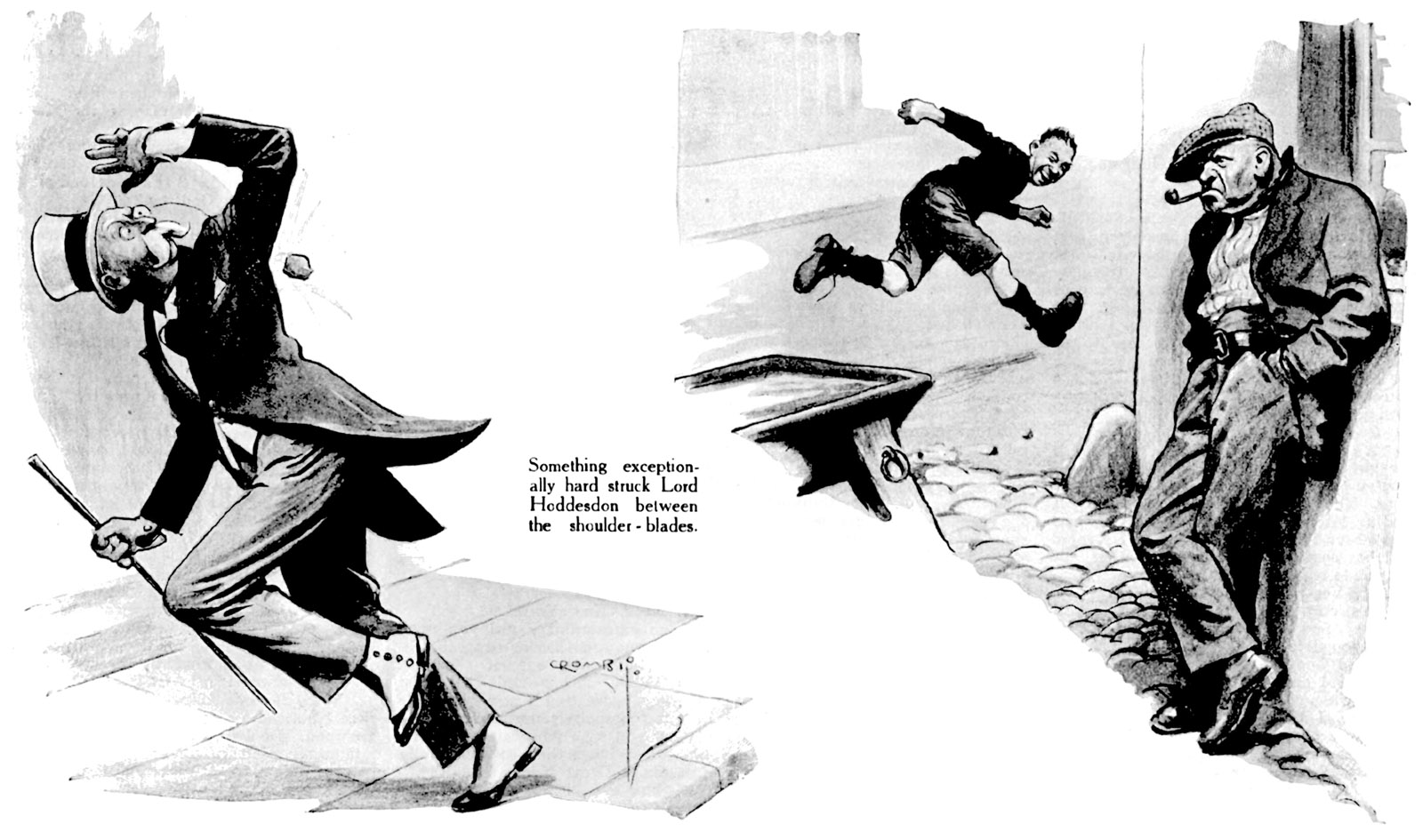
Lord Hoddesdon was dumbfounded. What had occurred seemed to him for an instant incredible. If he had been aware that the polite stripling and the man in the cloth cap were son and father, he would have divined that the same hatred of grey top-hats which animated the father ran also in the blood of the son. It was a simple case of hereditary instinct. But he did not know this. All he thought about the blood of the son was that he wanted to have it, and with this end in view he got smartly off the mark, and, though he had not run for years, was soon pelting up the road at an excellent pace—a pace far too gruelling for the little fellow, whom he overtook in the first few yards.
There are two schools of thought concerning the correct method of dealing with small boys who throw stones at their elders and betters in the public street. Some say they should be kicked, others that they should be smacked on the head. Lord Hoddesdon, no bigot, did both. And for a man who had not smacked head or kicked trouser-seat since his early days at Eton he acquitted himself remarkably well. For the space of about half a minute he worked vigorously; then, turning, somewhat out of breath, he retraced his steps and resumed the trek to Mulberry Grove.
He felt strangely elated. It was as if some healing balm had been applied to his bruised soul. For the first time that afternoon he was conscious of being quietly happy, when a voice spoke at his side.
“ ’Oy!” said the voice.
It was the cloth-capped man. He had put his pipe away, and was walking by Lord Hoddesdon’s side, smelling strongly of mixed ales. His eyes were bulging, and had in them a red gleam, like fire seen through smoke. From the recent battlefield there came shrilly the wailings of the wounded.
“What did you want to hit the nipper for?” asked the cloth-capped man.
Lord Hoddesdon made no reply.
“What did you want to hit my young ’Erbert for?”
Lord Hoddesdon started a little uneasily. My young ’Erbert? This was the first intimation he had received that ties of relationship linked these two. What had seemed at first merely the inquisitiveness of a stranger took on a more sinister significance when it became the muttered outpourings of a father’s heart. From the corner of his eye he flashed a glance at his companion, and wished that it had not been so easy to see him. There was, he perceived, a great deal of this man.
He quickened his steps. He had become now uneasily aware of the deserted nature of the ground he was covering. There was not a policeman in sight. In a place like this, he reflected bitterly, there would probably be only one policeman, and he would probably be asleep somewhere instead of doing his duty and busying himself in the interests of the public weal. For a moment, in his shrinking mind, Lord Hoddesdon became rather mordant about the police force of the suburbs.
But he was not able to think long about anything except this unpleasant-looking man, who continued to walk step by step with him. Incoherent mutterings had now begun to proceed from this person. His lordship caught the words “City clurk” and “Burjoisy,” repeated far too often for his peace of mind. In any circumstances, for he was a man of haughty spirit, he would have resented being taken for a City clerk; but the misapprehension was particularly disquieting now, for his companion was only too obviously a man who entertained a strong dislike for City clerks. This became sickeningly manifest when he began to speak with a sort of gloating note in his voice of knocking their heads off and stamping them into the mud, even if—or, perhaps, even more strongly because—they went swanking about in grey top-hats. That, as far as Lord Hoddesdon was able to follow his remarks, was, it appeared, the way Stayling would have behaved in Moscow, and what was good enough for Stayling was, the cloth-capped man frankly admitted, good enough for him.
It was at the point where the other, struck with a new idea, had begun to waver between stamping him into the mud and impaling him on the railings which decorated the farther side of the pavement that Lord Hoddesdon, who for some little time had been covering the ground in a style which would certainly have led to his disqualification in a walking race, definitely and undisguisedly broke into a run. They had turned the corner now, and had come in sight of houses; and it seemed to him that inside one of those houses sanctuary might be obtained.
With a sudden, swift movement Lord Hoddesdon’s rapid walk turned into a gallop.
It is curious to reflect how often in life Fate chooses the same object as a means towards two quite opposite ends. It was Lord Hoddesdon’s grey top-hat which had placed him in this very delicate situation, and it was this same top-hat which now for the moment extricated him from it. For, even as he started to run, it leaped from his head and rolled across the road, and his companion, sternly set though his mind was on the Holy War before him, was humanly frail enough not to be able to resist the lure. The hat went bouncing away, and the cloth-capped man, after but a second’s hesitation, charged in pursuit.
He cornered the hat in the gutter and kicked it. He followed it to where it lay and kicked it again. Finally, he jumped upon it with both feet and then kicked it for the third time. This done, he looked round, and was aware of its owner’s coat-tails vanishing at a considerable speed through the gate of the last house down the road. Following swiftly, he passed through the gate, which bore upon it the word “Castlewood,” and, finding nothing of interest in the front garden, hastened round to the back.
Here, too, he found only empty space. He paused awhile in thought.
IN moments of extreme peril the mind moves rapidly. In the beginning, Lord Hoddesdon had planned to walk with as great a dignity as he could achieve to one of these front doors, to ring the bell, to ask to see the master of the house, to inform the master of the house that he was being followed in a threatening manner by a ruffian who appeared to be the worse for drink, to be invited into the drawing-room, and to remain there in a comfortable chair while his host telephoned for aid to the police-station. And the entire programme had had to be scrapped at a moment’s notice.
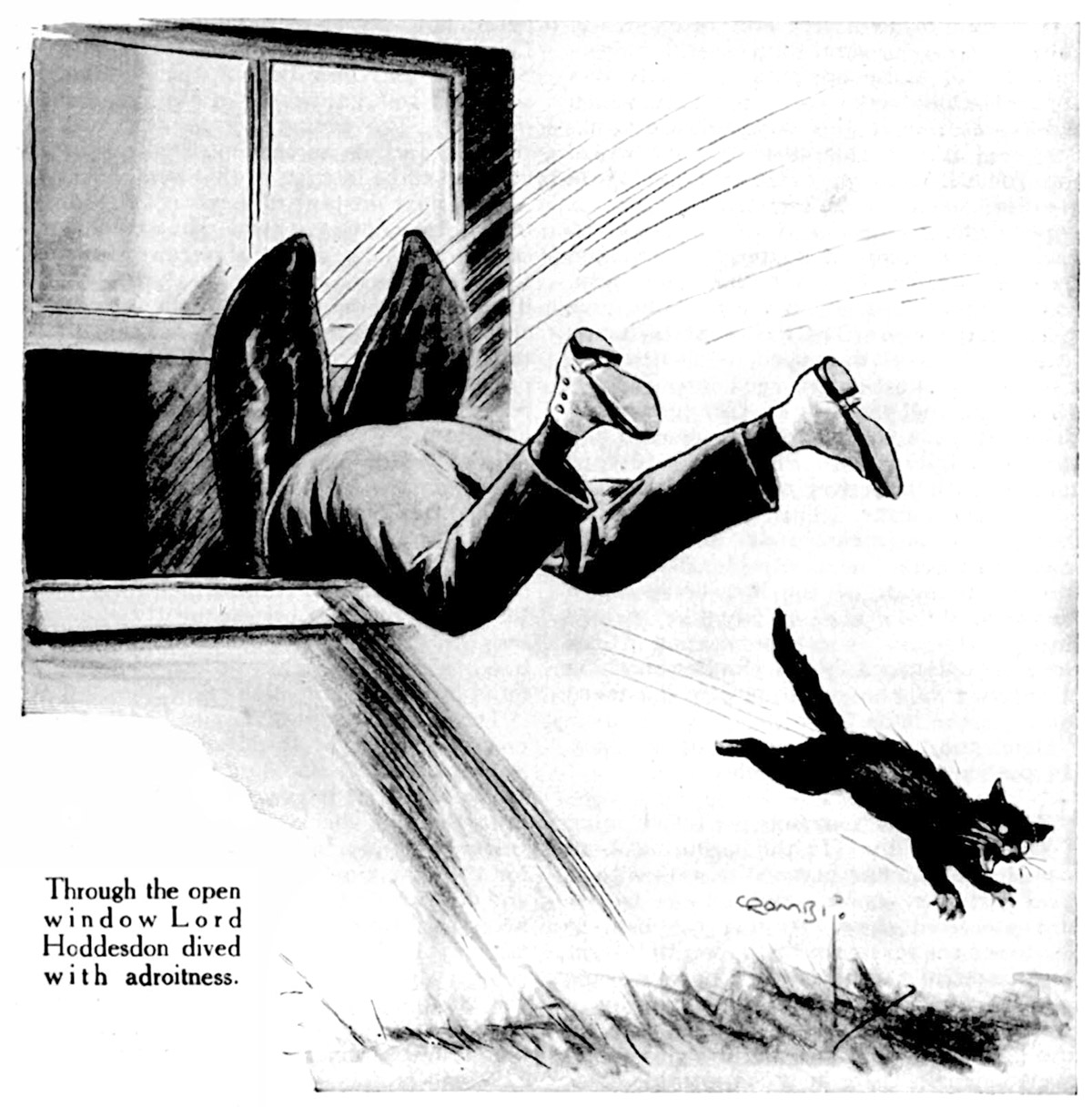
Obviously, there was no time for leisurely ringing of bells. An alternative scheme Lord Hoddesdon had not been able to shape at the moment of his entry into the garden of Castlewood, but it came to him as he rounded the angle of the house and perceived on the ground floor an open window. Through this window he dived with adroitness, and when his pursuer also entered the garden he was lurking on all fours inside the room.
And there for a moment the matter rested.
How long it would have gone on resting, it is difficult to say. The cloth-capped man was a slow thinker, and it might have been some little while before he would have been able to observe and deduce. As it happened, however, an irresistible urge came over Lord Hoddesdon at this moment to raise his head and peer out of the window, to see what was happening in the great world outside. The first thing he saw was his pursuer, and his pursuer most unfortunately chanced to be looking in that very direction.
The next instant the peaceful stillness of Mulberry Grove was shattered by a stern view-hallo, and the instant after that Lord Hoddesdon had banged the window down and bolted it. And then for a space these two representatives of the proletariat and the old régime stood staring at one another through the glass, like rare fishes in adjoining compartments of an aquarium.
Lord Hoddesdon was the first to weary of the spectacle. Hastily withdrawing, he backed out of the room and found himself in a passage. At the end of this passage was the front door, and beside the front door a hat-stand, from which protruded, like heads of the Burjoisy neatly skewered on pikes after the social revolution, divers hats. And at the sight of these his lordship’s mind began working along new lines.
The loss of his grey topper had not until now affected Lord Hoddesdon very deeply. Subconsciously, no doubt, he had been aware of it, but it was only at this moment that the full shock of bereavement really smote him. Seeing these hats, he realized for the first time his own lidless condition, and for the first time appreciated the vital necessity of remedying it. It was his ambition, if he ever got out of this ghastly suburb alive, to return to London. And at the thought of accomplishing that return bareheaded every blue drop of Hoddesdon blood in his veins froze. To go through London’s streets without a hat was unthinkable.
Nevertheless, as he stood scanning the hat-stand with the eyes of a shipwrecked mariner sighting a sail, his heart distinctly sank. Whoever owned this house appeared to have a perfectly astonishing taste in hats. On the three pegs were a cap with purple checks (a thing of pure nightmare), an almost unbelievable something constructed of black straw, and a bowler. It was at the bowler that his lordship directed his gaze. The other two, he saw at a glance, were out of the question.
Even the bowler was not ideal. It was of a type not often met with nowadays, being almost square in shape and flattened down at the top. But it was so distinctly better than the cap and the straw that Lord Hoddesdon did not hesitate. Bounding swiftly forward, he snatched it from its peg. And, as he did so, there came from behind him a roar like that of a more than usually irritable lioness witnessing the theft of one of her cubs.
“Hi!”
Lord Hoddesdon turned as if the word had been a red-hot poker pressed against his form-fitting trousers. He beheld, hurrying swiftly down the stairs, a little man with a mauve face and a monocle.
It was the practice of Major Flood-Smith, of Castlewood, to take a siesta in his bedroom on these warm afternoons. To-day he had been looking forward to uninterrupted repose. His niece Katherine had gone off with that young fellow, Smith, from next door, to a matinée performance at the Brixton Astoria, and he had the house to himself. Well content, he was just dozing off when that view-hallo from the garden had jerked him off the bed like a hooked minnow; and a glance out of the window had shown him a revolting-looking individual in a cloth cap, standing with his nose glued against the window of the morning-room. Pausing only to snatch his Service revolver out of its drawer, Major Flood-Smith had charged downstairs, and he would be damned if here wasn’t another blasted fellow strolling about the hall pinching his hats.
All the householder in Major Flood-Smith was roused.
“You!” he thundered. “What the devil are you doing?”
Unable to speak, Lord Hoddesdon remained standing where he was, holding the bowler.
“Who are you? How did you get in? What are you doing with that hat?” proceeded the Major, decorating the bald questions with a few of the rich expletives which a soldier inevitably picks up in his years of service.
Lord Hoddesdon was still unable to utter, but he was capable of the graceful gesture. With something of old-world courtesy, he replaced the bowler on its peg.
The Major, however, appeared dissatisfied.
“Breaking and entering! In broad daylight! Stealing my hats under my very nose! Well, I’ll be——”
He mentioned some of the things he would be.
Lord Hoddesdon at last found words. But when they came it would have been better if he had remained silent.
“It’s quite all right,” he said.
He could scarcely have selected a more unfortunate remark. Major Flood-Smith’s ripe complexion deepened to a still more impressive purple. He jumped about.
“Quite all right?” he cried. “Quite all right? Quite all right? Quite all right? I catch you in my hall, sneaking my ensanguined hats, and you have the hæmorrhagic insolence to stand there and tell me it’s quite all right. I’ll show you how all right it is. I’ll——”
He stopped abruptly. This was not because he had finished his observations, for he had not. If ever there was a retired Major who had all his music still within him, he was that Major. But at this moment there came from the rear of the house the dreadful sound of splintering glass. It rang out like an explosion, and it spoke straight to the deeps in Major Flood-Smith’s soul.
He quivered from head to foot, and said something sharply in one of the lesser-known dialects of the Hindu Khoosh.
Lord Hoddesdon, though he was not feeling himself, was capable of understanding what had happened. There is a certain point past which you cannot push the freemen of Valley Fields. That point, he now realized, had been reached when he had closed the morning-room window, leaving the cloth-capped man standing outside like a Peri at the gates of Paradise. It is ever the instinct of the proletariat, when excluded from any goal by a sheet of glass, to throw bricks. This the cloth-capped man had now done, and it surprised Lord Hoddesdon that he had not done it sooner. No doubt what had occasioned the delay was the selection of a suitable brick.
Major Flood-Smith was torn between two conflicting desires. On the one hand, he yearned to remain and thresh out with his present companion the whole question of hats. On the other, his windows were being broken.
The good man loves his hat. But he also loves his windows.
Another crash swayed the balance. The windows had it. Barking like a seal, Major Flood-Smith disappeared down the passage, and Lord Hoddesdon, saved at the eleventh hour, snatched at the hatstand, wrenched the front door open, banged it behind him, leaped into the street, and raced madly out of Mulberry Grove in the direction of the railway station.
It was only when he had come in sight of it that he discovered that what he had taken from the stand was the cap with the purple checks.
iii.
“I knew you would bungle it,” said Lady Vera.
CHAPTER VII.
i.
BERRY CONWAY came round the corner into Mulberry Grove and paused outside the gate of The Nook to fumble in his pocket for his latchkey. In the fading sunlight of the summer evening, Mulberry Grove was looking its best and most pastoral. A gentle breeze whispered through the trees; and in the ornamental water, which shone like an opal, one of the swans was standing on its head, while the other moved to and fro in a slow, thoughtful sort of way, like a man hunting for a lost collar-stud. It would seem, in short, almost incredible that anyone could have seen the place at this particular moment without instantly being reminded of the island Valley of Avilion, where falls not hail, or rain, or any snow, nor ever wind blows loudly.
But if this comparison presented itself to the mind of Berry Conway, he gave no sign of it. He eyed Mulberry Grove with dislike. He frowned at the trim little house. At the two swans, Egbert and Percy, he glowered.
THE inexplicable removal from his life of the only girl he had ever loved or could love had made existence a weary affair for Berry these days.
Having found his key, he entered the house and went to his bedroom. There he removed his clothes and, putting on a dressing-gown, proceeded to the bathroom. He splashed about in cold water for a while; then, returning to the bedroom, began to don the costume of the English gentleman about to dine. For to-night was the night of the annual banquet of the Old Boys of his school; and, though since his entry into the ranks of the wage-slaves he had preferred to lead a hermit existence and avoid, as far as was possible, the companions of his opulent days, some lingering sentimentality still caused him to turn out for these functions.
He had just completed his toilet when a knock sounded on the door. He had expected it sooner. He opened the door, congratulating himself, as he did so, that he had finished tying his tie. Otherwise, the faithful old retainer would have insisted on doing it for him.
“I didn’t hear you come in, Master Berry,” said the old retainer, beaming. “How nice you look! Would you like me just to straighten your tie?”
“Go ahead,” said Berry, resignedly.
“I always think a tie looks so different when you straighten it.”
“I know what you mean,” said Berry. “Straighter.”
“That’s it. Straighter. Gladys-at-Castlewood tells me,” said the old retainer, beginning the news bulletin, “that they had burglars there this afternoon. She says she’s never seen the Major look so purple. It was her afternoon out, she says, and when she came home he was walking round and round the garden with a pistol in his hand, muttering to himself. He was very cross, Gladys tells me. Well, I mean, enough to make any gentleman cross having men break into his house and steal his caps.”
“Did somebody steal that cap of the Major’s?” asked Berry, brightening. He had disliked the thing for eighteen months.
“They did, Master Berry. And somebody else broke two of the back windows with a stone.”
“Mulberry Grove is looking up!”
“But it’s all right,” said Mrs. Wisdom, soothingly. “I’ve had a word with Mr. Finbow, and he’s promised to keep an eye on us.”
“Who’s Mr. Finbow?”
“He’s a gentleman in the police, and though Mulberry Grove, he says, isn’t strictly speaking on his beat, he will make a point, he says, of looking in every now and then to see that we are all right. I thought it very civil of him and gave him a slice of cake. Would you like me to get a brush and give you a good brushing. Master Berry?”
“No, thanks,” said Berry, hastily. “I haven’t time. I must hurry. If I miss the six-fifty I shall be late for my dinner.”
“Be careful not to overheat yourself, dear.”
“Don’t worry. I’m not as hungry as all that.”
“I mean to say, it’s so dangerous to sit in a draughty railway carriage with the pores open.”
“I’ll shut them,” said Berry. “Good-bye!”
He charged out of the house, causing his next-door neighbour, Lord Biskerton, to utter a startled cry of admiration. The Biscuit at the moment was engaged in weeding his front garden, a pursuit which, like a good householder, he had taken up with energy.
“Golly!” said the Biscuit, eyeing his friend’s splendour open-mouthed. “Giving the populace a thorough treat, are you not? What is it? Meat tea at Buckingham Palace?”
“O.B. dinner,” explained Berry, briefly. “And if you weren’t a slacker you would be coming too.”
The Biscuit shook his head.
“Never again for me,” he said. “Not any more of those binges for me. I know them too well. The committee of management either stick you in among a drove of dotards who talk across you about the time they were given a half-holiday because of the Battle of Crécy, or else you get dumped down with a lot of kids whose heads you want to smack. And it is a very moot point which of the two situations is the fouler.”
“You won’t come, then?”
“No. I shall remain here and stroll in my garden. Quite possibly little Kitchie Valentine will be strolling in hers, and we will exchange ideas across the fence. I maintain that in the suburbs it is a duty to cultivate one’s neighbours. There is in English life too much of this ridiculous keeping of oneself to oneself. I deprecate it.”
It did not take Berry long, once the company had seated itself in the Oriental Banquet-Room of the Hotel Mazarin in Piccadilly, to realize which of the two alternatives mentioned by the Biscuit was to be his fate to-night. Dotards in considerable force had attended this Old Boys’ dinner, but they were sitting at distant tables. His own was the very heart and centre of the younger set. Boisterous striplings, who all seemed to know one another intimately and to have no desire to know him at all, encompassed him on every side. And gradually, as he watched them, his mood of sombre sadness deepened.
He knew now that he had made a mistake in exposing himself to this ordeal. He was in no frame of mind to suffer gladly beardless juveniles like these. Swollen with soup, they had now begun to rollick and frolic in a manner infinitely distressing to a heart-broken elder. Their infantile frivolity afflicted him more and more every moment with a sense of the passage of the years.
Once, he reflected—how long ago!—he, too, had had spirits like that. Once he, also, had lived in Arcady and thrown bread at Old Boys’ dinners. How far in the distant past all that sort of thing lay now!
Twenty-six next birthday! That was what he was. Twenty-bally-six, and no getting away from it.
And what had he done with his life? Nothing. Apart from being the sort of chump who, when he has the luck to meet the only girl in the world, lets her slip away from him like a dream at daybreak, what had he achieved? Nothing. If he were to pass away to-night—poisoned, let us say, by this peculiar-looking fish which, having died of some unknown complaint, had just been placed before him by an asthmatic waiter—what sort of gap would he leave? An almost invisible one. Scarcely a dimple.
Would that girl regret him? Most unlikely. Would she even remember that she had ever met him? Probably not. A wonderful girl like that met so many men. Why should she have continued to bear in mind so notably inferior a specimen as himself? Such a girl could take her pick of all that was best and brightest of England’s masculinity. Hers was a life spent in the centre of a whirling maelstrom of handsome, dashing devils with racing Bentleys and all the money in the world. What earthly reason had he to suppose that she had ever given him another thought? A doddering wreck like him—twenty-six next birthday. In a flash of morbid intuition he realized now why she had driven off that day and left him flat. It was because she was bored with him and had jumped at the chance of getting away while his back was turned.
He had reached this depth of self-torment and was preparing to go still deeper, when half a roll, propelled by a vigorous young hand, struck him smartly on the left ear. He leaped convulsively, and for an instant forgot all about the girl. In similar circumstances Dante would have forgotten Beatrice. The roll was one of those hard, jagged rolls, and the effect of its impact was not unlike that of a direct hit from a shell. He looked up wrathfully. And, as he did so, a child at the other end of the table, smirking apologetically, applied the last straw.
“Oh, sorry, sir!” cried this babe and suckling. “Frightfully sorry, sir. Most awfully sorry, sir. I was aiming at young Dogsbody.”
BERRY contrived to smirk back, but with an infinite wryness, for his heart was as lead. This, he felt, was the end.
The young germ had called him “Sir.”
“Sir!”
It was what he himself called T. Paterson Frisby, that genuine museum-piece who could not be a day less than fifty.
Now he saw everything. Now he understood. That girl had been civil to him at first because she was a sweet, kind-hearted girl who had been taught always to be polite to Age. What he had mistaken for camaraderie had been merely the tolerance demanded by his white hairs. Right from the start, no doubt, she had been saying to herself, “At the very earliest opportunity I must shake this old buster!” and at the very earliest opportunity she had done so. “Sir!” indeed! How right the Biscuit had been! He should never have been such a fool as to come to this blasted crèche. And the best thing he could do, having come, was to repair his blunder by oiling out immediately.
To leave a public dinner at the height of its fever is not easy, and it is to be doubted whether mere senile gloom, however profound, would have been enough to nerve Berry to the task. But at this moment his eye fell on the table at the top of the room, along which, on either side of the President, were seated some twenty of the elect; and it now flashed upon him that of these at least eight must almost certainly be intending to make speeches. And right in the middle of them, with a nasty, vicious look in his eye, sat a Bishop.
Anybody who has ever attended Old Boys’ dinners knows that Bishops are tough stuff. They take their time, these prelates. Berry hesitated no longer. The banquet had reached the petrified quail stage now, which meant that there was only the hair-oil ice-cream, the embalmed sardines on toast, and the arsenical coffee to go before the dam of oratory would burst. There was not an instant to be lost. He pushed his chair back and sidled furtively to the door. He reached the door and pulled it open. He slid through and closed it behind him.
He was standing now in the main lobby of the hotel. Festive-looking men and women were passing through, some to the dining-room, whence strains of music proceeded, others to the lifts. There seemed to be a dance or some other sort of entertainment in progress upstairs somewhere, for traffic on the lifts was heavy. Revellers were being taken up in dozens, and Berry watched them with a growing feeling of desolation and disapproval. It is not pleasant, when one is face to face with one’s soul, to see a lot of fatheads enjoying themselves.
An unusually large consignment was on the point of starting now. The lift was crammed with perishers of both sexes, the girls giggling and the men what-what-ing in a care-free manner that made him feel sick. So full was it that it scarcely seemed as if there would be room for the girl in the green opera-cloak who was hurrying with her escort across the lobby. But the man at the wheel contrived to squeeze them in somehow, and as the car started on its journey the girl turned to her companion and said something with a smile. And for the first time Berry saw her face.
And, as he saw it, the lobby rocked about him. A wordless exclamation burst from his lips. Reeling, he clutched at a passing waiter.
“Sir?” said the waiter, courteously ceasing to pass.
Berry smiled radiantly at the man. He could only see him through a sort of mist, but he was able to realize that this was by a considerable margin the nicest-looking waiter he had ever set eyes on. And all those people in the lifts—how wrong he had been, he now saw, in thinking of them as perishers. They were in reality a most extraordinarily jolly crowd. And how capital it was to think that they were enjoying themselves so much.
“What’s going on up there?” he asked.
The waiter informed him that Sir Herbert and Lady Bassinger were giving a ball in the Crystal Room on the first floor.
“Ah!” said Berry, thoughtfully. “A ball, eh?”
He handed the man half a crown, and stood for a moment gazing wistfully across the lobby. How splendid, he was thinking, it would have been if only he had been acquainted with these Bassingers. Then they might have invited him.
Berry pulled himself up with a start. He was shocked to find that for an instant he had been allowing himself to fall so far from the standard of a man of enterprise, dash, and resource as to look on a card of invitation as an essential preliminary to the enjoyment of the hospitality of Sir Herbert and Lady Bassinger. But it had been merely a passing weakness. He was himself again now, and what he felt was that any ballroom, Bassinger or non-Bassinger, where that girl was to be found was Liberty Hall for him.
The lift had just descended, and was standing on the ground floor once more, waiting for custom. Berry pulled down his waistcoat and walked towards it with resolute steps.
ii.
LADY BASSINGER’S ball at the Hotel Mazarin was an entertainment to which Ann Moon had been looking forward with pleasurable anticipation. Toddy Malling, the young man who, in the unfortunate absence of her fiancé, Lord Biskerton, was acting as her escort, had been almost lyrical about it in the car. It promised, said Toddy, to be the jamboree of the season. Champagne, he assured her, always flowed like water where the Bassingers set up their banner.
“Old B.,” said Toddy, “is not the sort of fellow I’d care to go on a walking-tour with, but at providing refreshment for man and beast he has few equals. He made about ten million quid in the clove market. And God bless cloves, say I,” he added, devoutly.
On Toddy’s suggestion, they had made straight for the supper-room. He held the view, for which there was much to be said, that it was silly to think of doing any hoof-shaking till they had stoked up. Having deposited Ann at a table for two, he had gone off to forage. And now she was sitting waiting for him to come back. And, as she watched the crowd, she wished that she could achieve something of the hearty party-spirit which so obviously animated Sir Herbert and Lady Bassinger’s other guests. She was conscious of a feeling of flatness ill-attuned to the rollicking note of the festivities.
It was strange, she reflected. Her conscience assured her that the most sensible thing she had ever done in her life was to drive off in her car and leave that attractive young man to catch his Sniffers for himself. She was engaged, conscience pointed out, and girls who have plighted their troth must not hobnob with handsome Secret Service men. And yet, so far from experiencing the glow of satisfaction which good girls are entitled to expect, she was feeling as if she had deliberately thrown away something wonderful and precious.
In torturing himself with the thought that this girl had forgotten him, Berry Conway had tortured himself unnecessarily.
“Bollinger, one bot.,” said Toddy Malling, appearing suddenly at her side. “I snaffled it off another table. Stick to it like glue and guard it with your life.”
The supper-room was looking now like a popular store during a bargain-sale. The idea of taking refreshment before dancing had not occurred to Toddy alone. On every side, thrustful cavaliers, like knights jousting for their ladies, were hurling themselves into the dense throng that masked the table where food and drink were being doled out. Supper at a Bassinger ball was always a test of manhood, and the lucky ones were those who had played Rugby football at school.
“Somewhere in the heart of that mob,” said Toddy, laying his precious burden on the table, “there is provender of sorts. I’ll try to get you something. I can’t guarantee what it will be, but are you more or less prepared for whatever I can snitch?”
“Anything,” said Ann. She came out of her thoughts with a little jump. “I’m not hungry.”
“You’re not?” said her escort incredulously. “Gosh! I could eat old Bassinger in person, if a spot of chutney went with him. I’ll try to hook a chicken. Amuse yourself somehow while I’m gone. And if I don’t come back, you’ll know I died game.”
He disappeared again, and Ann returned to her thoughts.
Yes, something wonderful and precious. And she had thrown it away. And its going had left life flat and monotonous.
The crowd was surging to and fro. Sharp, anguished cries rang through the room, as men, balancing plates of salmon mayonnaise, perceived men with plates of chicken salad backing into them. The heat and the noise combined to induce in Ann a distant dreaminess. Dimly she became aware that somebody was sitting down in the chair opposite her, and she roused herself to protect the rights of the absent Toddy.
“I’m sorry. That chair is——”
She broke off. She was not dreaming now. Her whole body was tingling as though fire had touched it.
“Oh!” said Ann, breathlessly.
And that, for awhile, was all she was able to say. Her heart was racing, and already conscience was beginning to comment on the deplorable way in which her lips had begun to tremble.
“All wrong!” said conscience, rebukingly. “This man is nothing but a casual acquaintance. Treat him as such. Bow stiffly.”
Ann did not bow stiffly. She went on staring. And across the table the intruder went on staring.
Ann found herself able to smile a tremulous smile.
“Good evening!” she said.
“Good evening.”
“You do keep popping up, don’t you?” said Ann. “You always seem to appear from nowhere, out of a trap.”
Her companion did not smile. There was something forceful and urgent about him. He conveyed the impression of one who is in a hurry and in no mood for light conversation.
“Where did you get to that day?” he asked, abruptly, and frowned, as if at an unpleasant memory.
Ann braced herself to be cool and quelling. She told herself that she resented his tone. He had spoken as if he supposed that he had some claim on her, regarded her as something belonging to him. This, she told herself, offended her, and rightly.
“I went home,” she said.
“Why?”
“Isn’t a woman’s place the home?”
“It was an awful shock when I came out and found you gone.”
“I’m sorry.”
“I couldn’t think where you had got to.”
“Really?”
(“The right tone?” asked Ann of her conscience.
“Quite right,” replied conscience. “Admirable. Keep it up.”)
“By the way,” said Ann, “was that man the Sniffer?”
Her companion started. For the first time, the forcefulness of his manner was tempered by something that seemed almost embarrassment. A flush had come into his face, and his eyes, instead of gazing piercingly into hers, wandered away to one side.
“Look here,” he said, awkwardly, “I want to tell you something. You see——”
He paused.
“Yes?” said Ann.
“I feel I ought to——”
He appeared to be hovering on the brink of a revelation of some kind.
“Well?” said Ann.
It had sounded to Ann as though he were about to make some sort of confession, but now he appeared to have thought better of it.
“Nothing,” he said.
“You began to say something about telling me——”
“No, it was nothing. I was going to say something, but I think I won’t.”
“You must have your secrets, I suppose? Well, was it the Sniffer?”
“No. It wasn’t.”
“I’m glad.”
“Why?”
A sudden and startling change came over Ann’s manner. Until now she had won her conscience’s complete approval by the distant coolness of her attitude. At this question she slipped lamentably. From distant coolness she lapsed into a deplorable sincerity.
“I thought you were going into the most terrible danger,” she said, breathlessly. “I thought he might kill you.”
“You were worried about—me?”
“Well, it’s not very nice for a respectable young girl,” said Ann, recovering, “to be mixed up in shooting affrays. Think of the papers!”
The eager light died out of her companion’s eyes.
“Was that all you cared about?” he asked, hollowly.
“What else would there be?”
“Nothing personal in your alarm, eh?”
“Personal?” said Ann, raising her eyebrows.
“Well, I’m glad you did the prudent, sensible thing,” said her companion, speaking, however, without noticeable elation, “and got away before there was trouble.”
“But there wasn’t,” Ann pointed out.
“No,” said her companion. And there was another silence.
Between Ann and her conscience there now existed a wide cleavage of opinion. Her conscience kept telling her that she had borne herself under trying conditions in an exemplary manner. She told herself that she was behaving like an idiot. A little more of this sort of thing, and this man would get up and go away for ever.
(“And a very good thing, too,” said conscience. “A most excellent termination to a very unfortunate entanglement.”
“Says you!” said Ann. And her lips tightened.)
Her companion had taken up the bottle of champagne and was shaking it in an overwrought sort of way—a proceeding which would have shocked and horrified Toddy Malling, had he been present, to the core. But Toddy was still far away, battling nobly where the fray was thickest.
“Of course I was worried about you,” said Ann, impulsively. “I only said that about the papers because—— Of course I was worried about you!”
A GLEAM like sunshine through cloud-wrack illuminated the brooding face opposite her.
“You were?”
“Of course.”
“You mean you were?”
“Certainly.”
“You really were?”
“Of course I was.”
He leaned forward.
“Shall I tell you something?”
“What?”
“Just this,” said her companion. “I’ve——”
He broke off with a sharp exclamation. Something warm and wet had fallen on the back of his head.
“The fault,” said a cheerful voice behind him, “is entirely mine. I ought never to have attempted to carry soup through a mob like this. Well, all I can say is, I’m sorry. There’s just one bright spot—it’s jolly good soup.”
Berry turned savagely. A man in love can stand just so much.
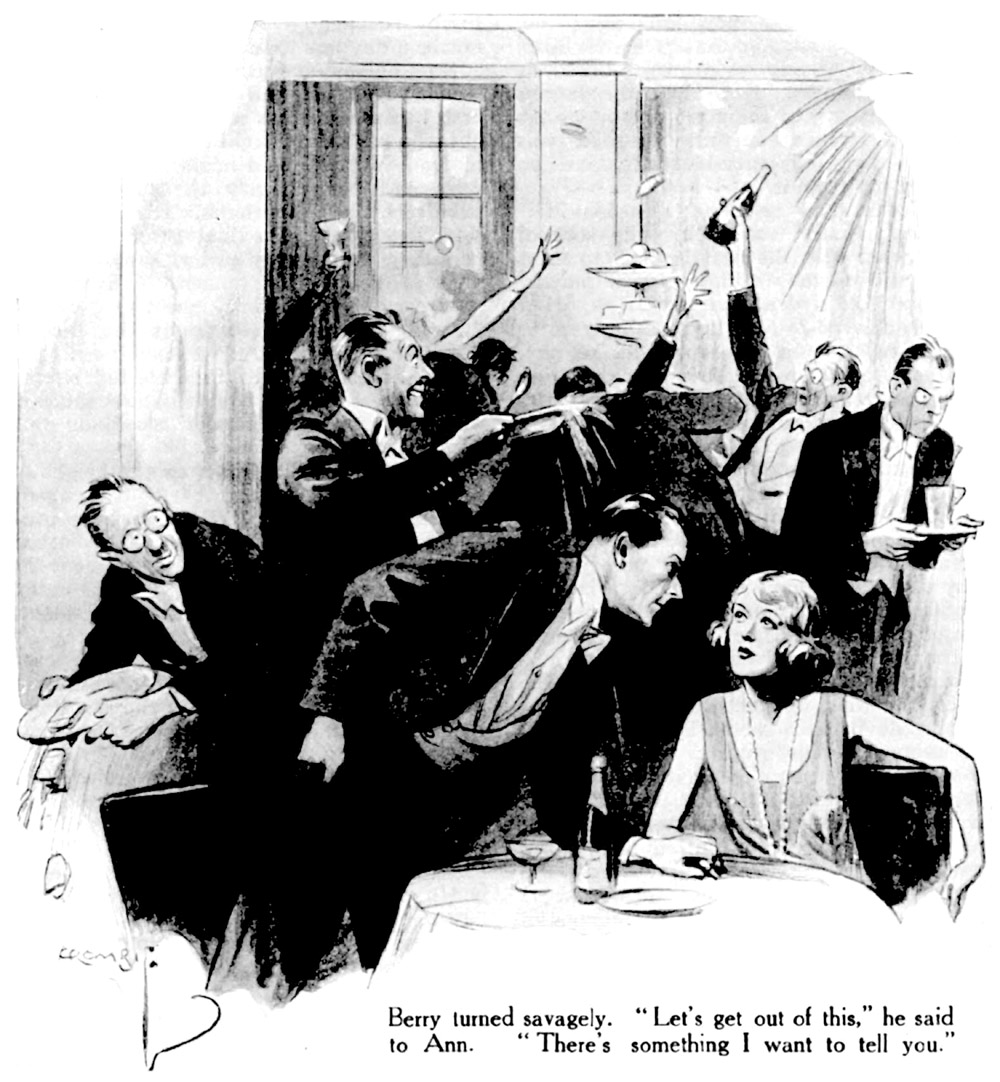
“Let’s get out of this,” he said between his teeth. “There’s something I want to tell you. We can’t talk here.”
“But Mr. Malling will be back in a moment,” said Ann. She had a sense of slipping, of struggling for a foothold.
“Who’s he?”
“The man I’m with. He’s gone to get me something to eat. If I go away, what will he think?”
“If he’s anything like the rest of the men here,” said Berry, “I don’t suppose he’s capable of thinking.”
He urged her towards the door. They passed out and were in a small anteroom. From somewhere beyond came the sound of music.
Berry slammed the door behind him and turned to her.
“I’ve something I want to tell you,” he said.
He seemed to Ann to be swelling before her eyes. He looked huge and intimidating. She became conscious of feeling very small and fragile.
“You’ll think me mad, of course.”
He was very close to her now, and conscience, chuckling like a hen, was urging her to draw back. She did not draw back.
He took her hand, and as he did so she saw him start, like one who has observed a snake in his path. It was her left hand that he had taken, and what he was staring at was the ring on the third finger. It was a nice ring, of diamonds and platinum, and Lord Biskerton owed a considerable sum for it, but there was no admiration in the young man’s gaze.
“You’re engaged!” he said.
The words were hardly a question. They resembled more nearly an accusation. Ann had a fleeting, but none the less disintegrating, sensation of having been detected in some act unspeakably low and base. She felt that she wanted to explain, and it seemed so impossible to explain.
“Yes,” she said, in a small, meek, penitent voice.
“My God!” said the young man.
“Yes,” said Ann.
“Engaged!”
“Yes.”
The young man breathed heavily.
“I don’t care!” he said. “I just want to tell you——”
The lobby between the supper-room and the Crystal Ballroom of the Hotel Mazarin on the night of a Bassinger dance is, perhaps, with the exception of the supper-room, the least suitable spot in the whole of London for the conduct of a tête-à-tête. Even as he spoke, the young man became aware of something male and intrusive at his elbow. This person seemed to be desirous of speech with him. He was tapping him on the arm.
“Excuse me,” he was saying.
And almost at the same instant the door of the supper-room flew open, and Ann, in her turn, found herself forced to recognize that there were more than two people in the world. The whole place had begun to take on a congested air.
“Oh, there you are!” said Toddy Malling.
TODDY was flushed and dishevelled. He seemed at some point in his recent activities to have run his right eye up against something hard, for it was watery and half closed. In his left eye, which was working under its normal power, there was the light of reproach.

“Oh, there you are!” said Toddy Malling. “I couldn’t think where you had got to. I’ve been looking for you everywhere.”
A sense of being torn in half came upon Ann. She felt as she had sometimes felt when wrenched from some beautiful dream by the ringing of the telephone at her bedside. She looked over her shoulder. The young man who had something which he just wanted to tell her was standing with a dazed expression on his face, gazing down absently at someone whom she recognized as her host, Sir Herbert Bassinger. Sir Herbert appeared to be asking him some question, and the young man was plainly having a little difficulty in giving his mind to it.
“I’ve snaffled an excellent chicken,” proceeded Toddy, with the modest pride of a Crusader who has done big things among the Paynim. “Also some salad of sorts. Come along.”
Ann was a kind-hearted girl, and one who hated hurting people’s feelings. Well aware of the perils to which Toddy had exposed himself in order that she might sup, she appreciated the justice of his claim on her society. For her sake he had fought and, practically, bled. She could not rebuff him now, in the very hour of his triumph. To do so would be to destroy all young Mr. Malling’s faith in woman.
Besides, there would be plenty of opportunity for resuming that interrupted talk later on—in some more secluded spot. From the solicitous way in which Sir Herbert was patting his arm, it was plain that her mysterious friend must be a favoured guest. She would find him in the Crystal Ballroom when she had contrived to shake off the insistent Toddy.
“All right, Toddy,” she said. “You’re a hero. Lead on.”
“You don’t mind if young Bertie Winch puts on the nose-bag with us, do you?” said Toddy anxiously, as they passed through the door. “I had to rope him in as an ally. It was imperative. I stationed him by the table and told him to look after that chicken like a baby sister. Otherwise, some of these bally pirates would infallibly have pinched it.”
Berry, meanwhile, had at last had it forced upon his senses that this voice which was babbling in his immediate neighbourhood was addressing its remarks to him; and, though still distrait, he answered civilly.
“Quite,” he said. “Absolutely. No doubt.”
The voice appeared dissatisfied. And, more than dissatisfied, indignant. It rose querulously.
“I’m asking you,” it said, now undisguisedly peevish, “who the devil you are and where the devil you came from and what the devil you think you’re doing here. I don’t know you from Adam, and I’d like to see your card of invitation, if you please.”
Berry came out of his reverie. There is a time for dreaming and a time for facing the issues of life in a practical spirit. This seemed to be one of the latter occasions. Peering through the golden mists which float about a lover, he perceived a rubicund little man of middle age with a walrus moustache and two chins. The moustache was twitching, and both chins waggled in an unpleasant and hostile manner.
“I beg your pardon?” he said.
“Never mind about begging my pardon,” replied his new acquaintance. “Show me your invitation-card.”
In gazing at Berry as if he were an escape of sewer-gas and addressing him in a tone which a bilious warder in a prison might have used towards a convict whom he did not like very much, Sir Herbert Bassinger, Bart., undoubtedly had justice on his side. There had been this season at Society functions quite an epidemic of what is technically known as gate-crashing. It had, accordingly, been enjoined upon the guests at the dance in the Crystal Ballroom of the Mazarin Hotel that they should bring their invitation-cards with them and be prepared to show them on demand.
“Invitation-card?” said Berry musingly, as if the word was new to him.
“Invitation-card.”
“Well, the fact is——” said Berry.
It was a conversational gambit which told Sir Herbert all he wanted to know. Only the sinful and black of heart, he was aware, begin their remarks with that phrase. Comfortably sure now that he was not ejecting from his dance some scion of a noble house whose face he had chanced to forget—or, worse, a gossip-writer from one of the daily papers—he unmasked his batteries.
“I must request you to leave immediately.”
“But——”
“Get out!” said Sir Herbert, becoming terser.
“But I must speak to——”
The walrus moustache quivered like a cornfield in the evening breeze.
“Are you going, or shall I call a policeman?”
Berry perceived that he must be polite and winning. He was still unaware of the name and address of his goddess of the car, and this man could supply them. He forced an ingratiating smile.
It did not go well.
“Don’t grin at me!” thundered Sir Herbert Bassinger.
Even filtered through the moustache, his voice made Berry leap a couple of inches. He removed the ingratiating smile. His companion’s wish was law. Besides, it was hurting his face.
“I’ll go,” he said reassuringly. “Oh, I’ll go. Of course I’ll go. I quite understand that I have no business here. I’ll go all right. I only came because I saw somebody I wanted to speak to going up in the lift. If you will just let me go into the supper-room and have a word with——”
Sir Herbert Bassinger was a man who, when stirred, was accustomed to fall back on a vocabulary of his own invention. He employed it now.
“Stop this tish-tosh!”
Berry continued to be polite and winning.
“Perhaps if you would just tell me her name?”
“Enough of this bubble-and-squeak!”
“Her name?” said Berry urgently. “I must know her name. If you’ll just be kind enough to tell me her name——”
“Will you kindly cease this tingle-tangle and get out of here?” said Sir Herbert Bassinger.
Several attendants in gay uniform had manifested themselves by now and were dotted about the room, eyeing Berry in that cold, severe way in which barmen eye the obstreperous in bars. Reluctantly, he realized that he could do no more. He had shot his bolt. A brawl, agreeable though it would have been to his ruffled feelings, was out of the question.
“Very well,” he said.
With no more tingle-tangle or tish-tosh, he turned and walked in silence to the stairs. His bearing was not exactly dignified, but it was as dignified as a man’s can be who is undergoing a spiritual frog’s march.