 Madame Eulalie’s Rare Plums
The Strand Magazine, January 1931
THE FIRST CHAPTERS.
Berry Conway’s only assets are a copper mine, of no account, and a longing for Adventure, unrealizable so long as he lives with his old nurse in the suburb of Valley Fields. Berry is the secretary of T. Paterson Frisby, an American financier. For his own reasons, Frisby is anxious to buy Berry’s mine through the intermediary of a hanger-on named Hoke. Frisby’s niece, Ann Moon, has become engaged to Berry’s friend, Lord Biskerton (“the Biscuit”), the creditor-harried son of the equally hard-up Lord Hoddesdon. Lord Hoddesdon’s sister, Lady Vera Mace, is chaperoning Ann Moon in London. To hide from his creditors the Biscuit goes to live next door to Berry in Valley Fields, where he becomes more interested than an engaged man should in his pretty neighbour, Kitchie Valentine, who has travelled on the same boat from New York with Ann Moon. Berry meanwhile meets, although without a formal introduction, and falls in love at first sight with Ann Moon. He is on the point of learning her identity when he is ejected as a “gate-crasher” from a party to which he has followed her—not before, however, he has noticed to his despair that she is wearing an engagement ring.
CHAPTER VII.
A LIGHT in the sitting-room of Peacehaven informed Berry on his return to Mulberry Grove that Lord Biskerton was still up and, no doubt, eager for a chat. He rapped on the window. It was opened hospitably and he climbed through.
“Well?” said the Biscuit. “What sort of a time did you have?”
He eyed Berry narrowly. There seemed to him in his friend’s demeanour something strange, an unwonted sparkle in the eye, a suppressed elation as of one who on honeydew has fed and drunk the milk of Paradise. This, the Biscuit felt, was scarcely to be accounted for by attendance at an Old Boys’ dinner.
“What’s the matter with you, reptile?” he asked. “You’re fizzing visibly. Come into money or something?”
Berry sat down, got up, sat down, got up, sat down again, and got up once more. His manner was feverish, and his host disapproved of it.
“Roost!” commanded the Biscuit. “Park yourself, confound you. You’re making me giddy.”
Berry balanced himself on the edge of the horse-hair sofa. He did it as one not committing himself definitely to a sitting position, but holding himself in readiness at any moment, should he see fit, to soar up to the ceiling.
“Now, then,” said the Biscuit. “Tell me all.”
“Biscuit,” said Berry, “the most extraordinary thing has happened. There’s a girl——”
“A girl, eh?” said the Biscuit, interested. He began to see daylight. “Who is she?”
“What?” asked Berry, whose attention had wandered.
“I said, who is she?”
“I don’t know.”
“What’s her name?”
“I don’t know.”
“Where does she live?”
“I don’t know.”
“You aren’t an encyclopædia, old boy, are you?” said the Biscuit. “Where did you meet her?”
“I saw her first across a restaurant.”
“Well?”
“We looked at one another a good deal.”
“And then?”
“Then we went on looking at one another. It was that day you were wearing that beard, Biscuit. You remember?”
“I remember.”
“I felt absolutely desperate. I knew, just by looking at her, that I had found the only girl I should ever love.”
“You boys!” interjected the Biscuit, tolerantly.
“And how on earth was I to get to know her? That was the problem.”
“It always is.”
“When I came out into the street, I saw her getting into her car. And suddenly I had an inspiration. I jumped in after her, and told her to follow you.”
“Follow me? How do you mean, me? How do I come into it?”
“You were in your car just ahead.”
The Biscuit’s interest deepened.
“Do you mean all this happened the day you lunched at the Berkeley, when I was giving the old fungus a trial trip?”
“Of course. I’m telling you.”
“Then who was the girl, I wonder?” mused the Biscuit. “I don’t remember seeing anything very special in the way of girls that time. However, don’t let’s wander from the point. You jumped into her car. What happened then?”
“You drove off, and we drove after you.”
“You mean she just said, ‘Yes, sir!’ and trod on the self-starter? I should have thought she would have called a cop and had you put where you belonged.”
Berry hesitated. They had reached the only point in this romance of his on which he did not like to let his mind dwell. No lover enjoys feeling that he is deceiving the girl he loves. There had been an instant during that scene in the supper-room at the Mazarin when he had braced himself for a full confession. He had thought better of it, but, none the less, his conscience irked him.
“Well, as a matter of fact, Biscuit,” he said, “I lied to her.”
“Starting early, what?”
“I told her I was a Secret Service man,” said Berry. “You see, that explained why I wanted her to follow you.”
“Why? Who did you say I was?”
“I told her you were the head of a great Cocaine Ring.”
The Biscuit thanked him.
“I had to give some reason for jumping into her car like that.”
“And what happened when you told her that you had been fooling her?”
“I didn’t.”
“You let her go on thinking you were a Secret Service man?”
“Yes.”
“God bless you, laddie! This is the best bed-time story I’ve heard for months and months and months. So she still thinks you’re a Secret Service man? You didn’t explain later?”
“No. What happened was this, you see. When I came out of the inn, she had gone. Her car wasn’t there. She had driven off. But to-night I met her again. There was a dance going on at the Mazarin, and I had come out from the dinner, and I saw her going up in the lift. So I went up after her, and found her in the supper-room. And we were just starting to talk, when the man who was giving the dance came along and chucked me out.”
The Biscuit uttered appreciative cries.
“But before that happened I had had time to see—I mean,” said Berry, becoming incoherent, “there was something in her eyes—— The way she looked—I believe if only I had had a minute longer—— It was the way she looked, if you know what I mean.”
“You clicked?” said the Biscuit, who liked his bed-time stories crisp.
Berry shuddered. The hideous phrase revolted him.
“I wish you wouldn’t——”
“Either a man clicks or he does not click,” said the Biscuit, firmly. “There are no half-measures. You did?”
“I think she was—pleased to see me.”
“Ah! Well, then, of course, you proceeded to ask her name?”
“No.”
“You didn’t?”
“I hadn’t time.”
“Did you ask her where she lived?”
“No.”
“Did she ask you your name?”
“No.”
“Did she ask you where you lived?”
“No.”
“What the dickens did you talk about?” asked the Biscuit, curiously. “The situation in Russia?”
Berry clenched his hands emotionally. Then a black recollection came to him, and his face clouded.
“I found out one thing about her,” he said. “She’s engaged.”
“Engaged?”
“Yes. I’m not worrying about finding her again. I know I shall find her. But if she’s engaged——”
He broke off dejectedly.
“You feel that a Conway should refrain from butting in and coming between this girl and some bloke unknown, who no doubt loves her devotedly?” said the Biscuit.
“Yes. All the same——”
“All the same, you jolly well mean to do it?”
“Yes.”
“Quite right, too.”
“Do you really think so?”
“Certainly,” said the Biscuit, firmly. “All’s fair in love and war, isn’t it? I seem to see this other bloke. A weedy bird with a receding chin and an eyeglass. I shouldn’t give him another thought. Good heavens! One can’t stop to consider the feelings of some unknown wart at a time like this. Don’t you worry, old boy. You take my tip and charge right ahead. There are enough difficulties confronting you already without your having to bother about any vague lizard in the background.”
Berry bestowed upon his friend a look of the utmost gratitude and esteem. He had drawn much comfort from his words.
“I’m glad you feel like that about it,” he said.
“I’m glad you’re glad,” said the Biscuit, courteously.
CHAPTER VIII.
MR. FRISBY buzzed the buzzer, and his private secretary came gambolling into the room like a lamb in springtime. The remarkable happenings of the previous night had had the effect of raising Berry Conway’s spirits to the loftiest heights.
“You rang, sir?” he said, affectionately.
“Of course I rang. You heard me, didn’t you? Don’t ask dam’-fool questions. Get Mr. Robbins on the ’phone.”
“Mr. Who, sir?” asked Berry. There was nothing he desired more than to assist and oblige his employer, to smooth his employer’s path and gratify his lightest whim, but the name was strange to him. Mr. Frisby had a habit, which Berry deplored, of being obscure. His construction was bad. He would suddenly introduce into his remarks something like this Robbins motive—vital, apparently, to the narrative—without any preliminary planting or preparation. “Mr. Who, sir?” asked Berry.
“Mr. gosh-darn-it-are-you-deaf-I-should-have-thought-I-spoke-plainly-enough-why-don’t-you-buy-an-ear-trumpet Robbins. My lawyer. Chancery 09632. Get him at once.”
“Certainly, sir,” said Berry, soothingly.
He was concerned about his employer. It was plain that nothing jolly had been happening to him overnight. He was sitting bunched up in his swivel chair as if he had received a shock of some kind. His equine face was drawn, and the lines about his mouth had deepened. Berry would have liked to ask what was the matter, how bad the pain was, and where it caught him. A long, sympathetic discussion of Mr. Frisby’s symptoms would just have suited his mood of loving-kindness.
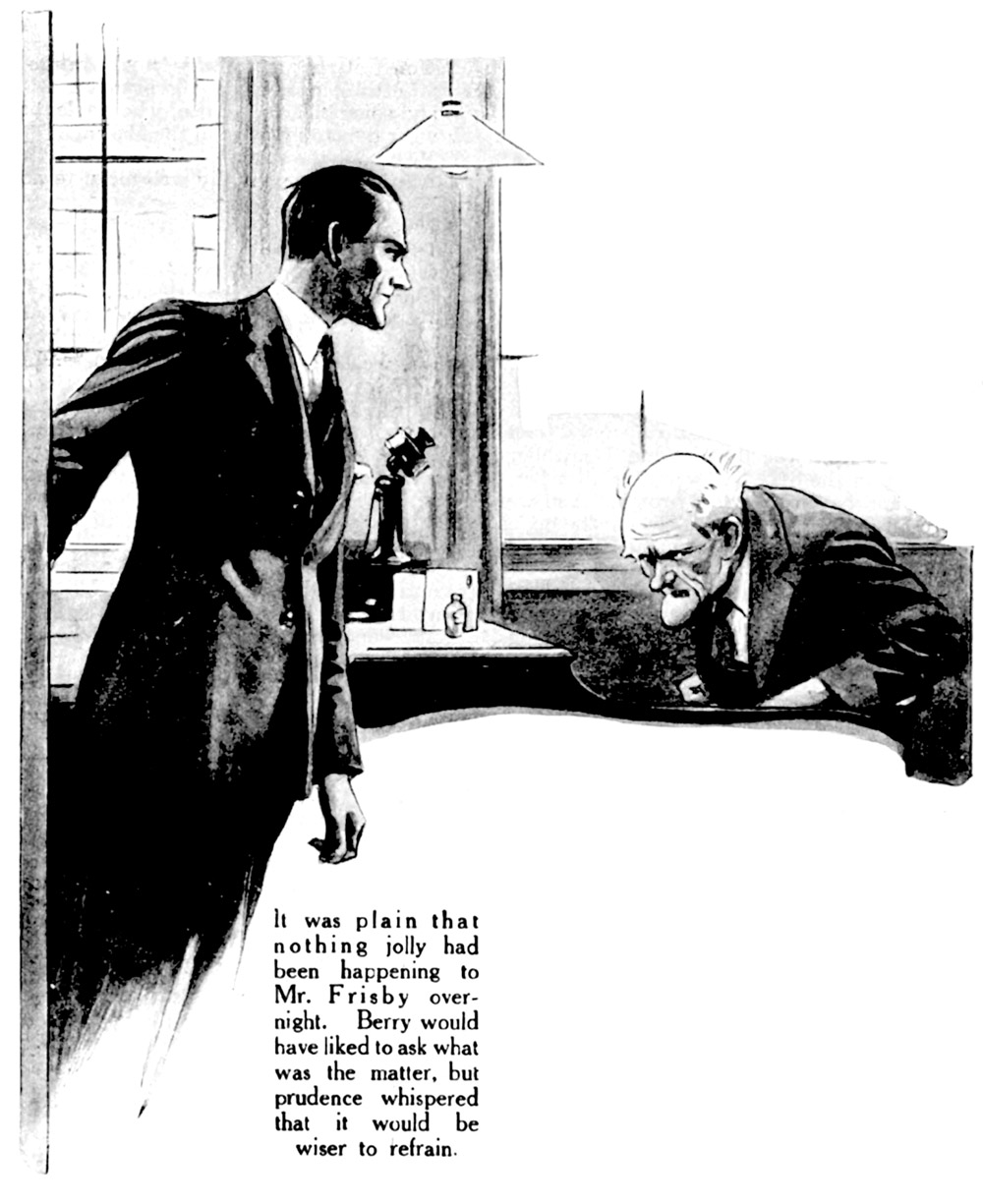
Prudence, however, whispered that it would be wiser to refrain. He contented himself with getting the number, and presently found himself in communication with Mr. Frisby’s legal adviser.
“Mr. Robbins is on the wire, sir,” he said in his best bedside manner, handing the instrument to the sufferer.
“Right,” said Mr. Frisby. “Get out.”
“Robbins!” he was barking into the telephone as the door shut.
A low, grave voice replied, a voice suggestive of foreclosed mortgages and lovers parting in the twilight.
“Yes, Mr. Frisby?”
“Robbins, come round here at once. Immediately.”
“Is something the matter, Mr. Frisby?”
“Oh, no!” The financier yapped bitterly. “Nothing’s the matter. Everything’s fine. I’ve only been swindled and double-crossed by a hellhound.”
“Tut!” said the twilight voice.
“I can’t tell you over the wire. Come round. Hurry.”
“I will start immediately, Mr. Frisby.”
Mr. Frisby replaced the receiver and, rising, began to pace the room. He returned to the desk, picked up a letter, read it once more (making the tenth time), uttered a stifled howl (his fifteenth), threw it down, and resumed his pacing. He was plainly overwrought, and Berry Conway, if he had been present, would have laid a brotherly hand on his shoulder and patted him on the back and said “Come, old man, what is it?” It was lucky, therefore, that instead of being present he was in his own little room, dreaming happy dreams.
These were interrupted almost immediately by the sound of the buzzer.
MR. FRISBY, when Berry answered the summons, was waltzing about his office. He looked like one of those millionaires who are found stabbed with paper-knives in libraries.
“Sir?” said Berry, tenderly.
“Hasn’t Mr. Robbins come yet?”
“Not yet, sir,” sighed Berry.
“Hell’s bells!”
“Very good, sir.”
Mr. Frisby resumed his waltzing. He had just paused to give the letter on the desk an eleventh perusal when the door opened again.
This time it was the office-boy.
“Mr. Robbins, sir,” said the office-boy.
Mr. Robbins, of Robbins, Robbins, Robbins, and Robbins, Solicitors and Commissioners for Oaths, was just the sort of man you would have expected him to be after hearing his voice on the telephone. He looked and behaved as if he were a mute at some particularly distinguished funeral. He laid his top-hat on the desk as if it had been a wreath.
“Good morning, Mr. Frisby,” he said, and you could see the mortgages foreclosing and the lovers parting all over the place.
“Robbins,” cried the financier, “I’ve been hornswoggled.”
The lawyer tightened his lips another fraction of an inch, as if to say that something of this kind was only to be expected in a world in which all flesh was as grass and where at any moment the most harmless and innocent person might suddenly find himself legally debarred from being a feoffee of any fee, fiduciary or in fee-simple.
“What are the facts, Mr. Frisby?”
“I’ll tell you what the facts are. Listen. You know I’m interested in copper. I practically own the Horned Toad mine.”
“Quite.”
“Well, the other day they struck a new vein on the Horned Toad. One of the richest on record, it looked like.”
“Excellent.”
“Not so darned excellent,” corrected Mr. Frisby. “It was on the edge of the Horned Toad, and it suddenly disappeared into the claim next door—a damned, derelict dusthole called the Dream Come True, which nobody had bothered to pay any attention to for years. It had just been lying there. That’s where that vein went.”
“Most disappointing.”
“Yes,” said Mr. Frisby, eyeing this word-painter strangely, “I was a little cross about it.”
“This would, of course,” said Mr. Robbins, who had a good head and could figure things out, “considerably enhance the value of this neighbouring property.”
“You’ve guessed it,” said Mr. Frisby. “And naturally I wanted to buy it quietly. I made inquiries, and found that the original owner had sold it to a woman named Mrs. Jervis.”
“And you approached her?”
“She was dead. But one morning, out of a blue sky, I’m darned if my secretary didn’t come in and inform me that he was her nephew and had been left this mine.”
“Your secretary? Young Parkinson?”
“No. Parkinson’s gone. This is a new one. A fellow named Conway. You’ve never seen him. He came in and asked my advice about selling the mine. He said it had never produced any copper, and did I think there was any chance of getting rid of it for a few hundred pounds. I tell you, when I heard him say those words, Robbins, I believed in miracles—a thing I haven’t done since I quit attending Sunday-school at Carcassonne, Illinois, thirty-nine years ago. Can you tie it? A fellow right in my office, and without a notion that the thing was of any value. I nearly broke my fountain-pen.”
“Remarkable.”
Mr. Frisby took a turn about the room.
“Well, I hadn’t much time to think, and I see now that I did the wrong thing. The way it seemed to me was that if I made a bid for the mine myself he might suspect something. So I told him I knew of a man named J. B. Hoke who sometimes speculated in derelict mines and I would mention the matter to him. This Hoke is a hydrophobia skunk who has been useful to me once or twice in affairs where I didn’t care to appear myself. A red-faced crook who makes a living by hanging around on the edge of the financial world and yess-ing everybody. He’s yessed me for years. I never liked him, but he was a man I thought you could rely on. So I told him to go to Conway and offer him five hundred pounds.”
“For a property worth millions?” said Mr. Robbins, dryly.
“Business is business,” said Mr. Frisby.
“Quite,” said Mr. Robbins.
“And did the young man accept the offer?”
“He jumped at it.”
“Then surely——?”
“Wait!” said Mr. Frisby. “Do you know what happened? I’ll tell you. That double-crossing scoundrel Hoke bought the mine for himself. I might have guessed, if I’d had any sense, that he would suspect something when I told him to go around buying up no-good mines. Maybe he has had private information from somewhere. He’s a man with friends in Arizona. Probably there was a leak. Anyway, he went to Conway, gave him his cheque, got his receipt, and now he claims to own the Dream Come True.”
“Tut!” said Mr. Robbins.
Mr. Frisby performed a few more waltz steps, rather pretty to watch. Finding himself pirouetting in the neighbourhood of the desk, he picked up the letter and handed it to the lawyer.
“Read that,” he said.
Mr. Robbins did so, and emitted two “H’m’s” and a “Tchk.” Mr. Frisby watched him anxiously.
“Can he get away with it?” he asked, pleadingly. “He can’t get away with it, can he? Don’t tell me he can get away with it. Raw work like that. Why, it’s highway robbery.”
Mr. Robbins shook his head. His manner was not encouraging.
“Have you anything in writing—any letter—or document—to prove that this man was acting as your agent?”
“Of course I haven’t. It never occurred to me——”
“Then I fear, Mr. Frisby, I greatly fear——”
“He can get away with it?”
“I fear so.”
“Hell!” said Mr. Frisby.
A thoughtful expression came into the lawyer’s face. He seemed to be testing this oath, assaying it, to see if it was one of the variety for which he was supposed to be a commissioner.
“But it’s murder in the first degree!” cried Mr. Frisby.
“I note that in his letter,” said Mr. Robbins, “this Mr. Hoke says that he is calling here this morning with his lawyer, Mr. Bellamy. I know Bellamy well. I am afraid that if Bellamy has endorsed the legality of his action we have little to hope. A very shrewd man. I have the greatest respect for Bellamy.”
“But look what he says on the second page. Look how he proposes to hold me up.”
“I see. He suggests that the Dream Come True be merged or amalgamated with your property, the Horned Toad, the whole hereinafter to be called Horned Toad Copper Incorporated——”
“And he wants a half interest in the combination!”
“If Bellamy is behind him, Mr. Frisby, a half interest is, I fear, precisely what he will get.”
“But it’s a gold mine!”
“A copper mine, I understood.”
“I mean, I’m parting with a fortune.”
“Most annoying,” said Mr. Robbins.
“What did you say?” asked Mr. Frisby, in a low voice.
“I said it was most annoying.”
“So it is,” said Mr. Frisby. “So it is. You’re a great describer.”
Mr. Robbins regarded his hat sadly but affectionately.
“If it is necessary for your purposes to acquire this Dream Come True property,” he said, “I can see no other course but to accept Mr. Hoke’s proposals. He undoubtedly owns and controls the property in question. If you would care for me to be present at the conference, I shall be delighted to attend, but I fear there is nothing that I can do.”
“Yes, there is,” said Mr. Frisby. “You can stop me beaning the fellow with a chair and getting hung for murder.”
THE door opened. The office-boy appeared. He was a lad whose voice was passing through the breaking stage.
“Mr. Hoke,” he announced, in a rumbling bass.
And then, in a penetrating treble like a squeaking slate-pencil:—
“And Mr. Bellamy.”
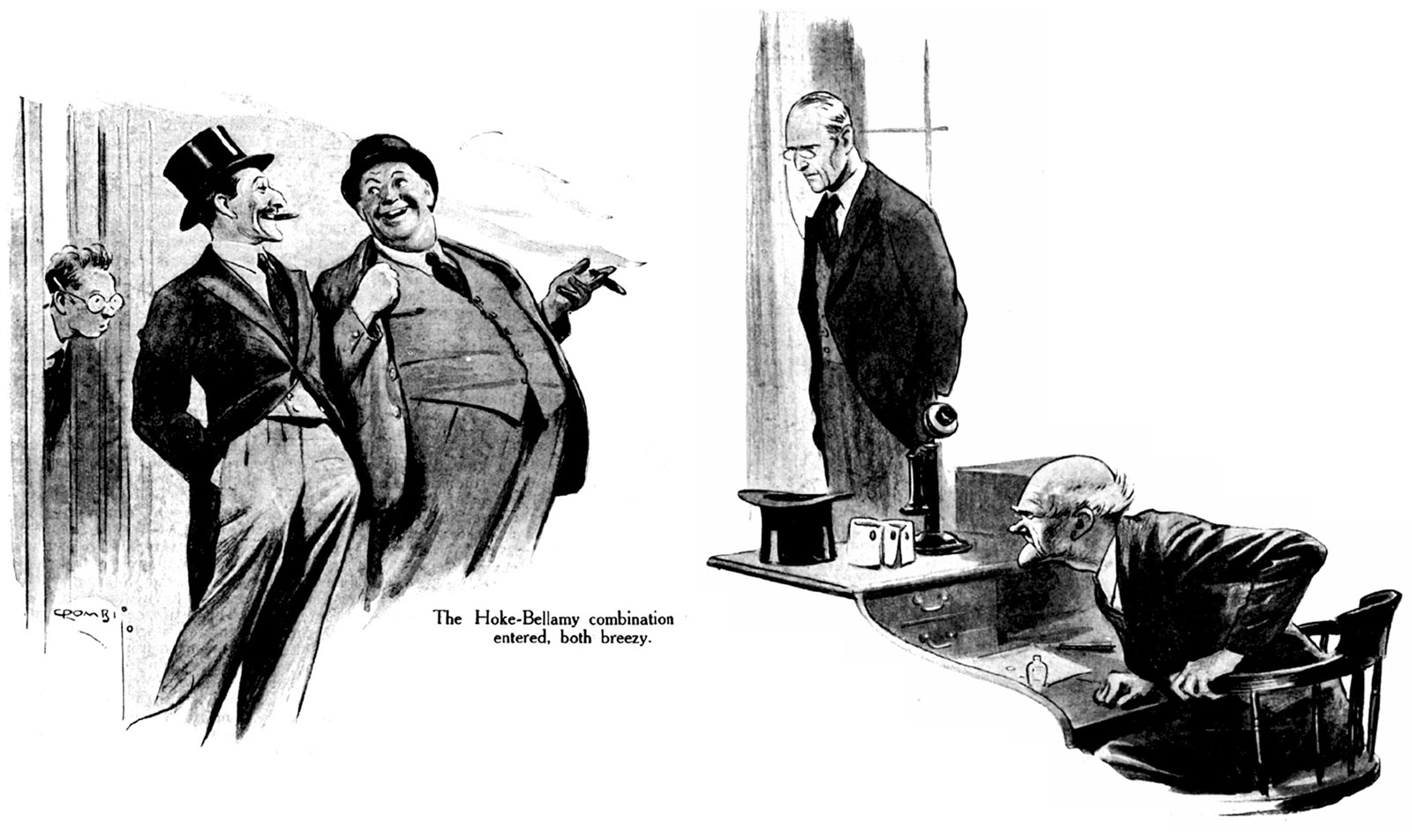
The Hoke-Bellamy combination then entered, both breezy. A very different person now, this J. B. Hoke, from the respectful underling who had yessed Mr. Frisby for so many years.
“ ’Morning, Pat,” said Mr. Hoke.
“Good morning, Mr. Frisby,” said his companion.
“Well, well, well, well, well!” said Mr. Hoke. “You’re looking fine.”
“How are you, Bellamy?” said Mr. Robbins.
“Fine. And you?”
“In capital health, thank you.”
“Splendid,” said Mr. Bellamy.
He took a chair. J. B. Hoke took a chair. Mr. Robbins took a chair. Mr. Frisby had a chair already.
The conference was on.
There was a silence for some moments.
Mr. Frisby was the first to break it.
“I been wondering,” said Mr. Frisby, in a meditative voice.
“Yeah?” said J. B. Hoke. “What about?”
“Oh, nothing,” said Mr. Frisby. “Just your initials. I was wondering what the B. stood for.”
“Bernard,” said Mr. Hoke, a little proudly.
“Oh?” said Mr. Frisby. “I thought it might be Barabbas.”
“Hey!” said Mr. Hoke.
“Gentlemen, gentlemen!” said Mr. Robbins.
“Really, really!” said Mr. Bellamy.
“Is that actionable?” inquired Mr. Hoke of his legal adviser.
Mr. Bellamy shook his head.
“To constitute a tort, the words should have been accompanied by a blow or buffet.”
“Is that so?” said Mr. Frisby, rising. “I didn’t know. Well, here she comes.”
“Gentlemen, gentlemen, gentlemen, gentlemen!” said Mr. Robbins, as if he were all four Robbinses speaking simultaneously.
There was another silence.
“This sort of thing isn’t going to get you anywheres,” said Mr. Hoke, reprovingly.
“Quite,” said Mr. Robbins, gazing at his principal as at a favourite but erring son.
“Do please, gentlemen,” said Mr. Bellamy, “let us try and endeavour and—er—attempt to steer clear of what you might call—er——”
“Cracks,” said Mr. Hoke.
“Snacks,” emended Mr. Bellamy.
“Verbal attacks,” said Mr. Robbins. “Personal animadversions. Vituperation, as Mr. Hoke has remarked, will get us nowhere.”
“Not that we’re trying to get anywhere,” said Mr. Hoke, speaking now with a return of his former cheeriness. “Mean-to-say, we’re here already. See what I mean? I mean there’s nothing to chew the rag about. The thing’s clear. I own the Dream Come True, don’t I? Well, say, don’t I? What I mean, if any poor fish present wants to argue otherwise, let him explain why. Let him tell this meeting what he thinks is eating him. Let him inform this meeting just where he imagines . . . Well, say, listen,” he said, directing his fire immediately upon Mr. Frisby. “I take it you aren’t disputing my title? Of course you aren’t. Well, then, let’s get down to it. Let’s talk turkey.”
“Turkey?” said Mr. Robbins, in an undertone.
“An American colloquialism,” said Mr. Bellamy, “meaning, Let us concentrate on the—ah—res.”
“Characteristically quaint,” said Mr. Robbins.
Mr. Frisby, gallant in defeat, put a point.
“You may own the Dream Come True,” he said, “just the same as Captain Kidd and Jesse James——”
“Please!” said Mr. Robbins.
“You may own the Dream Come True, but you can’t get the stuff out of it. Not without using my spur line. You’ll have to carry the stuff over the mountains on the back of mewels.”
“My principal,” said Mr. Bellamy, “is cognizant of that fact. Fully cognizant. It is for that reason that he has suggested this merger.”
“Amalgamation,” said Mr. Robbins.
“This amalgamation or merger,” said Mr. Bellamy.
“And I think I may as well say frankly, my dear Frisby,” said Mr. Robbins, “that in my opinion, my carefully considered opinion, there seems to be no other alternative before you but to accept the proposition on the lines laid down by Mr. Hoke.”
A sharp sound broke the silence which followed this observation. It was Mr. Frisby snorting. And with that snort ended what may be called the picturesque part of the proceedings. After that they became dull and technical, with the two lawyers taking matters in hand and doing all the talking. And, as no historian wants to spoil white paper recording the sort of thing lawyers say on these occasions, a further description may be omitted.
Mr. Bellamy jotted down a rough memorandum, and handed it to Mr. Robbins, saying he hoped it covered everything. Mr. Robbins, producing a special pair of spectacles in honour of the importance of the moment, scanned it and said it seemed to cover everything. Mr. Bellamy then read it aloud, and Mr. Hoke said Yes, that covered everything. Mr. Frisby just sat and suffered.
The two lawyers then left, chatting amiably about double burgage, heirs taken in socage, and the other subjects which always crop up when lawyers get together; and Mr. Hoke, having seen that the door was closed, approached Mr. Frisby’s desk in a cautious and conspiratorial manner.
“Hey!” said Mr. Hoke.
Mr. Frisby looked up wanly. He had been sitting with his head in his hands.
“Haven’t you gone?” he asked.
“No,” said Mr. Hoke.
“Why not?” said Mr. Frisby, inhospitably.
Mr. Hoke leaned over the desk.
“Say, listen,” he said. “Now that those two have left, you and I can have a little friendly pow-wow.”
Mr. Frisby’s reply to this was to inform Mr. Hoke that in his opinion he, Mr. Hoke, was a robber, a despicable thief, a pickpocket, and a body-snatcher. Once, said Mr. Frisby, when out in Mexico, he had seen a rattlesnake. He had not liked the rattlesnake—indeed, he had formed a very low opinion of its charm and integrity—but, nevertheless, if it came to friendly pow-wows, he would choose the serpent every time in preference to Mr. Hoke. Rather than pow with Mr. Hoke, he would wow with a hundred rattlesnakes. This, he explained, was because he considered Mr. Hoke a hound, a worm, a skunk, a ghoul, and a low-down, black-hearted hijacker.
“Yes, but all kidding aside,” said Mr. Hoke, amiably. “Listen. Now that we’re partners, you and me, here’s something we got to make up our minds about. How do you feel about the shareholders? What I mean, what’s your reaction to the idea of the shareholders getting money that we could both of us use quite nicely ourselves? What I mean, when do we spill the news of this new reef on the Dream Come True? Before we’ve bought in all the stock, or after?”
Mr. Frisby said nothing.
“It’s going to mean a difference of fifty points on the share when the thing comes out. Fifty? It might be a hundred. You never can tell where she’ll stop, once they start buying. And if you say you’d like to be loaded up with Horned Toad at four and watch her shooting into the eighties and nineties, you’ll only be saying the same as me.”
Mr. Frisby chewed his fountain-pen reflectively.
“You know what copper’s like,” urged Mr. Hoke. “It’s one thing or the other with copper. Either it’s down in the cellar, or else it’s up singing with the angels. One of the first stocks I ever bought was Green Cananea at twenty-five. I sold at fifty, and kicked myself every morning till it hit two hundred. To-day you could buy up all the Horned Toad shares you wanted and still have plenty over for a good meal and a couple of cigars. And a week after this information about the Dream Come True gets out, the National City Bank’ll have to hock its under-vest if it wants to blow itself to more than about half-a-dozen. That’s how good that stock is going to be. I’m telling you. What we want to do, you and me, is to get together and have a little gentlemen’s agreement.”
“Who are the gentlemen?” asked Mr. Frisby. interested.
“You and me.”
“Ah!” said Mr. Frisby.
MR. HOKE proceeded.
“It wouldn’t take us long to corner that stock at rock-bottom prices. It would be pie. What I mean, it isn’t as if the Horned Toad was a Kennecott or an Anaconda. It’s always been half-way between a may-be and a never-waser. If you start selling shares a couple of thousand at a time, folks’ll soon begin to sit up and take notice.”
Mr. Frisby bridled a little. He shifted irritably in his chair. It offended his amour propre that his companion should imagine it necessary to instruct him in the A B C of market-rigging.
“You go to your broker and start selling,” proceeded Mr. Hoke, not observing these signs of impatience, “and you can bet he’ll do something about it. He’ll notify his clients that the President of Horned Toad is getting out from under and that things look fishy. They’ll tumble over themselves to unload.”
“Naturally,” said Mr. Frisby.
“You go to him on ’Change and whisper in his ear that you want him to sell a couple of blocks of two or three thousand——”
“I know,” said Mr. Frisby. “I know. I know.”
“And all the while we’ll be buying the stuff up in Paris or Amsterdam. Well, what about it?”
Mr. Frisby brooded darkly. On moral grounds he had no objection to the scheme whatever. He heartily approved of it. What was distressing him was the fact that, in enriching himself, he would be compelled also to enrich Mr. Hoke.
“Is it a go?” asked that gentleman.
“Yes,” said Mr. Frisby.
“Oke,” said Hoke. “Then that’s settled.” A pretty enthusiasm lighted up his face. “I knew it was a lucky day for me when I went into partnership with you, Pat,” he said, handsomely.
“Don’t call me Pat,” said Mr. Frisby, morosely.
“Well, what’s your first name?”
“Never mind,” said Mr. Frisby.
It was a point on which he was sensitive. Much time had passed since then, but he could never quite forget the day when the leading wag of his school had discovered his secret.
“Well, I must be getting along,” said Mr. Hoke.
“Do,” said Mr. Frisby, cordially. “The air in this office won’t be fit to breathe till you’ve gone and I’ve had the windows opened.”
J. B. Hoke pranced out jubilantly, treading on air, and immediately outside the door cannoned into a substantial body.
“Can’t you look where you’re going? he demanded, aggrieved.”
“Why, hullo, Mr. Hoke!” said the body amiably.
J. B. Hoke recognized the young man, who might have been described, without stretching the facts, as the founder of his fortunes. It was to this young man that he owed the delightful experience of sitting in T. Paterson Frisby’s office and telling T. Paterson Frisby just where he got off. This pleasing reflection assuaged the pain in the toe on which Berry had trodden.
“Why, hello, Mr. Conway,” he said, genially. “Have a good cigar.”
“Thanks.”
“And how’s every little thing with Mr. Conway?”
“I’m fine. How are you?”
“I’m fine.”
“Both fine. Fine!” said Berry.
“Got any more mines to sell?” asked Mr. Hoke.
“No. That was the only one. I can do you five thousand shares of Federal Dye, if you like.”
“Not for me, thanks.”
“No,” said Berry. “I suppose you’re satisfied with the Dream Come True.”
Mr. Hoke looked grave.
“You stung me good over that,” he said. “Two thousand five hundred dollars for a patch of sand covered with barrelhead cactus. Well, well, well. You’re a business man, all right.”
It seemed to Berry—being, as he was, in a mood of universal benevolence, and wishing to see nothing but smiling faces around him—that he ought to say something to indicate a possible silver lining. He, too, considered that Mr. Hoke had allowed his native generosity to lead him into a bad bargain.
“Oh, come!” he protested, heartily. “You never know. I shouldn’t be at all surprised if there weren’t millions to be made out of the Dream Come True.”
The joviality had returned to Mr. Hoke’s face. It now faded again as if it had been wiped off with a sponge. For the first time, it occurred to him how very near the door Berry had been standing at the moment of their impact.
Could he have overheard that last little conference?
PALLIDLY, Mr. Hoke ran over in his mind the more recent of his companion’s remarks. He was horrified to discover that, read in the light of these new suspicions, they had a sickeningly sinister ring. “I suppose you’re satisfied with the Dream Come True,” he had said. And, after that, this shattering speech about the possibility of there being millions in the thing. He stared at Berry with eyes like apprehensive poached eggs.
“What makes you say that?” he quavered.
“Oh, it just struck me as a possibility,” said Berry, with a pleasant smile.
A smile, that is to say, which would have seemed pleasant to anyone else. To J. B. Hoke it suggested a furtive gloating.
“What were you doing, standing outside that door?” he asked.
“I thought I heard the buzzer.”
“Oh?” said Mr. Hoke, slowly. “Well, nobody touched the buzzer.”
“False alarm,” said Berry, genially. “I’ll get back to my basket.”
Mr. Hoke watched him out of sight. Then he burst into the office and, tottering to the desk, placed his lips to Mr. Frisby’s ear.
“S-s-s-say!” he hissed.
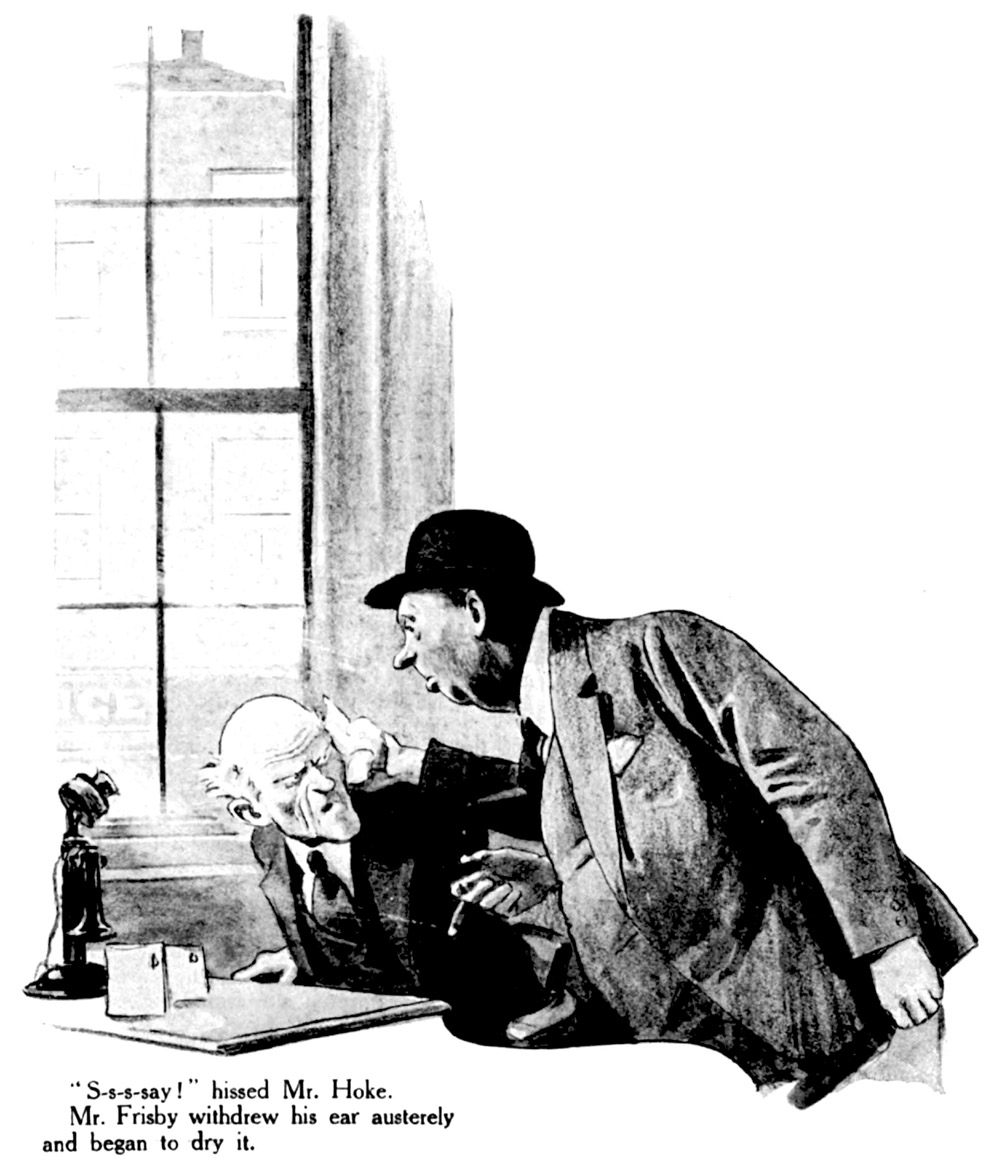
Mr. Frisby withdrew his ear austerely and began to dry it.
“Haven’t you gone yet?” he asked. “Do you want me to put a bed in here? What time do you like to be called in the morning?”
Sarcastic, of course. Bitter, undoubtedly. But there are times when a man may legitimately be sarcastic and bitter.
“Say, listen,” said Mr. Hoke, urgently. “Just outside the door I ran into that secretary of yours. He was standing there.”
“What of it?”
“Well, do you think he could have heard what we were saying? I was talking pretty loud.”
“You always do. It’s one of the things that get you so disliked.”
“And he said something—darned significantly, I thought—about wasn’t it possible that there might be millions made out of the Dream Come True.”
“He did?”
“He certainly did. Say, listen. If advance information of our little arrangement gets out before we’re ready, we’re sunk. It wouldn’t be difficult for this fellow to raise a bit of money and start in buying up the shares on margin. He might get thousands for next to nothing, and stay sitting pretty while they shot up. And before we knew what was happening those shares would be hitting the ceiling and we’d lose our shirts if we tried to buy them. I’ve known it happen that way before. Years ago, when I was with Mostyn and Kohn in Detroit, the time they were working that A. and C. ramp, there was a bad leakage in the office.”
“There would be, if you were there,” said Mr. Frisby.
“I had nothing to do with it,” protested Mr. Hoke, and in his voice there was the pain of what-might-have-been. “I never knew a thing that was going on. But somebody got advance information, and what they did to Mostyn and Kohn was nobody’s business. The stock kited sixty points the first day, and Mostyn and Kohn out in the cold, wondering what was happening to them and each of them accusing the other of double-crossing him. Mostyn hit Kohn on the beezer, I remember, and God knows there was plenty of it to hit. Well, that’s what’s going to happen here if we don’t watch out. You ought to fire that fellow, Pat.”
“Don’t call me Pat,” said Mr. Frisby. “And where’s the sense of firing him?”
“Well, we ought to do something.”
“Why did he say he was standing out there?”
“He put up some story about thinking he had heard the buzzer.”
“H’m!” said Mr. Frisby. “Well, good-bye.”
“Don’t you want me to wait?”
“Is it likely that anyone would ever want you to wait? Get out of this, and don’t keep coming running in again all the time.”
“Well, I’ll tell you. My mind’s not easy.”
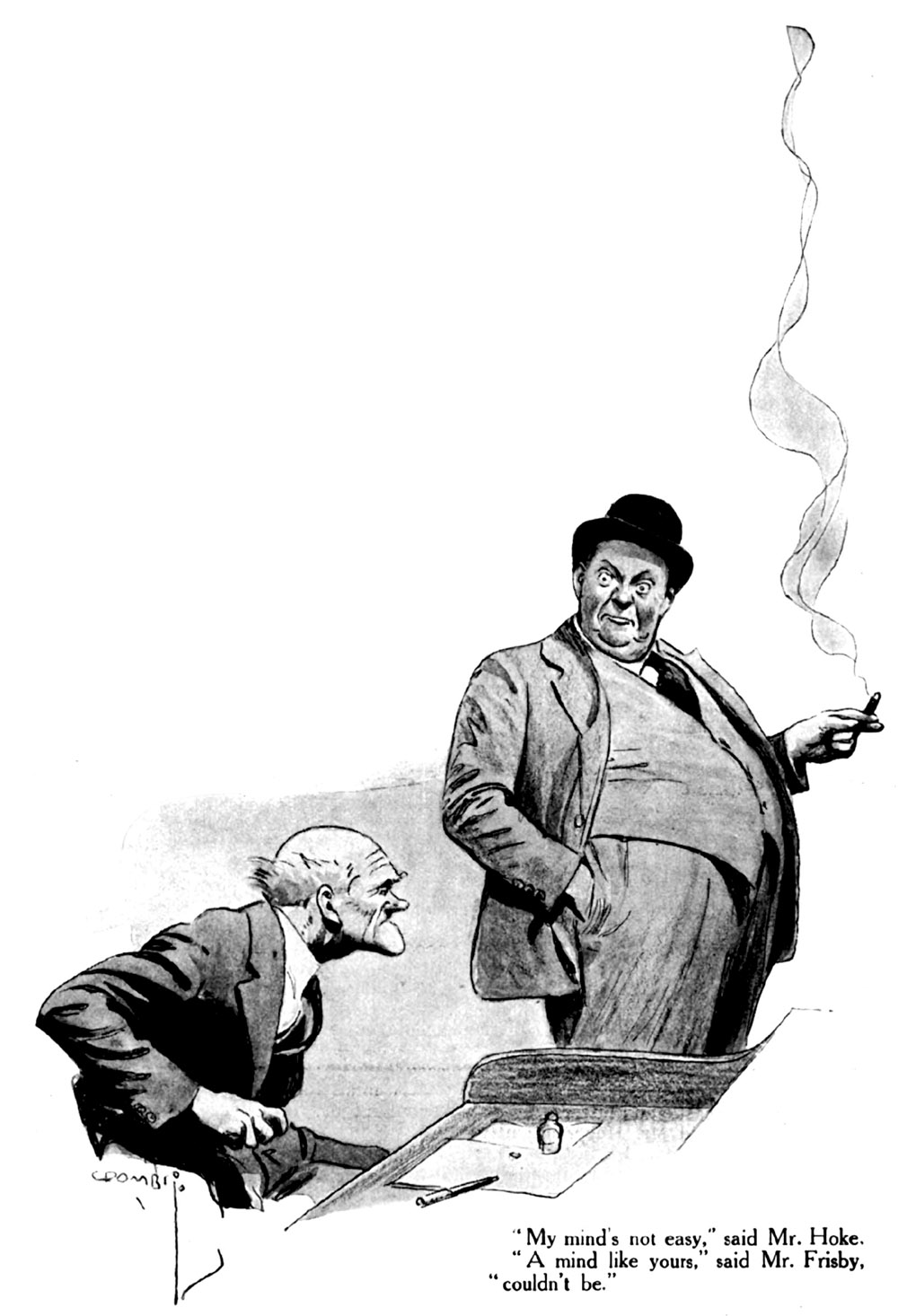
“A mind like yours,” said Mr. Frisby, “couldn’t be.”
For some moments after the door had closed, T. Paterson Frisby sat rocking meditatively in his chair. He was not thinking about Berry. His partner’s panic had aroused no responsive thrill in his heart. What did disturb him was the thought that, in a world which they said they were going to make fit for heroes to live in, nobody had started the millennium by lynching J. B. Hoke. It looked like negligence somewhere.
He spent nearly twenty minutes thinking about Mr. Hoke. At the end of that period, crystallizing his thoughts, as was his custom, into the telling phrase, he reached for a cuff and wrote on it as follows:—
“J. B. Hoke is a son of a ——”
In moments of strong emotion the handwriting tends to deteriorate. Mr. Frisby’s did. So what that last word was we shall never know.
CHAPTER IX.
i.
THE total failure of her brother George to accomplish anything constructive by his trip to Valley Fields had convinced Lady Vera Mace of the truth of the ancient proverb that if you want a thing well done you must do it yourself. Reluctantly, therefore, for she was a woman with many calls on her time, she caught the six-thirty-four train some days later, and, arriving at the gate of Peacehaven, met her nephew, Lord Biskerton, coming out. Another moment, and she would have missed him.
Had she done so, it would have been all right with the Biscuit. This sudden apparition of a totally unwanted aunt affected him much as the ghost of Banquo on a memorable occasion affected Macbeth.
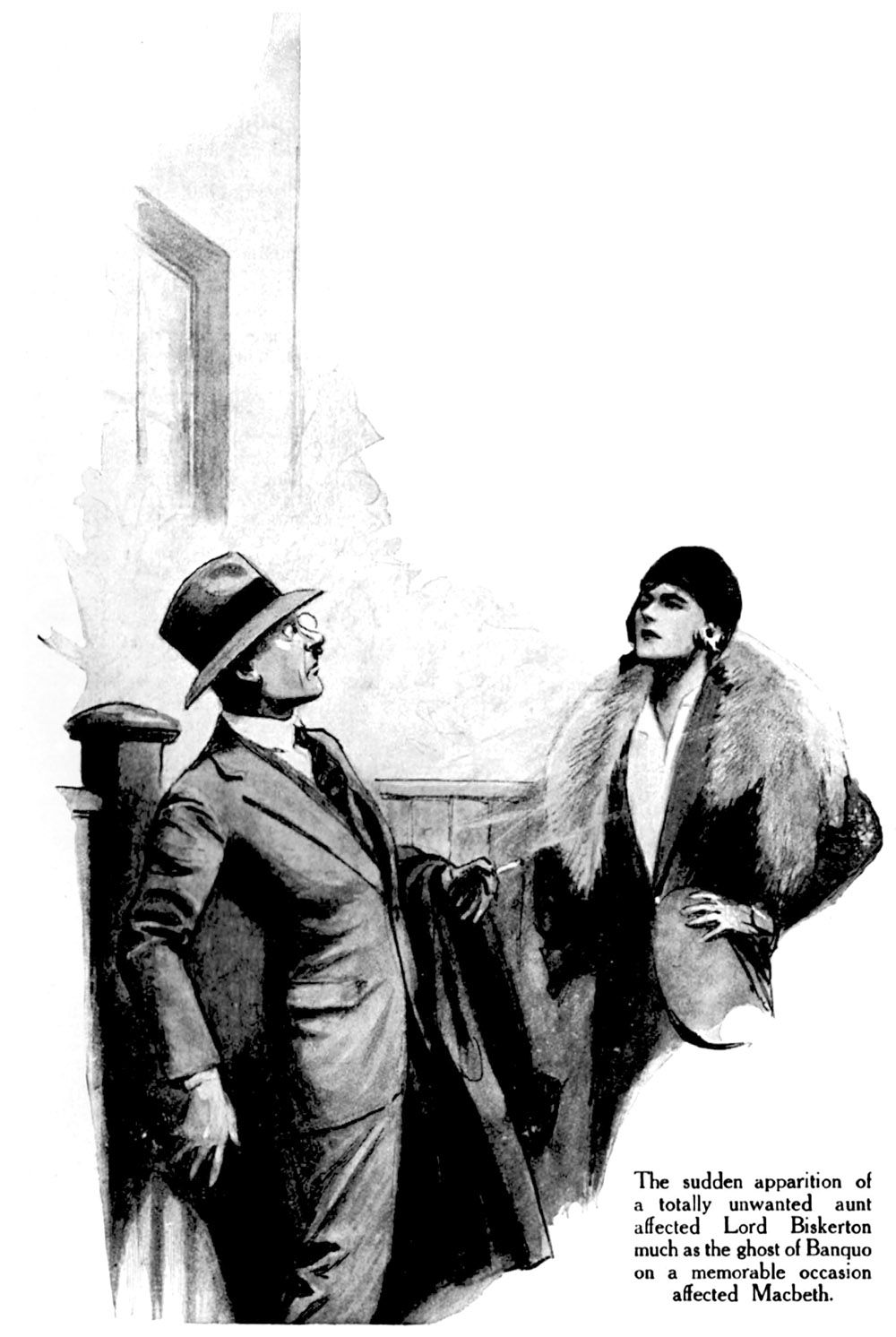
“Good Lord!” he exclaimed. “What on earth are you doing down here?”
“I want to have a talk with you, Godfrey.”
“But you can’t,” protested the Biscuit. “I’m not open for being talked to.”
His emotion was understandable. He was just on his way to Castlewood to collect Miss Valentine and take her to the Bijou Palace (One Hundred Per Cent Talking) at the corner of Roxborough Road and Myrtle Avenue, the meeting-place of all that is best and fairest in Valley Fields. And, while he knew that he was doing this merely because he was sorry for a lonely little girl, a stranger in a strange land, who had few pleasures, the last thing he wanted was a prominent member of the family dodging about the place, taking notes of his movements with bulging eyes.
“I’m busy,” he said. “Occupied. Full of appointments. I’m just off to the pictures.”
“What I have to say is much more important than any pictures.”
“Not than these. They’re showing a film of the Life of a Spanish Onion. Full of educative value, with a most beautiful theme song.”
“I sha’n’t keep you more than a few minutes. I’ve got to catch the seven-ten train back to Victoria. I am dining out.”
“Ah!” said the Biscuit, relieved. “That puts a different complexion on the matter. Well, I’ll walk to the station with you.”
HE hurried her round the corner and into the asphalt-paved, beehive-lined passage that led thither. Only when they were out of sight of Mulberry Grove did his composure return.
“How the dickens did you find out I was living here?” he asked. “It looks to me as if there had been a leakage somewhere.”
“Your father went round to your flat and made Venner tell him.”
“Ah, that explains it. How is the guv’nor? Pretty fit and insolvent? Still stealing the cat’s milk and nosing about in the street for cigar-ends?”
“His health and finances are in much the same state as usual.”
“Poor old chap!” said the Biscuit, sympathetically. “Odd, how none of our family seem able to get their hooks on a bit of money.”
“He tells me he is hoping to let Edgeling to Mr. Frisby for Goodwood. I think it would be an excellent thing. But I did not come here to talk about your father. I want to speak to you about Ann.”
“Yes?” said the Biscuit. “Good old Ann? How is she?”
“She is very well.”
“Buzzing about a lot and rejoicing in her youth, I suppose? Parties, routs, and revels?”
“She was at home, answering her letters of congratulation, when I left. At least, I think she was.”
“You think? Are there secrets between you?”
“It is quite possible,” said Lady Vera, “that she was writing to everybody to say that congratulations were unnecessary, as she was no longer engaged.”
The Biscuit gaped.
“Says which?”
“What do you mean by that extraordinary expression?”
“Eh? Oh,” said the Biscuit, momentarily confused, “I picked it up. From a fellow next door. A man. He’s an American. An American man. One of the first families in Great Neck, New York. The phrase implies astonishment and incredulity. Why the dickens should Ann say she was no longer engaged?”
“Because she may be intending to break off the engagement.”
The Biscuit stared.
“What! Give me the push?”
“Yes.”
“You mean, actually slip me the old acid-drop?”
“Yes.”
“But what would she do that for?”
Lady Vera began to deliver the exordium which she had roughed out in the train.
“Your father and I are terribly worried, Godfrey. We both think that you have made the greatest mistake in disappearing like this.”
“But I had to disappear. Didn’t the guv’nor explain? I was the hunted fox with the pack in full cry after me. I was the hart that pants for cooling streams when heated in the chase. I couldn’t go out of doors without hearing a ‘Yoicks! Hark Forrard!’ from a shirt merchant or a ‘Tantivy!’ from a bespoke tailor.”
“I know all that,” said Lady Vera, impatiently. “Naturally, it would have been a fatal thing if you had had to appear in the County Court. But whatever induced you to tell Ann you had the mumps?”
“A pal of mine suggested that. You see, I had to give some explanation of why we failed to notice among those present the young and popular Lord Biskerton. Couldn’t just disappear without a word.”
Lady Vera did not snort, for she was a woman of breeding. But she uttered a snort-like exclamation.
“It was an insane suggestion. So idiotic that I am surprised that you did not think of it yourself.”
“Harsh words,” said the Biscuit, pained. “It seemed to me a ruse that met the case most admirably. Mumps are infectious, so Ann couldn’t come calling at the flat and smoothing my pillow and noticing with surprise that the bed was empty and had not been slept in. If you don’t think it a good idea, all I can say, Aunt Vera, is that you are pretty hard to please.”
“Mumps! And Ann a girl who is so painfully romantic and idealistic.”
“What’s that got to do with it?”
“Good gracious, Godfrey——”
“What a title for a musical comedy!” said the Biscuit, with enthusiasm. “ ‘Good Gracious, Godfrey!’ Can’t you see it on the—— But I’m interrupting you,” he broke off, courteously, observing in his companion some slight signs of fermentation.
“What I was about to say was this. I think—and your father thinks—that Ann accepted you—well, shall we say without quite knowing her own mind? That being so, the slightest thing may cause her to change it. And you have deliberately put yourself into a position where, every time she thinks of you, it is to picture you with a face like a water-melon.”
“You mean,” said the Biscuit, incredulously, “you actually mean that a sweet girl like Ann would allow herself to be affected——”
“There is something so utterly ridiculous about mumps.”
“Well,” said the Biscuit, bitterly, “if that is what a woman’s heart is like, then all I can say is, A pretty sex! Yes, I mean it. A pretty sex!”
“And, in addition to that, I have every reason to believe that Ann has met some other man and become dangerously attracted by him.”
The Biscuit gasped. This was news, hot off the griddle.
“You don’t mean that!”
“I do. She has been behaving in a very odd manner.”
“But, dash it, what can I do?”
“You must come back.”
“But I can’t.”
“Yes, you can. You must tell her that you haven’t got mumps, after all. And to account for your absence you must say that you have had to go over to Paris. I have been talking it over with your father, and he agrees with me that it would be a very good thing if you did go to Paris. I can afford to pay your expenses, and I think I might manage to take Ann over there for a week or two. She would like Paris.”
“But I shouldn’t,” said the Biscuit, explosively. “I can’t stand Paris. I hate the place. Full of people talking French, which is a thing I bar. It always seems to me so affected.”
“It is better than talking like an idiot.”
“Besides, I want to stay here.”
Lady Vera looked at him searchingly.
“Why? What is the wonderful attraction about this extraordinary place?”
“I like it,” said the Biscuit, stoutly. “It has a quiet charm. I enjoy strolling in my garden of an evening, drinking in the peace of the gloaming and plucking snails off the young lobelias.”
“Are you flirting with some girl down here, Godfrey?” said Lady Vera, tensely.
IT is possible that at that moment Valley Fields was full of nephews whom an aunt’s suggestion had just outraged to the very core. But none of these could have looked half so appalled as the Biscuit.
“Me?” he cried. “Me?”
“Well, I don’t know if you are or not, but I can tell you one thing. If you don’t want to lose Ann, you had better leave Valley Fields at once and show yourself again in civilized surroundings.”
The seven-ten train rolled into the station. Lord Biskerton assisted his aunt into a first-class carriage.
“I have it,” he said, jubilantly. “Here is the solution, sizzling from the pan. Tell Ann I haven’t got the mumps, but am in reality in the Secret Service of my country, and am away somewhere on a job the nature of which I am not empowered to reveal. That will bring the roses back to her cheeks. That will make her regard her Godfrey with admiration and esteem.”
The seven-ten rolled out of the station. It bore with it an aunt thinking poorly of her nephew. Lady Vera’s opinion of Lord Biskerton’s mentality, never high, had in the last few minutes sunk to a new low figure. She supposed that she had done something to cause Providence to afflict her with a nephew like that, but she could not recall any offence of the colossal proportions which would justify the punishment. She sighed deeply, and fell back on woman’s only consolation in times of stress. Opening her bag, she produced a puff and began to powder her nose.
As for the Biscuit, he picked up his feet and returned to Castlewood on the run.