 Madame Eulalie’s Rare Plums
The Strand Magazine, February 1931

THE FIRST CHAPTERS.
Berry Conway’s only assets are a copper mine, of no account, and a longing for Adventure, unrealizable so long as he lives with his old nurse in the suburb of Valley Fields. Berry is the secretary of T. Paterson Frisby, an American financier. For his own reasons, Frisby is anxious to buy Berry’s mine through the intermediary of a hanger-on named Hoke. Frisby’s niece, Ann Moon, has become engaged to Berry’s friend, Lord Biskerton (“the Biscuit”), the creditor-harried son of the equally hard-up Lord Hoddesdon. Lord Hoddesdon’s sister, Lady Vera Mace, is chaperoning Ann Moon in London. To hide from his creditors the Biscuit goes to live next door to Berry in Valley Fields, where he becomes more interested than an engaged man should in his pretty neighbour, Kitchie Valentine, who has travelled on the same boat from New York with Ann Moon. Berry meanwhile meets, although without a formal introduction, and falls in love at first sight with Ann Moon. He is on the point of learning her identity when he is ejected as a “gate-crasher” from a party to which he has followed her at the Hotel Mazarin—not before, however, he has noticed to his despair that she is wearing an engagement ring. Frisby is dismayed to discover that Hoke has himself bought Berry’s mine—which really contains a rich vein—and is forced to a merger with Hoke.
[CHAPTER IX §2]
IN Lady Vera’s flat in Davies Street, Mayfair, Ann had paused in the writing of her letters to have one of her heart-to-heart talks with her Conscience. Ever since the night of the Bassinger Ball at the Hotel Mazarin, this incubus had been making itself more than ordinarily obnoxious.
“Tired?” asked Conscience.
“No.”
“Then why have you stopped writing?”
“I don’t know.”
“To think, perhaps? To muse, maybe? About that affair at the Mazarin, possibly?” suggested Conscience.
“Well, why shouldn’t I?”
“A pretty disgraceful affair, that,” said Conscience, with growing severity. “A very shady bit of work indeed, I should describe it. I suppose you realize that, if Toddy Malling hadn’t come along at that particular moment, that man would have kissed you?”
“Would he?”
“You know he would. And you would have liked it, too. That’s the part that sickens me. That’s the thing that makes me writhe. That’s——”
“All right,” said Ann, shortly.
Conscience was not to be silenced.
“A nice girl like you! A girl who has always prided herself on her fastidiousness. A girl who could never understand how other girls in her set could make themselves cheap and let themselves be—— Ugh!” said Conscience, witheringly. “Philanderer!”
Ann shuddered.
“Yes! Philanderer! And you engaged to a delightful young man, heir to one of the finest titles in England. And a young man, what is more, who is at this very instant writhing on a bed of pain, his only consolation the thought of you. ‘This may be agony,’ he is saying to himself, as the spasm catches him, ‘and I’m not pretending it isn’t. But on the other side there is this to be said: Ann loves me. Ann is true to me. Ann is not going about the place on private petting-parties with men she scarcely knows by sight.’ That’s what he is saying, this unhappy young man.”
There was a pause.
“And this other man,” resumed Conscience. “What do you know about him? Coming right down to it, how do you know he’s worthy of you?”
“He must be with a face like that.”
“Statistics show that fifty per cent. of murderers and other criminals have pleasing faces. You can’t go by the face.”
“And he’s the only man I have ever met who was really romantic.”
“Romantic! That’s the trouble with you,” said Conscience, snatching at the point. “Do you know what you are? A silly, sentimental schoolgirl. Isn’t it romantic enough for you to be the future Countess of Hoddesdon?”
“I’ve got to get on with my letters,” said Ann.
She resumed her task. It was one she had found laborious of late. All these idiotic people writing to wish her happiness, when they ought to have known that marrying Lord Biskerton wasn’t going to make her—— She checked herself sternly. It was just this kind of reflection which had caused Conscience to maltreat her so much in the last few days.
“Dear Lady Corstorphine,” she wrote, doggedly,—“How sweet of you to . . .”
She worked off the Corstorphine one. Two pages of pretty, girlish spontaneity which made her feel as if she were having teeth dragged out of her. Then she picked up the next in order from the pile.
Castlewood,
Mulberry Grove,
Valley Fields, S.E.21
Dear Ann,
I suppose you have quite forgotten me. . . .
Ann looked at the signature,
K. Valentine.
A sensation that was like poignant nostalgia swept over Ann Moon. Kitchie Valentine! The girl who had been such fun on the boat coming over from America—such ages ago. Ann started guiltily. She was a girl who formed friendships with the eager impulsiveness of a kitten, and she had loved Kitchie. When they had parted at Waterloo Station, they had vowed to have all sorts of good times together. And here she had been in England weeks and weeks and weeks and had never once given Kitchie a thought.
Reading the letter did nothing to heal her remorse. Poor Kitchie! She seemed to be having a wretched time. This uncle of hers might have been the life and soul of the officers’ mess of the Royal Loyal Worcestershires, but he was evidently proving a poor companion for a young girl. True, there was some mention of a man next door, a Mr. Smith, who appeared to be agreeable; but there was very little about him and a great deal about the absent Merwyn Flock. Merwyn, it seemed, had not written for nearly a month, and it was this that was distressing Kitchie Valentine almost more than her uncle Everard’s habit of falling asleep after lunch and making a noise like a bassoon.
Ann put down her pen. She glowed with altruistic fervour. This letter, happening to coincide with the first free evening she had had for a considerable time, decided her. She could, and would, go straight down and call at Castlewood, and bring Kitchie back to town for dinner somewhere. And after dinner they would come back to the flat and have one of their long shipboard talks.
HER two-seater was garaged just round the corner. Ten minutes later, having been informed that the route to Valley Fields was through Sloane Square, Clapham, Brixton, and Herne Hill, she was hurrying on her way. Half an hour later she had pulled up outside Castlewood. Thirty-two minutes later she was being informed that Miss Valentine was not at home. She had gone to the pictures, Gladys-at-Castlewood said, with Mr. Smith from Peacehaven.
Ann could not help feeling a little annoyed. She knew that she ought not to be grudging Kitchie any simple pleasures she might be able to snatch from life, but her relief expedition had undeniably fallen somewhat flat. Her rush to ameliorate the monotony of life at Castlewood seemed to have been wasted on one who, despite the hard-luck stories she told in her letters, was apparently never without a Smith to help her through the long days.
The gleam of water across the road caught her eye. She walked to the railings and stood looking at the swans. They had little to offer her in the way of entertainment. Ann turned away, and, doing so, was aware that her sylvan solitude had been invaded. Over the gate of the house named The Nook a young man was leaning. The smoke of his tobacco floated up towards the smiling sky.
Ann started to walk to her car. There was a cosy smugness about Mulberry Grove which somehow seemed to invest the presence there of two persons of the opposite sex with the suggestion of a tête-à-tête, and she disliked this enforced intimacy. She felt almost as if she were shut up in a railway carriage alone with this young man, and had a feeling that he might at any moment open a conversation by asking her if she objected to smoking.
When he did open conversation, however, it was not to make this inquiry. She had scarcely passed him when he uttered the word “Gosh!” in a loud and startled voice. And almost simultaneously the gate slammed and he was at her side.
She stopped. She turned. She arranged her features for a withering look, a look which would say “Sir!” even if she did not say it.
She gave a little gasp. She stared. The withering look went all to pieces, and in its place appeared one of blank astonishment.
“Oh!” said Ann, sharply.
The swan Egbert, roused from his beauty sleep, uttered a crisp oath and dozed off again.
BERRY CONWAY had come out of The Nook to lean on his gate and smoke in no idle spirit of dolce far niente. It was not the mere beauty of the summer evening that had drawn him thither. He had come because the Old Retainer had been weeping on his neck indoors and seemed likely, if he remained, to go on weeping indefinitely.
It was immediately on his return from the City that he had first perceived that this woman was not her old, placid self. She appeared to be in the grip of some powerful, though at the moment suppressed, emotion. When she spoke, it was in a low, husky voice. She sniffed once or twice. And as he went upstairs to change his clothes he could feel her eyes fixed on his back in a stare like that of some dumb animal trying to express itself.
This was at six-thirty. Descending the stairs at six-forty-five, he found her waiting in the hall. At six-fifty it had all come out. Sergeant Finbow, until that morning Police-Constable Finbow, had celebrated his promotion by making her an offer of marriage.
At seven-fifteen she was still saying that she would not dream of deserting Master Berry. At seven-twenty, arguing forcibly, Berry had begun to try to convince her that, even lacking her protective care, he would manage to get along somehow. At seven-thirty the weeping had set in. And at seven-thirty-five he had broken from the clinch, lit his pipe, and come out to lean on the gate and adjust his mind to this extraordinary piece of good fortune.
With the Old Retainer satisfactorily settled and off his mind, he could at last begin to come to terms with this business of life. She had always been the great obstacle. The future now opened out before him, rich and splendid. No more Nook. No more Frisby.
He leaned on the gate, planning great things. Mulberry Grove, now that he was so near to parting from it, had taken on quite an attractive air. There was a girl across the road, inspecting the swans. The sight of her turned his thoughts to their favourite theme, and for some moments a mist hid Mulberry Grove and the rest of the world from his sight.
It cleared away, and he saw that the girl was coming towards him.
ANN was the first to speak. She was still feeling a little breathless. She had just become a convert to the doctrine of predestination, and was finding the experience somewhat overwhelming. It was, she realized, evidently Fate’s intention that, wherever she might happen to be, this young man should materialize out of thin air at her side, so there was nothing to be done about it. Conscience could not blame her for what was Fate’s fault.
She spoke with a childlike wonder.
“Is there any place where you aren’t?” she said.
Berry continued to stare.
“Is it really you?” he said.
Ann said it was.
“Well, I suppose all this is happening,” said Berry, “but I can’t believe it. What——?”
“What——?” said Ann, simultaneously.
“I beg your pardon.”
“Go on.”
“I was going to say, What are you doing here?”
“So was I. I came to see a friend who lives here.” Ann paused, trying to assimilate an idea. “Do you live here?” she asked, surprised. Of course, one knows that Secret Service men must live somewhere, but one somehow does not associate them with fragrant backwaters in the suburbs.
Berry would have given much to deny it. He glowed with shame for Mulberry Grove. Beastly smug, placid, prosaic place. Black Joe’s opium dive in Deptford was the only fitting address for the man he would have liked to be.
“Yes,” he admitted.
“But why?”
Berry was frank about it.
“They don’t pay us much in the Secret Service,” he said.
“What a shame!” cried Ann. “Considering all the dangerous things you have to do.”
“Oh, well!” said Berry.
There was another pause.
“What,” said Ann, “became of you the other night? At the dance?”
“I was ejected by a man with a walrus moustache, who seemed to be someone in authority.”
“That was your host.”
“Not mine.”
Ann’s eyes widened.
“Do you mean to say you were not invited?”
“Only to get out.”
“But why——?”
“To see you, of course.”
“Oh!” said Ann.
“I was in the lobby. I saw you getting into the lift. They told me there was a dance going on upstairs, so I went up.”
An odd shyness had taken possession of Ann. She was annoyed to find herself trembling. A sense of something momentous about to happen was making her feel strangely weak.
To counteract this, she endeavoured to keep the conversation on a light, chatty note.
“What a lot of people there were at that dance!” she said, brightly.
“Only one, for me,” said Berry.
The light, chatty note seemed to have failed. And Ann began to see that, if this interview was to be kept within bounds which would meet with the approval of a rigid New England Conscience, she would have to be more adroit than she had been up to the present. She remembered expressing to her uncle Paterson over the transatlantic telephone some weeks earlier a desire to become acquainted with one of those men who meet a girl and gaze into her eyes and cry, “My mate!” and fold her in their arms. She seemed to have found him.
“I couldn’t think what had become of you that night,” she said.
“You mean you missed me?” said Berry, hungrily. “Do you mean you missed me?”
Ann’s Conscience, which up till this moment had been standing aside and holding a sort of watching brief, now intruded itself upon the scene.
“I don’t want you to think I am always shoving myself forward,” said Conscience, frigidly, “but I should be failing in my duty if I did not point out that you are standing at a girl’s cross-roads. Everything depends on what reply you make to the very leading question which has just been put to you. I don’t know if you have been observing this young man at all closely, but I ought to inform you that there is a gleam in his eye which I don’t at all like. The slightest encouragement at this point will obviously be fatal. I would suggest some such answer as ‘Oh, no,’ or ‘What makes you think that?’ or even a wordless raising of the eyebrows. But, whatever you do, let me urge upon you, with all the emphasis of which I am capable, not to drop your eyes and say ‘Yes.’ ”
“Yes,” said Ann, dropping her eyes. “Of course I did.” She raised her eyes again and looked straight into his. She was a girl who was lost to all shame. “You had just begun to tell me something, you see, and naturally I wanted to know what it was.”
Berry clenched his hands. He coughed. And, having coughed, he uttered a sort of high-pitched bark. The swan Percy woke up and hissed an opprobrious epithet at him.
“It was only this,” said Berry, choking over each syllable. “I’ve loved you from the very first time I saw you.”
“I thought that was it,” said Ann.
 He was gazing into her eyes. He now folded her in his arms. He did not cry “My mate!” but Ann received the impression that the remark was implied. She hung limply to him. What had become of her Conscience, she did not know. It appeared to be dead or unconscious. In a situation where she should have been feeling nothing but shame, she felt only a happiness that seemed to be tearing her asunder. At a moment when the face of Lord Biskerton, swollen and wrapped in flannel, should have been hovering reproachfully before her eyes, she saw only Berry.
She drew away, and gave a little sigh.
“I knew this would happen,” she said. “That’s why I ran away that day.”
Berry caught her in his arms again. The swan Egbert turned to the swan Percy and said something in an undertone. Percy nodded, and both birds then sneered audibly. Swans, like sub-editors, are temperamentally incapable of understanding love’s young dream.
“Of course, we oughtn’t to,” said Ann, reflectively. “It’s all wrong.”
“It isn’t.”
“But I’m engaged,” said Ann. It sounded silly to her, even as she said it. Such a trifling objection.
“I love you,” said Berry.
“I love you,” said Ann.
“I knew I loved you the moment I saw you that day at the Berkeley.”
“I suppose I did, too.”
A happy smile lit up Ann’s face. “The row there’s going to be about this!”
“Row?” said Berry. In his exalted mood, it seemed incredible to him that the whole world would not greet this wonderful consummation of all his hopes and dreams with cheers and enthusiasm. “Do you mean,” he demanded incredulously, “that you think anyone’s going to object?”
“I do.”
“Who?”
“My fiancé, for one.”
“Oh!” Berry dismissed this negligible unknown with a gesture.
“And my father. And my mother. And my uncle. And——”
Berry laughed scornfully.
“Let ’em!” he said.
Ann’s laugh was a contented laugh, a little bubble of happiness breaking from a rainbow.
“I knew you would say that. That’s what I love about you. How awful it would be if you were—just ordinary!”
Berry started. Out of a blue sky there seemed to have come the rumbling of distant thunder.
“Ordinary?”
“Like all the men I’ve ever met. They work in offices and——”
“Work in offices,” said Berry. He spoke dully, and that thunder seemed to him to be coming closer.
But Ann had come closer, too, and that made him forget the thunder.
“I’ve just had an idea,” she said.
“What?”
“Why shouldn’t we tell each other our names? Think how nice it would be to know who we are.”
“My name’s Conway.”
“Well, you don’t expect me to call you Mr. Conway.”
“Beresford Conway. All my pals call me Berry.”
“All my pals call me Ann. Moon is the other name.”
“Ann Moon?”
“Ann Moon.”
Berry wrinkled his forehead.
“But it’s familiar.”
“Is it?”
“I mean I’ve heard it before somewhere.”
“Have you? Where?”
“I can’t remember. Or did I read it somewhere?”
Berry became aware that in a futile discussion of names golden moments were running to waste.
“What does it matter, anyway?” he said. “You’re you.”
“And you’re you.”
“And here we both are!”
“But we won’t stay here. I don’t like those swans.”
“I don’t like those swans,” said Berry, scrutinizing them.
“They’re sneering at us.”
“They are sneering at us.”
“We’ll fool them. We’ll get into my car and we’ll drive up to London and we’ll have dinner somewhere—Mario’s is a good place; one needn’t dress in the balcony—and then we can talk without having a bunch of birds listening to everything we say.”
“Splendid!”
“That’ll make them feel silly.”
“It will make them feel about as silly as two swans have ever felt.”
Egbert looked at Percy. Percy looked at Egbert.
“Well!” said Egbert.
“These young couples!” said Percy. “Another minute and I should have been sick.”
MULBERRY GROVE slept under the night sky. Up and down it, smoking a thoughtful cigarette, paced Godfrey, Lord Biskerton. He appeared to be in a sentimental mood. From time to time he gazed up at the stars and seemed to think well of them.
Rapid footsteps turned the corner. He advanced to meet the new-comer.
“Berry?”
“Hullo!”
“Take a turn along the road with me, laddie,” said the Biscuit. “I want a word with you.”
Berry would have preferred to slip past and postpone this interview. He was conscious of an extreme discomfort. Since his departure from Mulberry Grove in Ann’s car, many things had been made clear to him. He knew now why the name Ann Moon had sounded familiar.
Few things in life are more embarrassing than the necessity of having to inform an old friend that you have just got engaged to his fiancée. But the Biscuit, apparently mistrustful of his ability to hold his companion purely by the magic of his conversation, had seized his elbow in a firm grip.
“Yes, old boy,” he said, “I want your counsel. Where have you been all night?”
“I went out to dinner. At a place called Mario’s.”
“I know it well,” said the Biscuit. “I’ve taken Ann there.”
It was a cue, and Berry knew that he ought to have accepted it.
“Nobody should go to Mario’s,” said the Biscuit, “without trying the minestrone. Did you have minestrone?”
“We had some sort of soup, I suppose,” said Berry, “but I was so——”
“We?” said the Biscuit.
“I was with a girl,” said Berry. It seemed monstrous to refer to Ann in that casual way, but still it was the technical description of her.
“The girl?” asked the Biscuit, with sudden interest.
“Yes.”
“So you’ve met her again?”
“Yes.”
“And how’s everything coming along?”
BERRY plunged. If this thing had to be done, it was best to do it quickly.
“We’re engaged,” he said.
“Fine!” said the Biscuit. “So you’re engaged? Well, well!”
“Yes.”
“Just to this one girl, I suppose?”
“What do you mean?”
“You always were a prudent, level-headed fellow who knew where to stop,” said the Biscuit, enviously. “I’m engaged to two girls.”
“What!”
The Biscuit sighed.
“Yes, two. And I’m hoping that you may have a word of advice to offer on the subject. Otherwise, I see a slightly tangled future ahead of me.”
“Two?” said Berry, dazed.
“Two,” said the Biscuit. “I’ve counted them over and over again, but that’s what the sum keeps working out at. I started, if you remember, with one. So far, so good. A steady, conservative policy. But complications have now arisen. You may have heard me speak of one Kitchie Valentine?”
“The kid next door?”
The Biscuit frowned.
“Don’t call her the kid next door. The angel next door, if you like, or the adjoining seraph.”
“Biscuit, let me tell you——”
“No,” said Lord Biskerton, with gentle firmness, “let me tell you. I added young Kitchie to the strength to-night. Somewhere near the end of Roxborough Road, under, if I remember rightly, the third lamp-post from Myrtle Avenue. It happened like this.”
“Biscuit, listen——”
“It happened like this,” said Lord Biskerton. “Until recently she was engaged to a bounder of the almost incredible name of Merwyn Flock. How she ever came to do such a cloth-headed thing I cannot say, but such are the facts. He’s an actor, and some day, if all goes well, I hope to pop over to America, where he performs, and fling a hearty egg at him. The low hound! He chucked her, Berry,” said the Biscuit, wrestling with a rising emotion. “She got a letter from him to-night, saying that he had just married some actress or other, but hoped they would always be friends.”
“Biscuit——”
“I thought she seemed a bit under the weather when we were starting off for the pictures. Not at all her old bright self, she wasn’t. She was depressed during the six-reel feature-film, and the two-reel Micky Mouse didn’t get a smile out of her. On our way home she told me all. And, believe me or believe me not, old boy, I hadn’t got more than about half-way through the cheering-up process when I suddenly found that we were linked in a close embrace, murmuring soft words of endearment, and two minutes later I discovered with some surprise that we were engaged. That’s Life.”
“Are you fond of her?” was all Berry could find to say.
“Of course I’m fond of her,” said the Biscuit, with asperity. “I love her with a passion that threatens to unseat my very reason. I can see now that it was a case of love at first sight. The moment I set eyes on her, I remember, something seemed to tell me that I had found my mate. Oh, don’t make any mistake about it, my lad, we are twin souls. On the other hand, that doesn’t alter the fact that I’m engaged to two girls.”
“But you aren’t.”
“Tut, tut!” said the Biscuit, annoyed at his friend’s denseness. “Count them for yourself. Kitchie, one; Ann——”
“I’m engaged to Ann.”
The Biscuit clicked his tongue.
“No, you’re not, old boy,” he said, patiently. “Don’t try to cloud the issue by being funny. You’re engaged to this girl of yours, whatever her name is.”
“Her name is Ann Moon.”
“What!” cried the Biscuit.
“You heard.”
“I did hear,” said the Biscuit. “But I was wondering if I could believe my ears, if I could credit my senses. You mean to tell me that Ann, while engaged to me, heartlessly and callously went off and got engaged to somebody else? My gosh! Doesn’t this throw a blinding light on the fickleness of woman! You mean—literally—that you and Ann——?”
“Yes.”
“Was she the girl into whose car you jumped and said you were a Secret Service man?”
“Yes.”
“Well, this is the most extraordinary thing I ever heard in my life,” said the Biscuit.
He brooded for a while in stunned silence.
“Perhaps it’s all for the best,” he said, at length.
“I think so,” said Berry.
“In fact,” said the Biscuit, now definitely perking up, “you might describe it as a consummation devoutly to be wished.”
“That’s just how I was going to describe it.”
“Yes, yes, yes, yes, yes,” said the Biscuit, with growing satisfaction. “I see now that it is the best thing that could possibly have happened. The momentary spasm of pique and chagrin is over, and I can face facts. I realize now that Ann never did care a damn for me.”
“She likes you. She said so.”
The Biscuit smiled sadly, and emitted five more Yeses.
“But we were not affinities. I saw that from the start. She had a way of looking sideways at me suddenly and looking quickly away again as if she had hoped I wasn’t true, but was reluctantly compelled to believe that I was. She would never have been happy with me. It was only the fact that I proposed to her at Edgeling at the exact moment when the sunset and the ivied walls had made her feel all emotional that ever caused her to accept me. Take her, old friend, and my blessing with her. Take her, I say.”
“All right,” said Berry. “All right—I’m going to.”
The Biscuit uttered a sharp exclamation.
“But are you?” he said, significantly.
“I am.”
“You think you are, which is a very different thing, old boy. Have you considered? Have you reflected? Have you tried to realize your very equivocal position?”
“What do you mean?”
“What do I mean? Why, you’ve ensnared her heart under false pretences. You must see that for yourself. Dash it, you offer this charming and idealistic girl a Secret Service man, complete with mask and gun and dripping with romance, and she books you on those terms. What’s she going to say when she finds that you are in reality an inky devil with paper cuff-protectors, who works in a City office?”
“Yes,” said Berry, dismally.
“What do you mean, yes?”
“I mean I had thought of that. You think she will be annoyed when she finds out?”
“Annoyed?” said the Biscuit. “I should think she would chew your head off.”
“I shouldn’t mind that,” said Berry, “if she didn’t refuse to have anything more to do with me.”
There was a silence.
“I am going to chuck my job with old Frisby to-morrow,” said Berry. “Then I shall go off somewhere—to America or somewhere—and try to do something worth while.”
The Biscuit, a sympathetic soul, became encouraging.
“An excellent idea. Go West, young man, shoot a couple of Mexicans and send her the skins, and, who knows, all may yet be well. The main thing is that on no account must she ever know that you were her uncle’s office-boy.”
“You wouldn’t tell her?”
“Tell her?”
“I hate the feeling that I’m lying to her.”
“It would be fatal, fatal, absolutely fatal, old boy,” said the Biscuit, vehemently. “At the present stage of affairs, utterly fatal.”
“But she’s got to find out some time.”
“Some time, yes. But let it be later, when the links forged by the laughing Love God have grown stronger. You haven’t studied the sex as I have, laddie. I know women from beads to shoe-sole. Never confess anything to a girl till you have consolidated your position with her. A girl learns that a comparative stranger has been fooling her, and she hits the ceiling. But later on it is different. Later on, she simply says to herself, ‘Oh, well! It’s only old George or whatever the name may be. I always did think him a bit of a loony, and now I know.’ And she curses him for about twenty minutes, just for the good of his soul and to show him who’s boss, and then the forgiveness, the reconciliation, and the slow fade-out on the embrace.”
“There’s something in that,” said Berry, brightening.
“There’s everything in that. But for the time being not a word. Secrecy and silence. Don’t dream of confessing anything till the moment is ripe.”
“I won’t!”
Berry drew a deep breath.
“Thanks, Biscuit,” he said, with fervour. “I’m glad I asked your advice—I feel a lot better now.”
“I’m not feeling so bad myself,” said the Biscuit. “I think we must celebrate this, old boy. How about lunch to-morrow in the City somewhere? I could go to the City without having Dykes, Dykes, and Pinweed jumping on my neck. I’ll call for you at the office at about one-thirty.”
LORD HODDESDON had spent this momentous evening dining luxuriously at his club. He had eaten all the things the doctor had told him to avoid, and had drunk a bottle of wine which his doctor insisted was poison to him. There are occasions which have to be observed with fitting solemnities, in the teeth of the whole medical profession, and one of these had come to brighten Lord Hoddesdon’s life. He had just let Edgeling Court to Mr. Frisby for Goodwood Week and another month after that, and a cheque for six hundred pounds was even now on its way to exhilarate a banker who had almost given up hope.
At the inception of the campaign, Lord Hoddesdon had feared that he would never be able to bring the thing off. Shown photographs of Edgeling, T. Paterson Frisby had at first merely grunted.
Later, however, he had wobbled from this firm standpoint. He had asked to see the photographs again. He had requested time to consider. And to-day he had fallen completely, justifying the capitulation by saying that he wasn’t sure, after all, but what a house-party for Goodwood might not be a nice sort of thing for his niece, Ann. Be able to entertain all her friends and repay hospitality and that, said Mr. Frisby.
Lord Hoddesdon did not believe that this was his true motive. An observant man, he had witnessed the growing alliance between Mr. Frisby and Lady Vera Mace, and he fancied that Vera must have used her influence with the financier. If so, reflected Lord Hoddesdon, sipping Benedictine and smoking a Corona Corona, it was dashed sporting of her. Yes, dashed sporting. There had been times when he had found himself unable to think of his sister without a rising feeling of nausea, but to-night he approved of her in toto.
He decided to toddle round to Davies Street and give her a head of the family’s blessing. A just man, he believed in encouraging sisters, when deserving. He finished his cigar, donned hat and coat, and set out.
There was nobody in the flat but the maid when he arrived. He seated himself comfortably, and gave himself up to opalescent meditations on the subject of the six hundred pounds. Presently a latchkey clicked in the door, and the next instant Lady Vera had hurried into the room.
“George!” she cried, and there was relief in her voice. “Thank goodness you are here. I was just going to telephone to your club to ask you to come round at once.”
“Were you, old girl?” said Lord Hoddesdon, jovially. “Well, here I am. And I’ve got news.”

“I’ve got news,” said Lady Vera, sinking into a chair like a tragedy queen. “The worst possible news.”
“Oh, my Lord!” said Lord Hoddesdon, deflated. He was feeling that he might have counted on Vera to spoil his evening.
Lady Vera had sprung from her chair and was now standing on the rug, panting at him. Lord Hoddesdon ground a heel into the carpet. There were moments when his sister reminded him of a rocketting pheasant; and, while he liked rocketting pheasants at the proper time and in their proper place, he strongly objected to amateur imitations of them in a small drawing-room.
“What is it?” he demanded, irritably.
Lady Vera found speech.
“George, I’ve just come from dining with Lady Corstorphine at Mario’s.”
“Well?”
“Ann was there.”
“Why shouldn’t she be?”
“Not with us. She was up in the balcony.”
“Well?”
Lady Vera held her brother with a glittering eye, and delivered her thunderbolt.
“She was with a man, George!”
Lord Hoddesdon made one last feeble attempt to clutch at the vanishing skirts of Happiness. But he knew, even as he spoke, that the effort was futile.
“No harm in that,” he said, though quaveringly. “Can’t see any harm in that. Girls nowadays——”
“Don’t be a fool, George,” said Lady Vera, curtly, shattering his last hope. “If it had been Toddy Malling or Bertie Winch or any of the men she goes dancing with, do you suppose I should be upset? This was a man I had never seen before. It was obviously the man!”
“Not the one Jane Venables said she saw with Ann in her car that day!” gasped Lord Hoddesdon.
“It must have been.”
“You can’t be certain,” pleaded Lord Hoddesdon, faintly.
“I can make certain,” said Lady Vera. “Here is Ann. I will ask her.”
A latchkey had turned in the front door, and from the hall there came the voice of a girl. She was singing softly to herself.
“She sounds happy!” said Lord Hoddesdon, apprehensively.
“And she looked happy in the restaurant,” said Lady Vera. Her voice was grim. “They were staring into each other’s eyes.”
“No!”
“And holding hands.”
“No, dash it!”
“I saw them, I tell you.”
The door opened.
“Ah, Ann, my dear,” said Lady Vera. “So you’ve got back.”
ANN’S gaiety had waned. No girl enjoys a disagreeable scene, and she knew that there was one before her. Anything like subterfuge was foreign to Ann Moon’s nature. She had no intention of concealing what had happened. The only thing that was perplexing her was the problem of how best to reveal it.
“Who was your friend?” asked Lady Vera.
“Fellow you were dining with,” added Lord Hoddesdon, underlining the point. “Fellow,” he went on, removing the last trace of ambiguity, “who was up in the balcony with you at Mario’s.”
“Yes,” said Lady Vera, in a voice of the purest steel. “You were holding his hand, if you remember, and gazing into his eyes.”
It was a situation in which a nice girl should have quailed. An exceptionally nice girl might even have burst into tears and covered her face with her hands. Ann, after an uncontrollable start, was unfortunate enough to see the ludicrous side of the affair. Before she could check it, a happy laugh was echoing through the room.
Lord Hoddesdon’s views on happy laughs were identical with his views on rocketting pheasants. At the proper time nobody enjoyed them more than himself. At a moment like this, and from a girl who had been playing fast and loose—yes, dash it, fast and loose with his only confounded son, he resented them keenly.
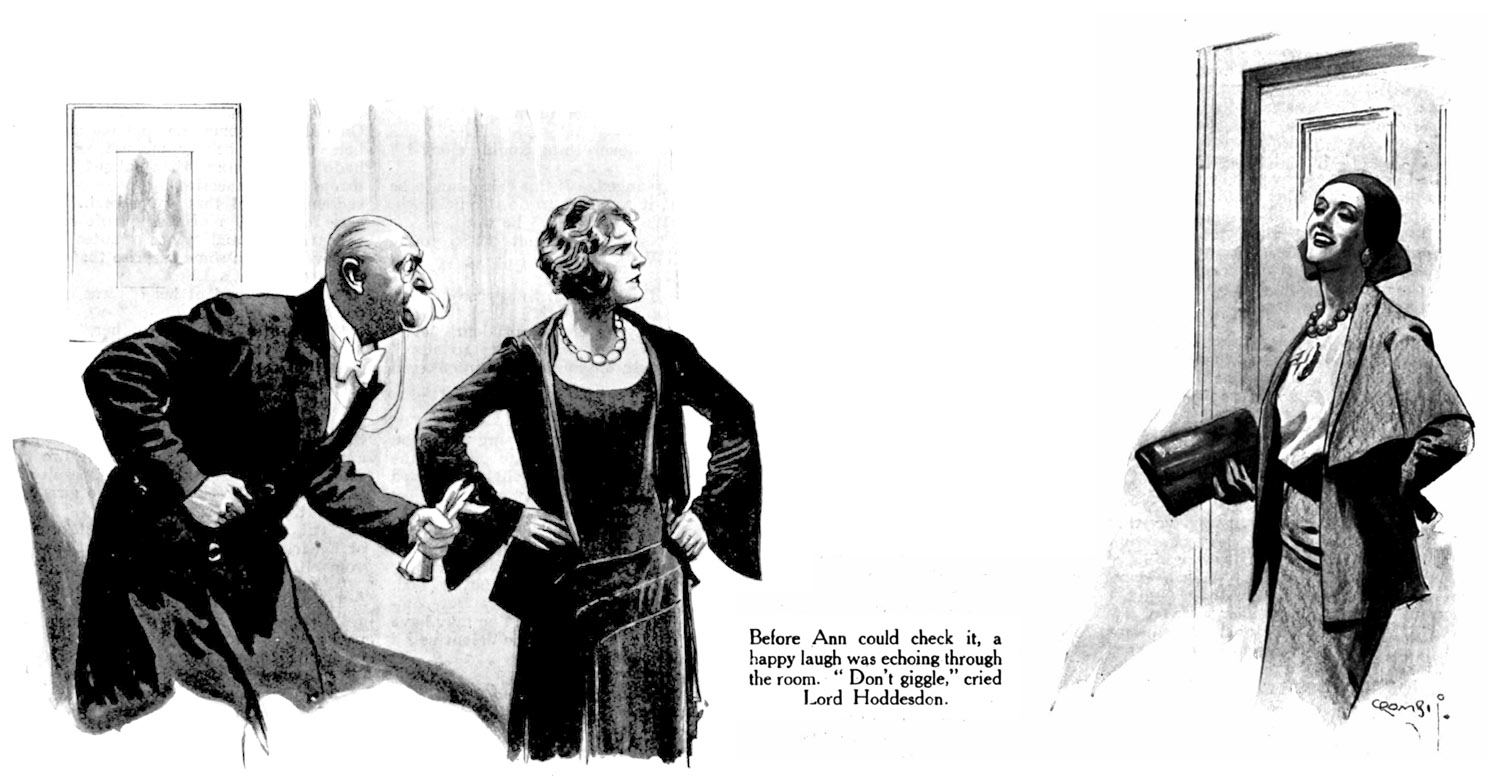
“Don’t giggle!” he cried.
Ann became brave.
“I’m sorry,” she said. “Only it seemed funny that you should have been looking on all the time.”
“The humorous aspect of the matter,” said Lady Vera, heavily, “is not the one that appeals to me.”
“I’m sorry,” said Ann. “I shouldn’t have . . . It was too bad of me. . . . But you know how it is when you’re nervous.”
“Nervous!” Lord Hoddesdon snorted. “You nervous? If ever I’ve seen a girl calmer and more—er—what’s the word?—more—ah—begins with a b——”
“George,” said Lady Vera, “be quiet.”
Lord Hoddesdon subsided into his chair. He seemed to be wishing that he had brought his Dictionary of Synonyms along with him this evening.
“I’m sorry,” said Ann, for the third time, “and if I had known about it sooner I would have told you sooner, but I’m afraid I am not going to marry Godfrey.”
Lord Hoddesdon heaved slightly, like a volcano erroneously supposed to be extinct. His sister, noting the symptoms, raised a compelling hand.
“George!”
“Aren’t I to say a word?” demanded Lord Hoddesdon, with pathos.
“No.”
“Oh, very well. I’m the head of the family. Biskerton is my only son. This girl comes calmly in and tells us that she proposes to throw him over like a—like a—well, to throw him over. And I am not to say a word. I see. Precisely. Quite. I suppose,” said Lord Hoddesdon, witheringly, “that you would have no objection to my amusing myself with a game of solitaire while you two discuss this affair—this affair in which I, of course, have no interest whatever. Ha!” said his lordship, feeling, in spite of himself, a good deal better.
Lady Vera turned to Ann.
“Perhaps you will explain?”
“I don’t think there is anything to explain.”
“Of course not,” said Lord Hoddesdon, heartily, addressing a china cat which stood on a small table at his elbow. “Certainly not. Nothing to explain. Quite so. Very bad form of us to be inquisitive. But let me tell you——”
“George!”
“Oh, all right,” said Lord Hoddesdon.
“I mean,” said Ann, “if you saw me at Mario’s, you must know that——”
“I know what apparently seems to you the only point worthy of discussion, that you propose to jilt my nephew in favour of this man you were dining with to-night. But I think that, as you have been put in my charge by your parents and that I am, therefore, in a position of trust and responsibility, I am entitled to ask——”
“Who the devil is the mouldy feller?” said Lord Hoddesdon, rising suddenly to the surface.
Lady Vera tightened her lips. The question was, in essence, the high spot to which her speech was tending, though she would have phrased it differently. But she liked to ask her own questions for herself. She directed at her brother a glance which sent him back into the recesses of his chair, and turned to Ann expectantly.
“Yes,” she said. “Who is he?”
“His name is Conway.”
“And what is he?”
“He is in the Secret Service.”
Lord Hoddesdon, though crushed, could not let this pass.
“Secret Service?” he said. “Secret Service? Secret Service? Never heard such nonsense in my life.”
“George!”
“Yes, but dash it——”
“George!”
“Oh, all right!”
“He is in the Secret Service, is he?” said Lady Vera, ignoring a low rumbling from the Volcano. “He told you that?”
“Yes.”
“To-night?”
“No. When we first met.”
“When was that?”
“About a week ago.”
“A week! A week! A week——!”
“George!”
“Oh, all right.”
“So you have known this man you intend to marry as long as a week?” said Lady Vera. “Fancy! Might I ask how you made his acquaintance?”
“He jumped into my car.”
“He—what? Why did he do that?”
“He was chasing the Sniffer——”
“I’m afraid I don’t understand this modern slang. What do you mean by chasing the Sniffer?”
“He was trying to catch a criminal called the Sniffer. Only he wasn’t. I mean, it wasn’t the Sniffer, after all. But he thought it was, and he jumped into my car and I drove him down to Esher. And then I met him again.”
“Where?”
“At the Bassingers’ dance.”
“Oh?” Lady Vera was a little shaken. “He knows the Bassingers, does he?”
Ann was her honest self.
“No,” she said.
“But you say he was at their dance?”
“He came there because he saw me going up in the lift. He wasn’t invited.”
The Volcano erupted.
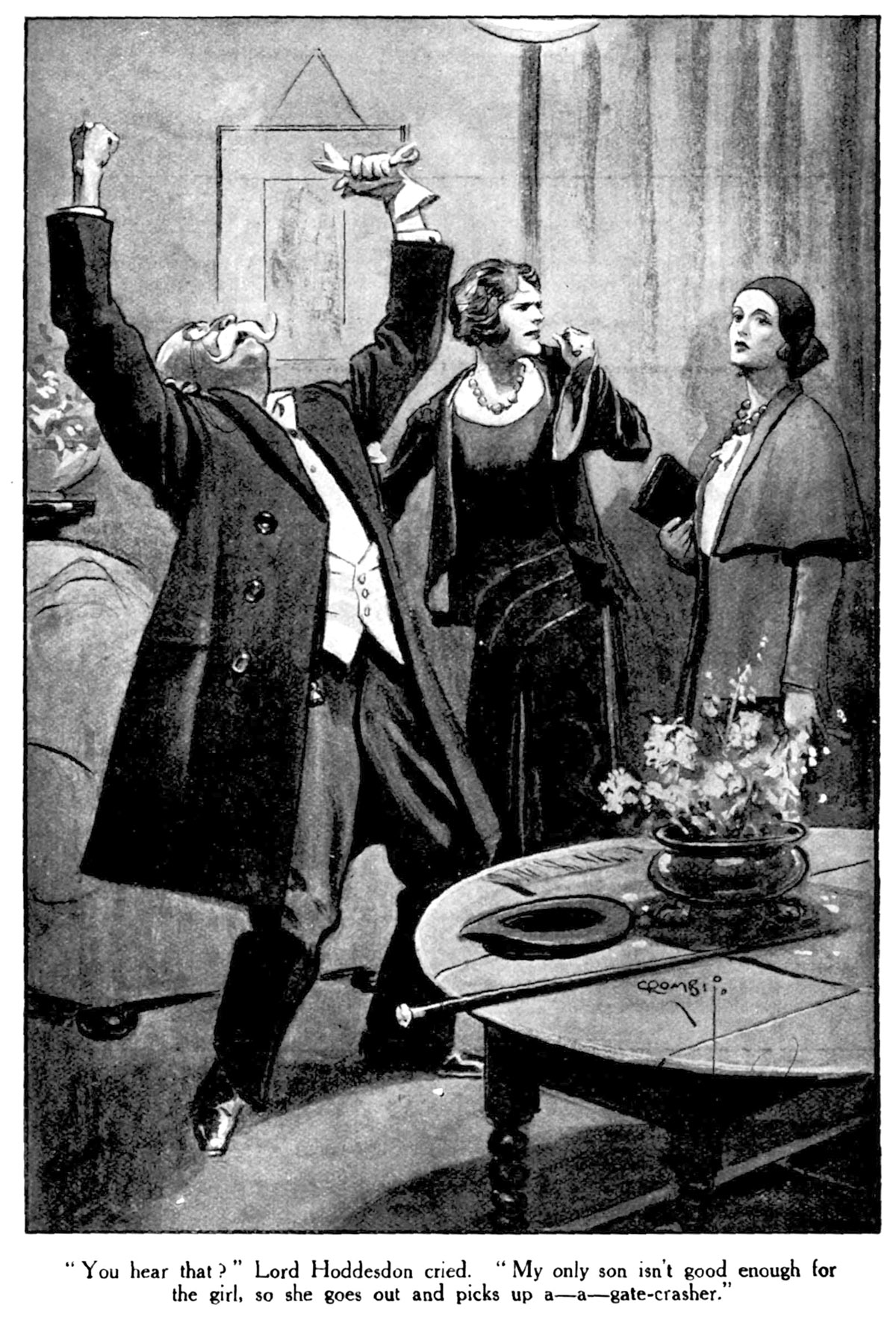
“Wasn’t invited? Wasn’t invited? A gate-crasher! You hear that? My only son isn’t good enough for the girl, so she goes out and picks up a—a—gate-crasher!”
The revelation had moved Lady Vera so deeply that she could not even spare the time to say “George!”
“Well!” she said, drawing in her breath sharply.
“I thought it was very sporting of him,” said Ann, defiantly.
“Sporting!”
“Well, it was. To do a thing like that just because he wanted to see me so much. It isn’t very pleasant for a man to be turned out of a dance.”
“So he was turned out? I see. Charming! And when did you meet him again?”
“To-night.”
“And——?”
“He kissed me,” said Ann, stoutly, wishing, for she was a self-respecting modern girl, that she had been able to refrain from blushing. “And I kissed him. And he told me he loved me. And I told him I loved him. And then we went off to dinner.”
THERE was a silence, broken only by a noise from Lord Hoddesdon like the bubbling of molten lava.
“And you know nothing about him,” said Lady Vera, “except that he says he is in the Secret Service and is not persona grata at the Bassingers’ dances? Has this remarkable person any fixed abode? Or does he just wander about the streets jumping into girls’ cars?”
“He lives,” said Ann, softly, breathing the address in a devout voice, for it was sacred to her, “at The Nook, Mulberry Grove, Valley Fields.”
“What!” cried Lady Vera.
“What!” cried Lord Hoddesdon.
“Why, what’s the matter?” asked Ann, surprised.
“Nothing,” said Lady Vera.
“Nothing,” said Lord Hoddesdon.
“If you’re thinking that people have no right to live in the suburbs,” said Ann, once more with defiance in her voice, “he has to, because they don’t pay you much in the Secret Service.”
“I see,” said Lady Vera, silkily. “This young man is not well off. How lucky he has decided to marry money!”
“What do you mean?” cried Ann. “Are you suggesting——?”
Lady Vera’s manner changed. She became so intensely motherly that her brother, rumbling in his chair, stared at her, awed.
“My dear child,” she said, and her smile was a composite of all of the smiles of all the mothers in filmdom, “of course, I know just how you are feeling about this man, but you really must use your intelligence. It is not as if you were a stupid, unsophisticated girl. You have seen quite enough of the world to know that life is not a fairy-story.”
“Or a twopenny novelette,” said Lord Hoddesdon.
“Or a twopenny novelette,” said Lady Vera. “You know what big cities are like. London is full of adventurers, as I suppose New York is. This man is one of them.”
“He isn’t!”
“My dear child, of course he is. And you could see it for yourself if you were not blinded by infatuation. Jumping into girls’ cars! Honest men don’t jump into girls’ cars.”
“I don’t,” said Lord Hoddesdon, mentioning a case in point. “Never jumped into a girl’s car in my life.”
“What you don’t realize, dear,” proceeded Lady Vera, gently, “is that you are a very well-known girl. Your photograph has been in all the weekly papers. You have been seen about everywhere. There are a dozen ways in which this man could have got to know you by sight. Obviously, he must have marked you down; and when he saw you in your car that day he seized his opportunity. He knew how it would appeal to an imaginative girl, a man jumping in beside her and asking her to help him pursue a criminal. He knew that you are the daughter of a very rich man——”
Ann had had sufficient.
“I’m not going to listen to any more,” she said, pinkly.
“There isn’t any more to listen to,” said Lady Vera. “I have told you the whole story. And, if you have any sense at all, you will realize for yourself——”
“Good night,” said Ann, and went out with her chin up.
SHE left behind her an electric silence. Lord Hoddesdon was the first to break it.
“Well?” he said. “Do you suppose you have convinced her about this fellow?”
“At least I have given her something to think about.”
Lord Hoddesdon pulled at his moustache.
“Odd about that address.”
“My dear George,” said Lady Vera, with the same patient contempt with which another great mind was wont to say, “My dear Watson,” “I really cannot see why you should consider it odd.”
“Why, dash it,” protested his lordship. “The coincidence. You can’t say it’s not a coincidence. Mulberry Grove, Valley Fields, is where Godfrey is living.”
“Exactly. And I have no doubt that this man has somehow managed to scrape acquaintance with Godfrey. Godfrey, who has no idea of reticence, but babbles all his most private affairs into the ear of the first person who comes along, must undoubtedly have told him who he was and, I suppose, showed him Ann’s photograph and mentioned that she was a very romantic girl. And when the man found her sitting alone in her car, he saw his chance.”
“I see. I’ve often thought,” said Lord Hoddesdon, with a father’s sad earnestness, “that Godfrey ought to be in some sort of mental institution. He has gone and messed things up thoroughly now. Is there anything we can do, do you think?”
“Of course there is something we can do. You don’t imagine that I am going to sit quietly and see this man ruin Ann’s life? I should imagine that the thing will resolve itself into a question of money. Mr. Frisby must buy him off.”
“You think he would?”
“Of course he would. He will be just as anxious as we are to free Ann from this entanglement.”
“Why?”
“His sister, Ann’s mother, is, I understand, the sort of woman who would make herself exceedingly unpleasant if Ann were to marry the wrong man.”
“Ah!” said Lord Hoddesdon, enlightened. He knew all about unpleasant sisters.
“So,” said Lady Vera, “you had better go down to Valley Fields to-morrow morning and see this man. I’ll get Mr. Frisby to give you a cheque.”
Lord Hoddesdon started violently. Until this moment he had been looking on the affair in a spirit of easy detachment. He had never dreamed that there would be any suggestion of his undertaking the negotiations. The mere idea of paying a return visit to the stamping-ground of the disciple of Stayling appalled him.
“Go to Valley Fields!” he cried. “I’m dashed if I do!”
“George!”
“No,” returned Lord Hoddesdon, reckless of the lion-tamer’s gleam in his sister’s eye, “I will not. You aren’t going to get me down to that Hell on earth, not if you argue all night.”
“George!”
“It’s no good saying ‘George’! I’m not going. I don’t like Valley Fields. There’s something about the place. It’s unlucky.”
“Don’t be absurd.”
“Absurd, eh? Well, look what happened last time. I went down there in a grey top-hat that I had meant to see me through another half-dozen Ascots, and I only just managed to escape with my life in a cloth cap with purple checks. And that wasn’t all. That wasn’t half of it. I had to run—run like a hare, dash it!—to escape being murdered by a beer-swilling native. I had to gallop into back gardens and leap through windows. And you calmly ask me to face all that over again! I can see myself! No,” said Lord Hoddesdon, firmly. “I approve of the idea of offering this bounder money to release Ann, but I decline to be appointed Paymaster. Do the thing in a regular and an orderly manner, I say. Go to your friend Frisby and tell him to send his lawyer to interview this fellow. It’s a lawyer’s job. Good night, Vera!”
And, seizing his hat, Lord Hoddesdon sprang for the door. He could have lingered, had he wished, to hear what his sister had to say in reply to this ultimatum, but he did not wish.
Printer’s error corrected above:
Magazine, p. 218b, had “filmdon”.
Editorial difference not corrected:
Magazine, p. 216a, had “repay hospitality and that”; UK and US book versions agree, but US magazine had “repay hospitality and all that” which seems more likely the original wording.