 Madame Eulalie’s Rare Plums
The Strand Magazine, March 1931
CHAPTER X.
i.
ALTHOUGH the little luncheon arranged by Lord Biskerton and his friend Berry Conway had been designed primarily as a celebration of their joint felicity, they had scarcely settled themselves at the table before it lost this care-free aspect and became undisguisedly a discussion of ways and means.
“I am not saying,” said the Biscuit, “that this isn’t the maddest, merriest day of all the glad new year, because it is. We love. Excellent. We are loved. Capital. Nothing could be sweeter. But now the question arises, How the dickens are we going to collect enough cash to push the thing through to a happy conclusion? We must not fail to realize that between us we have got just about enough to pay for one marriage ceremony. And we shall need a couple.”
Berry nodded. He had not failed to realize this.
“Because,” said the Biscuit, “there is none of that one-portion-between-two stuff with clergymen. Each time the firing-squad assembles, even though it be on the same morning and with a breathing-space of only a few minutes, the vicar wants his little envelope. So we are faced by the eternal problem of Money and how to get it. Who,” he asked, looking across the room, “is the red-faced bird who has just waved a paternal hand at us? I don’t know him. One of your City friends?”
Berry followed his gaze. At a table near the door a stout and florid man was sitting, obviously doing himself well. J. B. Hoke, that obese double-dealer, always made of his lunch almost a holy rite; and as a temple in which to perform it he usually selected this particular restaurant. Things were going well with Mr. Hoke. He had unloaded all his Horned Toad Copper at four shillings, and his financial paper informed him this morning that it was down to one shilling and sixpence. At his leisure he proposed to buy it in again, possibly when it had sunk to a shilling, and then the information of the discovery of the new reef would be made public and he would have nothing to do but sit pretty and watch her shoot skywards. The future was looking to Mr. Hoke as rosy as his face.
“That,” said Berry, “is Hoke. The fellow who bought my mine.”
“Is it?” The Biscuit scrutinized the philanthropist with interest. “Bought the mine, did he? Odd. He doesn’t look like a mug. You don’t think it’s possible——”
“What?”
“I was just wondering whether that mine was quite such a dud as you thought it. I don’t like Hoke’s looks. I suspect the man. He has the air of one who would be pretty rough with the widow and the orphan if he got a chance. What’s become of this mine? Is he using it as a summer camp or something?”
“I believe it has been absorbed into a thing old Frisby owns—Horned Toad Copper.”
“How does Frisby get mixed up with it?”
“Hoke’s a friend of his.”
“Is he?” The Biscuit snorted. “Well, that damns him properly. What honest man would be a friend of old Frisby? You take it from me, Berry, these hounds have done you down.”
“Well, it’s too late to worry about it now.”
“I suppose it is.”
“What we had better think about is how we are going to raise a bit of money.”
The Biscuit frowned.
“Money!” he said. “Yes. You’re right. We might try the old secret game, of course.”
“I don’t know that.”
“Yes, you do. I recollect telling you. The two blokes—Bloke A. and Bloke B. Bloke A. goes up to Bloke B. and says, ‘I know your secret!’ And Bloke B.——”
“I remember now. But suppose your second bloke hasn’t got a secret?”
“My dear old boy, everybody has a secret. It’s one of the laws of Nature. When you get back to the office, try it on old Frisby and watch him wilt. Become a gentlemanly blackmailer and earn while you learn.”
“Talking of Frisby,” said Berry, looking at his watch, “I suppose I ought to be getting along. He’s had another of his dyspeptic attacks and didn’t come to the office this morning. He ’phoned to say he wanted me to bring the mail up to his flat in Grosvenor House. Rather convenient.”
“Why convenient?”
“Well, for one thing, I want to see him to tell him I’m chucking my job. And then,” said Berry, “I shall be near the Park. I promised to meet Ann at the Tea House. We’re going to feed the ducks on the Serpentine.”
“My God!”
“Well, we are,” said Berry, doggedly. “And if you don’t like it, try to do something about it. Are you coming along?”
“No. I shall sit here and think. I must think. I must think—think. How the dickens, with your whole future clouded with the most delicate financial problems, you can waste your time feeding ducks——”
“I don’t look on it as a waste of time,” said Berry. “So long. See you to-night.”
He walked to the door, and was hailed in passing by Mr. Hoke.
“And how’s Mr. Conway?” asked Mr. Hoke.
“I’m all right, thanks,” said Berry.
“Who’s your friend?”
“Man who lives next door to me down at Valley Fields.”
“What were you talking about so earnestly?”
Berry wanted to hurry on.
“Oh, various things. The Dream Come True, among others.”
“The Dream Come True, eh?”
“Yes. He seemed interested in it. Well, I must rush.”
“Pleased to have seen you,” said Mr. Hoke.
He returned to his steak, and for some moments became absorbed in it. Then a shadow fell on the table, and, looking up, he perceived his old friend, Captain Kelly.
ii.
MR. HOKE was not glad to see Captain Kelly. Indeed, he had been going to some little trouble of late to avoid him. But his mood was too radiant to allow him to be depressed by this encounter.
“ ’lo, Captain,” he said, amiably.
Captain Kelly pulled a chair back and lowered himself into it with a tight-trousered man’s slow caution.
“Lunch?” said Mr. Hoke.
“No,” said Captain Kelly.
His manner was undeniably on the curt side, and a man with a more sensitive conscience than Mr. Hoke possessed might have been troubled.
“Want a word with you,” said Captain Kelly.
J. B. Hoke cut off a generous piece of steak, dipped it in salt, smeared it with mustard, bathed it in Worcester sauce, placed a portion of potato on it, added cabbage and horse-radish, and raised the complete edifice to his mouth. Only when it was safely inside did he reply, and then only briefly.
“Yeah?” he said.
The Captain continued to eye him fixedly.
“What about that mine?” he said.
“What mine?”
“The Dream Come True I’m talking about.”
“What about The Dream Come True?”
“Yes, what about it?” said the Captain.
Mr. Hoke engulfed his mouthful, and sat champing placidly. The spectacle appeared to infuriate his friend.
“See here,” said Captain Kelly, his face, educated by a thousand poker-games, still expressionless save for a little vein below the temple which swelled and throbbed. “Wasn’t the agreement that you and I should buy that mine together? Wasn’t it? And didn’t you go off and buy it for yourself? It’s no use trying to deny it. Bellamy was there when you did it, and he told me.”
“Bless your heart,” said Mr. Hoke, with gentle amusement, “I’m not trying to deny it.”
“Ah!” said Captain Kelly.
“You want to watch your step when you’re doing business,” said Mr. Hoke. “If you don’t, you find yourself sidetracked, and there you are, out in the cold, and nothing to be done about it.”
“Nothing to be done about it?”
“Not a thing,” said Mr. Hoke, “to be done about it.”
Captain Kelly breathed softly through his nose.
“Ah!” he said again.
“Say ‘Ah!’ just as often as ever you like,” said Mr. Hoke, generously. “It won’t make any difference.” He swallowed another mouthful of steak. “I’m sorry for you, Captain. If it’s any consolation to you to know it, I’m sorry for you. You’ve let yourself be out-smarted. It’s the fortune of war. That’s all there is to it. Happens all the time. You to-day, me to-morrow.”
“What do you expect to make out of this deal?” asked the Captain.
Mr. Hoke had no objection to answering that question.
“Thousands and thousands,” he said. “And thousands.”
“And I might have had half,” sighed Captain Kelly.
“And you,” agreed Mr. Hoke, “might have had half.”
The Captain sighed again. There was a long silence.
“I could have done with a bit of money just now,” said the Captain.
“I bet you could,” said Mr. Hoke, cordially.
“I’ve a lot of expenses just at present.”
“We all have,” said Mr. Hoke.
“You see, it costs money to entertain these fellows,” said the Captain, pensively.
Mr. Hoke cut steak.
“What fellows?” he asked.
“A couple of lads from Chicago have come over with a letter of introduction from a friend of mine in America. He’s a man I’m under obligations to, so it’s up to me to take care of them. And they seem to think,” said Captain Kelly, sighing once more, “of nothing but pleasure. That’s why I want to find some money.”
“I suppose so,” said Mr. Hoke.
“Of course, there’s the other side. They’re grateful to me. They look on me like an elder brother. They said yesterday that there wasn’t anything in the world they wouldn’t do for me.”
“That’s fine,” said Mr. Hoke, heartily. “A nice spirit.”
“You’d have laughed if you had heard what their idea of doing something for me was,” proceeded the Captain. “They asked me if there wasn’t anybody I wanted bumped off. If there was, they said, they would be proud and happy to do it for me free of charge, just to show their gratitude and keep their hands in.”
MR. HOKE may have laughed, but, if so, he did it inaudibly.
“Bumped off?” he said, in a thin voice.
“Bumped off,” said the Captain. “Didn’t I mention,” he went on, with a glance of mild surprise at his companion’s drooping jaw, “that they were gunmen?”
“Gug?” said Mr. Hoke.
“Yes. And rather well known, I believe, over on the other side. What they call Chicago gorillas. Extraordinary chaps!” said the Captain, reflectively. “Children of Nature, you might say. Just a couple of great, big, happy schoolboys. Fancy wanting to repay hospitality by coshing somebody who had done your host a bad turn! It amused me.”
He chuckled, to show that he still found the pretty fancy entertaining. He had a curious way of chuckling. His mouth lifted itself slightly on one side, the lips remaining tightly closed. His eyes during the performance retained their normal aspect, which was that of a couple of bits of light blue steel. Mr. Hoke found it interesting, but not attractive.
“Well, I mustn’t waste the whole day talking to you,” said Captain Kelly, rising.
“Hey!” said Mr. Hoke. “Wait!”
“Something you want to say?” asked the Captain, resuming his seat.
Mr. Hoke swallowed painfully.
“Guys like that ought to be in jail,” he said, with feeling. “In jail, that’s where they ought to be.’
Captain Kelly nodded lightly.
“They were for a day or two,” he said, “that time they shot Joe Frascati in Chicago. They let them out, though. Still, they had to come here till it blew over.”
“Shush—shot him?” quavered Mr. Hoke.
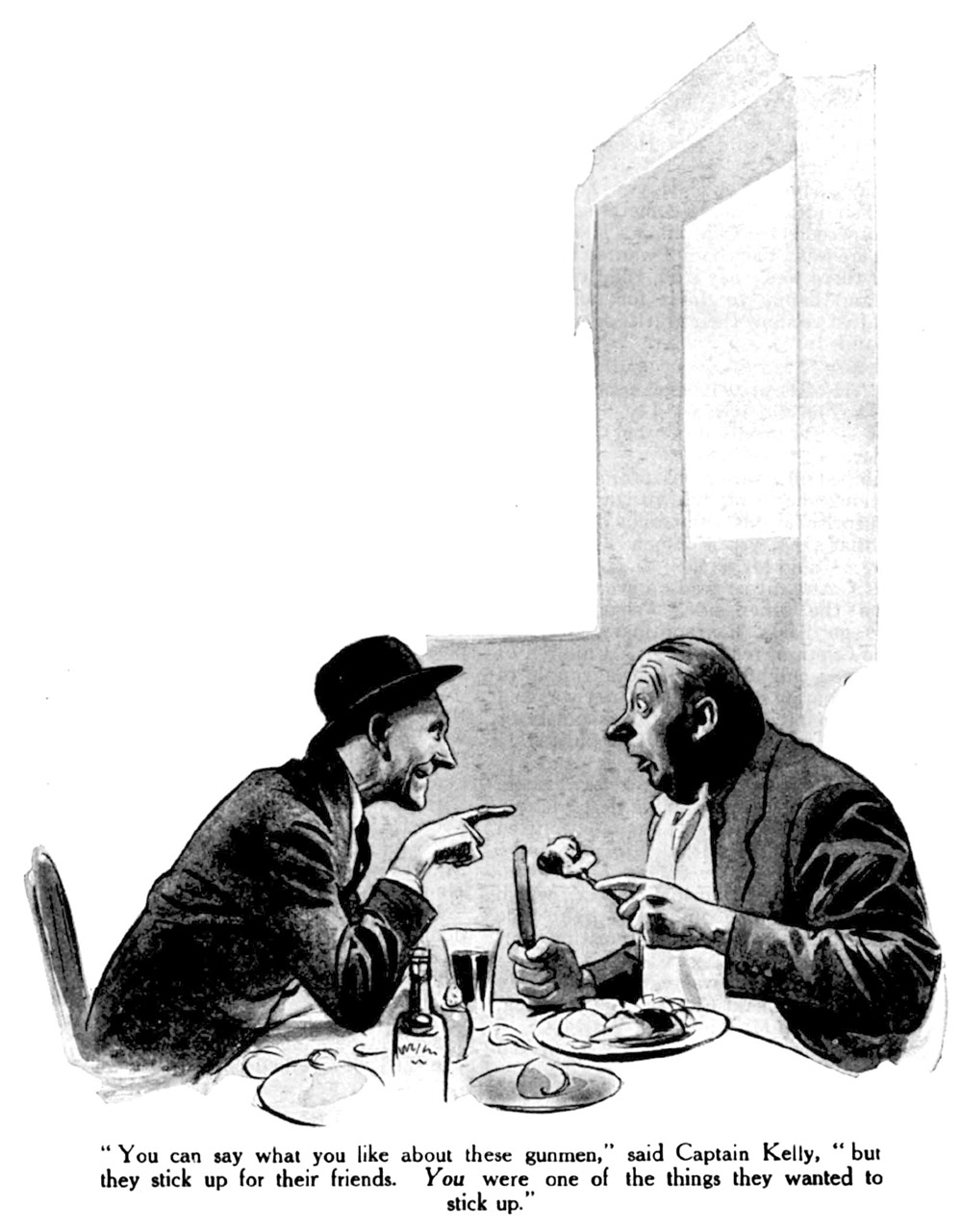 “Bless you,” said the Captain, “that’s nothing in Chicago. You ought to know that, coming from the other side. Well, as I was saying, they wanted to oblige me, and by a bit of bad luck I happened to mention the way you had done me down. You never saw two fellows so worked up. Big-hearted, that’s what they are. You can say what you like about these gunmen, but they stick up for their friends. You were one of the things they wanted to stick up,” said Captain Kelly, chuckling at the pleasantry. His spirits seemed to have improved.
Mr. Hoke became vociferous.
“Stick me up? What for? I’ve not done nothing. You don’t suppose I was really planning to do you down, do you—an old friend like you? I was just kidding you, Captain, to get your goat. I wanted to see how you’d take it.”
“Well, you saw,” said the Captain, briefly. “And now I really must be going. I promised to meet those two at the club.”
“Wait!” said Mr. Hoke. “Wait! Wait!”
He gulped.
“You get your half share all right,” he said. “I’ll give you a letter to that effect, if you like. Write it now, if you want me to.”
Something that was very near to being a pleased smile flitted across the Captain’s face.
“I should,” he said. “I know it would please those boys. The waiter will bring you ink and paper.”
“I’ve a fountain-pen,” said Mr. Hoke, thickly. “And here’s a bit of paper that will do.”
He scribbled feverishly. Captain Kelly examined the document, seemed contented with it, and put it carefully away in his pocket.
“I’ll be at the club all the afternoon,” he said, rising. “Only to look in at Somerset House to get this stamped.”
He walked in a leisurely manner to the door. And Mr. Hoke, his appetite no longer what it had been, stopped eating steak and called for coffee and a double brandy.
Then, lighting a large cigar, he gave himself up to meditation. The sunshine which so recently had bathed his world had vanished. There had been a total eclipse.
iii.
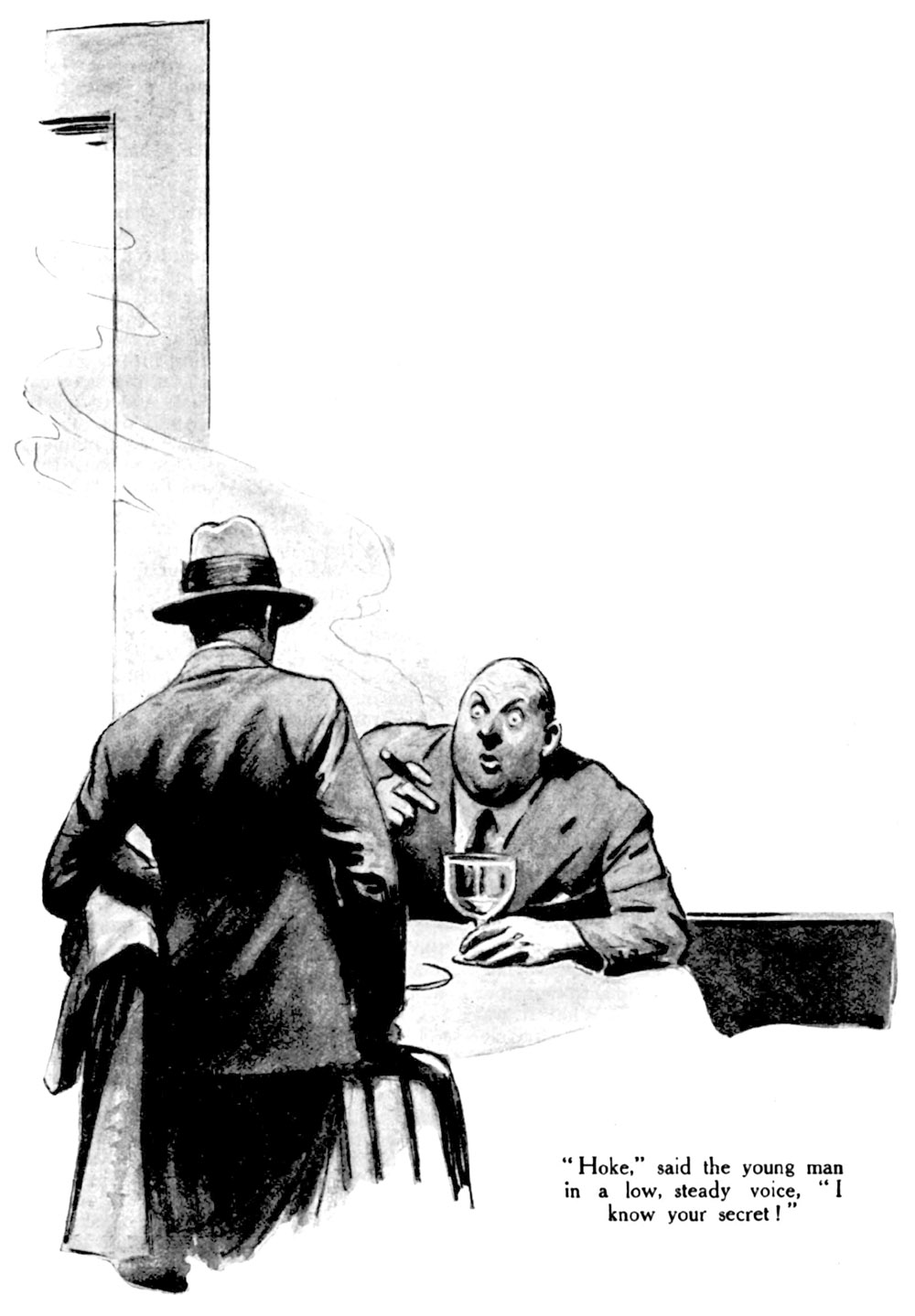
IT was as he reached the point in his cigar where a good smoker permits himself the first breaking of the ash that J. B. Hoke became aware that his privacy had once more been invaded. Standing beside his table was the young man who had been lunching with Berry Conway. This young man was eyeing him meaningly.
 It disturbed Mr. Hoke.
Mentally, at this moment, J. B. Hoke was a little below par. His nervous system had lost tone. He was in the state where men start at sudden noises and read into other people’s glances a sinister significance which, at a happier time, they would not attribute to them. And, as he met the Biscuit’s eye, there came to him abruptly the recollection that this was the man who, according to young Conway, had shown such an interest in The Dream Come True.
“Well?” said Mr. Hoke, belligerently. He found the other’s scrutiny irritating. “Well?”
The young man’s gaze narrowed.
“Hoke,” he said in a low, steady voice, “I know your secret!”
CHAPTER XI.
i.
PRONE on the sofa, in his palatial apartment on the second floor of Grosvenor House, T. Paterson Frisby lay and stared at the ceiling. It seemed to him that they had been painting it yellow. The walls were yellow, too: and some minutes previously, when he had risen with the idea of easing his agony by pacing the floor, he had noticed this same gamboge motif in the sky. The fact is, extraordinary things were happening inside Mr. Frisby. He had been eating roast duck again. It seemed to Mr. Frisby that his punishment was out of all proportion to the crime. Just one brief period of self-indulgence, and here he was, derelict.
What was going on in T. Paterson’s interior resembled in some degree a stormy shareholders’ meeting. Nasty questions were being asked. Voices were being raised. At times it seemed as though actual violence had broken out. And the pepsine tablets which he kept swallowing so hopefully were accomplishing nothing more than might on such an occasion the bleating “Gentlemen, please!” of an inefficient chairman.
“Ouch!” said Mr. Frisby, as a new spasm racked him.
He had but one consolation. In all the dark cloud-rack there was only one small patch of blue sky. At any moment now his secretary would be arriving with the mail, and he looked forward with something approaching contentment to the thought of working off some of his venom on him. Minus roast duck, he was not an unkindly man; but under its influence his whole nature changed, and he became one of those employers who regard a private secretary as a spiritual punch-ball.
It was in this unpromising frame of mind that Berry found him.
BERRY was feeling a little disturbed himself. The pleasure of the Biscuit’s society had caused him to prolong his luncheon beyond its customary limits; and on his return to the office there had been a succession of visitors, anxious to see Mr. Frisby. These he had had to deal with, and it had taken time. There was only another fifteen minutes before the hour of his tryst with Ann at the Hyde Park Tea House. As he entered the room, he was looking fussily at his watch.
“Well——” began Mr. Frisby, half rising from his bed of pain.
It had been his intention to continue the speech at some length. What it was in his mind to say was that when he telephoned to the office for his mail to be brought to Grosvenor House after lunch, he meant after lunch and not five minutes before dinner-time. He would have gone on to inquire of Berry if he had lost his way, or if he had been entertaining himself between Pudding Lane and Grosvenor House by rolling a peanut along the sidewalk with a toothpick. To this he would have added that if Berry supposed that he paid him a weekly salary simply because he admired his looks and liked having something ornamental about the office, he, Berry, was gravely mistaken.
For Mr. Frisby, as we have seen, could, when moved, be terribly sarcastic.
All these things the stricken financier would have said, and many more; and the saying of them would undoubtedly have brought him much relief. But even as he uttered that “Well,” his visitor spoke.
“I can only give you a minute,” he said.
It affords a striking proof of the superiority of mind over matter that at these words Mr. Frisby completely forgot that he was a sick man. A sudden lull fell on that shareholders’ meeting inside him. So great was his emotion that he sprang from the sofa like a jumping bean.
Mr. Frisby had once had a secretary who had startled him by coming into the office one afternoon in a state of smiling intoxication and falling over a chair and trying to take dictation with his head in a waste-paper basket. And until this moment this had always seemed to him to constitute what might be called the Farthest North of secretarial eccentricity.
But now that episode paled into insignificance. Between a pie-eyed secretary who fell over chairs and a curtly impatient secretary who looked at his watch and said he could only give him a minute there was no comparison whatever.
“I’m sorry,” said Berry, “but I’ve promised to go and feed the ducks on the Serpentine.”

It was undoubtedly that fatal word “ducks” that struck Mr. Frisby dumb. Nothing else could have withheld him from the most eloquent address that had ever scorched a private secretary’s ears. But at the sound of that word, as once had happened in a palace in Fairyland at the sound of a kiss dropped on the brow of Sleeping Beauty, everything inside him seemed suddenly to come alive again. The shareholders’ meeting was on once more in all its pristine violence.
Mr. Frisby sank back on to the sofa and reached feebly for the pepsine bottle.
“As a matter of fact,” proceeded Berry, “I only looked in to tell you that I was resigning my position. But you will be all right,” he added kindly. “You can ’phone to an agency to send you up a stenographer to attend to these letters, and you can always get another secretary in half an hour. And now,” he said, “I’m afraid I really must rush. I’ve got to be at the Tea House in the Park in five minutes.”
He hurried out, feeling that he had conducted the delicate business of resignation in a tactful and considerate manner. In a way, he was fond of Mr. Frisby, and wished that he had had more time to spare him; but the necessity of being punctual at the tryst was imperative. He raced for the door of the suite, and reached it just as it was being opened by Mr. Frisby’s man for the admittance of a new visitor.
The new arrival was no stranger to him, though he supposed he was to her. It was Lady Vera Mace. Berry was never quite sure how he stood with Lady Vera in the matter of bowing or smiling or other form of intimacy. Eleven years ago she had visited her nephew, Lord Biskerton, at school, and he, Berry, as the Biscuit’s best friend, had been included in the subsequent festivities; but, though in his own memory this affair still remained green, the party of the second part had evidently forgotten it entirely. On the one occasion when they had met since that distant date, in Mr. Frisby’s outer office, when she had called to discuss the chaperoning of Ann, she had given no sign of recognition.
So now he claimed no acquaintance. He did not bow, but stood on one side in a courtly manner, to allow her to pass. And as she passed her eyes fell on him, and he was surprised to see them light up suddenly, as if in recognition. And what surprised him more was that the light in those eyes was not merely that of recognition, but of fear and dislike. Why, if Lady Vera remembered him at all, she should remember him as something obnoxious, Berry could not understand. At the age of fifteen he had probably not been exactly fascinating, but he was astonished to find that he had been so repulsive as to cause this woman, eleven years later, to shudder at the sight of him.
It was rather saddening, in a way. But he had no time to worry himself about it now. Lady Vera had passed on and was entering the room where Mr. Frisby and his interior organism were conducting their silent battle. Berry dismissed the matter from his mind, and ran down the corridor to the stairs. All he was thinking of now was that in another five minutes he would be meeting Ann again. A man with a thing like that before him had no time to worry about his unpopularity with the sisters of Earls.
Lady Vera Mace was a dignified woman; and, like all women who are careful of their dignity, she seldom hurried. But such was the emotion with which the sight of Berry had filled her that, as she crossed the threshold of Mr. Frisby’s sitting-room, she was positively running. The desire to receive some explanation of the presence in the financier’s suite of one whom she had come to look upon as London’s leading adventurer accelerated her movements to an extraordinary degree. Daughter of a hundred Earls though she was, she charged in like a greyhound on the track of an electric hare. She trembled with curiosity, and with that horror which good women feel when they have just met members of the underworld face to face in a narrow passage. And she was just about to pour forth a rain of questions when she perceived that her host was sitting doubled up in a chair, uttering sounds as of one in pain.
LADY VERA stopped, concerned. Accustomed to making up her mind quickly, at a very early date in their acquaintance she had decided quite definitely that later on she would marry T. Paterson Frisby. At their very first meeting she had recognized him as one who needed a woman to look after him, and when, in the course of their conversation, she had discovered that the post was vacant, she had determined to fill it.
So now she gazed upon him with something stronger than the detached womanly pity which she would have bestowed on a mere stranger whom she had found tying himself into knots.
“Whatever is the matter?” she asked.
“Ouch!” said Mr. Frisby.
Lady Vera had that splendid faculty which only great women possess of going instantly to the heart of the problem. At their first encounter this man had been in very much the same condition, and he had confided to her then his hidden secret.
“Have you been eating duck again?” she asked, keenly.
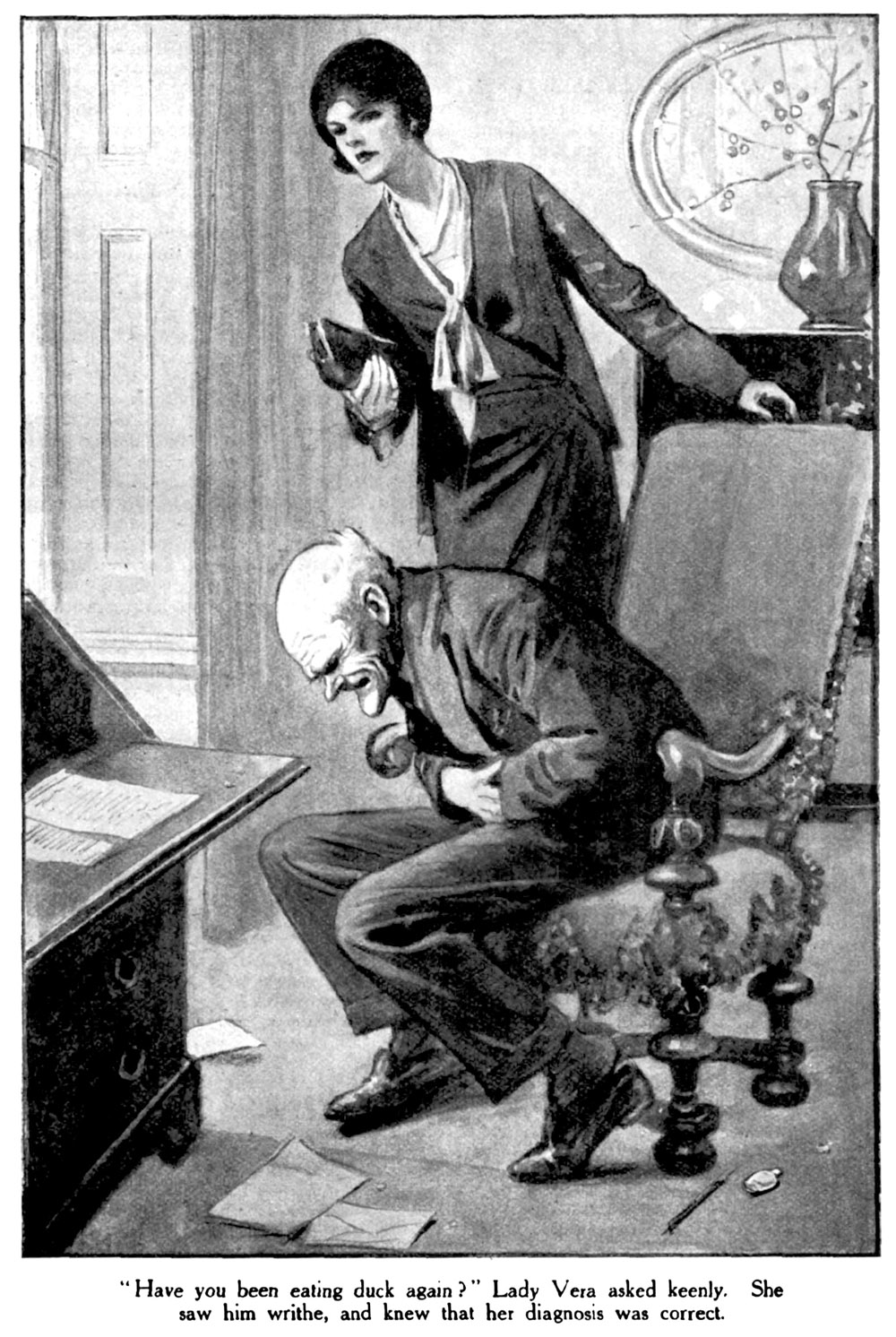
She saw him writhe, and knew that her diagnosis had been correct.
“Wait!” she said.
A woman of acute perception, she realized that this was no time for advising the patient to think beautiful thoughts, to recommend him to fancy himself a bird upon a tree, and to seek relief in song. The thing had gone too far for that. Cruder and swifter remedies were indicated.
She went to the telephone and was almost immediately in communication with the druggist on the main floor of the building. She spoke authoritatively, and as one having knowledge; and presently there was a ring at the bell and a small boy appeared, bearing a brimming glass full of some greyish liquid.
“Drink this,” said Lady Vera.
Mr. Frisby drank, and instantly it was as if some strong man had risen in the meeting of shareholders, dominating all. The shouts died to whispers, the whispers to silence. Peace reigned. And T. Paterson Frisby, licking his lips, spoke in a low, awed voice.
“What was it?”
“It is something my husband used to recommend. He suffered as you do. But after lobster. He said it was infallible.”
“It is,” said Mr. Frisby. “Have you ever tried it on a corpse? I should say it would work.”
A great surge of emotion had risen within him. He looked at Lady Vera Mace with glowing eyes, and a voice seemed to whisper to him that now was the moment for which he had been waiting so long. On a score of previous occasions T. Paterson Frisby had contemplated the idea of laying his widowed heart at the feet of this woman, of putting his fortune to the test, to win or lose it all; but always he had refrained. He had lacked the necessary courage. She had seemed so aloof, so statuesque. Now, as she stood there radiating gentle sympathy, she became approachable; and that inner voice seemed to say to him, “Go to it!”
He cleared his throat. What there had been in that stuff which he had just swallowed he could not say, but its effect had been to bring him to the top of his form. He felt confident. And he would undoubtedly have expressed himself in a series of telling phrases, calculated to win the heart of any woman, had not Lady Vera abruptly remembered that ten minutes ago she had hurried into this room in a spirit of research and inquiry. Even as Mr. Frisby was shaping his opening sentence, she shattered his whole scheme of thought with an agitated exclamation.
“That man!” she cried.
“Eh?” said Mr. Frisby.
“What was that man doing here?”
Regretfully, T. Paterson Frisby recognized that the golden moment had passed. The subject had been definitely changed. He saw now that his visitor’s mind was not in a condition to be receptive to the voice of Love. She seemed to want to know something about some man, and it was plain that no other topic would interest her. He swallowed his emotion, therefore, and sought enlightenment.
“Man?” he said. “What man?”
“The man I met as I came in. What was he doing here?”
Mr. Frisby was puzzled. She seemed to be referring to his late secretary.
“He came to bring me my mail,” he said.
“Your mail?” Lady Vera’s eyes widened. “Do you know him?”
A warm gleam came into Mr. Frisby’s eye. Subsequent occurrences had dimmed the memory of that remarkable interview with Berry Conway, but now it came back to him. He quivered a little.
“I thought I did,” he said. “Yes, sir! But he certainly surprised me just now. The young hound! ‘I can only give you a minute!’ He said that. To me! And off he went to feed ducks!”
Mr. Frisby paused, wrestling with a strong emotion.
“But who is he?”
“He is—was—my secretary.”
“Your secretary?”
“That’s right. His name’s Conway. And until to-day I’d always found him an ordinary, respectful——”
Lady Vera uttered an exclamation. She saw all.
“So that’s how he came to know Ann?”
Mr. Frisby found himself puzzled again.
“Ann? My niece Ann? He doesn’t know Ann.”
Lady Vera hesitated. It seemed cruel to let the thing descend on this man suddenly, like an avalanche.
“He does,” she said.
“I don’t think so,” said Mr. Frisby.
“I saw them dining together last night, Mr. Frisby,” said Lady Vera, unequal to the task of breaking the news gently. “I have had a talk with Ann. An awful thing has happened. She has broken off her engagement with my nephew, and says she is resolved to marry this man Conway. That is why I came here this afternoon to see you. We must decide what to do about it.”
Mr. Frisby uttered an exclamation. He, too, saw all.
“So that’s why he was so fresh?”
There was something not unlike satisfaction in his voice. All he could think of for the moment was that a mystery had been solved which might have vexed him to his dying day. Then, like an icy finger on his spine, came the realization of what this meant.
“Marry him?” he gasped. “Did you say marry him?”
“She said she intended to marry him.”
“But she can’t!” wailed Mr. Frisby. “My sister Josephine would never give me a second’s peace for the rest of my life.”
He stared at his visitor, appalled, and was stunned to perceive a soft smile upon her face. What anyone could find to smile at in a world where his sister Josephine’s daughter was going about marrying penniless ex-secretaries was more than Mr. Frisby could understand.
“Why, of course!” said Lady Vera. “How foolish of me not to have seen it directly you told me!”
“Eh?”
“Everything is going to be quite simple,” said Lady Vera. “If this man Conway is really your secretary, the problem solves itself.”
“Eh?” said Mr. Frisby again.
“But I didn’t tell you, did I? You see, Mr. Frisby, what has happened is this. This man, as far as I can gather from her story, seems to have swept Ann off her feet by telling her a lot of romantic stories about himself. Well, surely, when she finds that he has been lying to her and is nothing but a miserable secretary, she will realize the sort of man he is and will give him up of her own accord.”
Mr. Frisby looked doubtful.
“Told her romantic stories, did he?”
“He said he was a Secret Service man. You can imagine the effect that that would have on an impressionable girl like Ann. But when she finds out——”
Mr. Frisby shook his head.
“A bird as smooth as that,” he said, “is going to be smooth enough to jolly her along even when she does find out.”
“Then what you must do,” said Lady Vera, with decision, “is simply to send your lawyer down to his house to offer him money to give Ann up.”
“But would he give her up?” Mr. Frisby drooped despondently. He could see the flaw in the idea. “Why would he take money to give her up, when he could get more money by standing pat?”
Lady Vera overruled the objection.
“When your lawyer explains to him that Ann will be sent back to America immediately, out of his reach, if he refuses to come to terms, I am sure that he will be only too glad to take whatever you offer.”
The gloom passed from Mr. Frisby’s face. He gazed reverently at this woman of infinite sagacity.
“You’re dead right,” he said. “I never thought of that. I’ll get on to Robbins on the ’phone right away.”
“Yes, do.”
“I’ll tell him to start the bidding at a thousand pounds.”
“Or two?”
“Yes, two. You’re right again. He’ll drop sure for two thousand. Two thousand is big money.”
“What I would have done without you,” said Lady Vera, “I don’t know. Some men in your position would have ruined everything by being niggardly.”
MR. FRISBY glowed and expanded beneath her approbation. Once more that voice seemed to be whispering in his ear that it would be well to go to it. He simply needed an opening. The emotion was there, all ready to be poured out. All he required was a cue.
“Nothing niggardly about me,” he said, with modest pride.
“No.”
“I’m fond of money—I don’t deny it—but——”
“Isn’t everybody?”
“What?”
“Fond of money.”
“Are you?”
“Of course I am.”
“Have mine,” said Mr. Frisby.
He strode to the telephone, unhooked the receiver, and barked into it to cover a certain not unnatural confusion. If his cheeks had not been made of the most durable leather, they would have been blushing. What he had said was not what he had been intending to say. He had planned something on tenderer and more romantic lines. Still, that was the way it had come out. The proposition had been placed on the agenda, and let it lay, was Mr. Frisby’s view.
“Chancery 09632? Robbins? Come right round to Grosvenor House, Robbins. Yes, at once. Want to see you.”
Lady Vera was contemplating his rigid back with a kindly smile. She was experienced in the matter of inarticulate proposals. The late Colonel Archibald Mace had grabbed her hand at Hurlingham one summer afternoon, turned purple, and said, “Eh, what?” Compared with him, Mr. Frisby had been eloquent.
“Well?” said T. Paterson Frisby, replacing the receiver and turning.
“You go with it, I suppose?” said Lady Vera.
Mr. Frisby nodded curtly.
“There is that objection,” he said.
Lady Vera smiled.
“I don’t consider it an objection.”
“Vera!” said Mr. Frisby.
“Paterson!” said Lady Vera.
“Don’t call me Paterson,” said Mr. Frisby, breathing devoutly down the back of her neck. “It’s a thing I wouldn’t mention to anyone but you, and I hope you won’t let it get about, but my first name’s Torquil.”
ii.
TO Berry Conway, hurrying across its verdant slopes to where the Tea House nestled among shady trees, Hyde Park seemed to be looking its best and brightest. True, the usual regiment of loafers slumbered on the grass and there was scattered in his path the customary assortment of old paper bags; but this afternoon, such is the magic of Love, these objects of the wayside struck him as merely picturesque. Dogs, to the number of twenty-seven, were barking madly in twenty-seven different keys; and their clamour sounded to him like music.
If anyone had told him that his manner during their recent chat had been of a kind to occasion Mr. Frisby pain, he would have been surprised and wounded. He was bubbling over with universal benevolence. And when, coming in view of the Tea House, he perceived Ann already seated at one of the tables, his exhilaration bordered on delirium. The trees seemed to dance. The sparrows sang with a gayer note. The family at the next table, including though it did a small boy in spectacles and a velvet suit, looked like a beautiful picture. Many a person calmer than Berry Conway at that moment had been accepted—and with enthusiasm—by the authorities of hospitals as a first-class fever patient.
He leaped the railings and covered the remaining distance in two bounds.
“Hullo!” he said.
“Hullo!” said Ann.
“Here I am,” he said.
“Yes,” said Ann.
“Am I late?” asked Berry.
“No,” said Ann.
A just perceptible diminution of ecstasy came to Berry Conway. He felt ever so slightly chilled. Nearly eighteen long hours had passed since he and this girl had last met, and he could not help feeling that something more in the key of drama should have signalized their reunion. Of course, in a public place like Hyde Park girls are handicapped in the way of emotional expression. Had Ann sprung from her seat and kissed him, the small boy at the next table would undoubtedly have caused embarrassment by asking in a loud voice, “Ma-mah, why did she do that?” No, he could quite see why she did not spring and kiss him.
But—and now he saw what the trouble was—there was nothing whatever to prevent her smiling, and—what is more—smiling with a shy, loving tenderness. And she had not done so. Her face was grave. If he had been in a slightly less exalted mood, he might have described it as unfriendly. There was not a smile in sight. Her mouth was set, and she was not looking at him. She was concentrating her gaze—letting her gaze run to waste, as it were—on a small, hard-boiled-looking Pekingese dog which had wandered up and was sitting by the table, waiting for food to appear.
Love sharpens the senses. Berry realized now what the matter was.
“I am late,” he said, contritely.
“Oh, no,” said Ann.
“I’m most frightfully sorry,” said Berry. “I had to see someone on my way here.”
“Oh?” said Ann.
Even a man with Berry’s rosy outlook could not blink the fact that the thermometer was falling. He cursed himself for not having been punctual. This, he told himself, was the way men rubbed the bloom off romance. They arranged to meet girls at five sharp at Tea Houses, and then they loitered and dallied and didn’t arrive till five-one or even five-two. And, meanwhile, the poor girls waited and waited and waited, like Marianas in Moated Granges, longing for their tea.
Now he saw. Now he understood. Tea! Of course. All he had ever heard and read about the peril of keeping women waiting for their tea came back to him. And he was conscious of a great surge of relief. There was nothing personal about her coldness. It did not mean that she had been thinking things over and had decided that he was not the man for her. It simply meant that she wanted a spot of tea and wanted it quick.
He banged forcefully on the table.
“Tea,” he commanded. “For two. As quick as you can. And cakes and things.”
Ann had stooped and was tickling the Peke. Berry decided for the moment, till the relief expedition should arrive with restoratives, to keep the conversation impersonal.
“Lovely day,” he said.
“Yes,” said Ann.
“Nice dog,” said Berry.
“Yes,” said Ann.
Berry withdrew into a cautious silence. Talking only made him feel that he had been thrown into the society of a hostile stranger. He marvelled at the puissance of this strange drug, tea, the lack of which can turn the sweetest girl into a sort of trapped creature that glares and snaps. Amazing to think that about two half-sips and a swallow would change Ann into the thing of gentleness and warmth that she had been last night.
He sat back in his chair, and tried to relieve the strain by looking at the silver waters of the Serpentine. From its brink a faint quacking could be heard. Ducks. In a very short while he and a restored, kindly Ann would be scattering bits of cake to those ducks. All that was needed now was——
“Ah!” said Berry.
A tray-laden waitress was approaching.
“Here comes the tea,” he said.
“Oh?” said Ann.
He watched her fill her cup. He watched her drink. Then, reassured, he braced himself to make his apology as an apology should be made.
“I feel simply awful,” he said, “about keeping you waiting like that.”
“I had only just arrived,” said Ann.
“I had to go and see someone——”
“Who?”
“Oh, a man.”
ANN detached a piece of cake and dropped it before the Peke. The Peke sniffed at it disparagingly, and resumed its steady gaze. It wanted chicken. It is the simple creed of the Peke that, where two human beings are gathered together to eat, chicken must enter into the proceedings somewhere.
“I see,” said Ann. “A man? Not a gang?”
Berry started. The tea sprang from his cup. The words had been surprising enough, but not so surprising as the look which accompanied them. For, as she spoke, Ann had raised her head and for the first time her eyes met his squarely. And her eyes were like burning stones.
“Er—what?”
“A gang, I said,” replied Ann. Her eyes were daggers now. They pierced him through and through. “I thought that, whenever you had a spare five minutes, you spent it rounding up gangs.”
In the distance ducks were quacking. At the next table the small boy had swallowed a crumb the wrong way, and was being pounded on the back by abusive parents. Sparrows twittered, and somewhere a voice was calling to Ernie to stop teasing Cyril. Berry heard none of these things. He heard only the beating of his heart, and it was like a drum playing the Dead March.
He opened his mouth to speak, but she stopped him.
“No, please don’t bother to tell me any more lies,” she said.
She leaned forward, and lowered her voice. What she had to say was not for the ears of the family at the next table.
“Shall I tell you,” she said, “how I spent the afternoon? When I got home last night, I had a talk with Lord Biskerton’s aunt, who is chaperoning me while I am over here. She had seen you and me dining at Mario’s, and she had a lot to say about it. I wanted to discuss things with you, so I went down to Valley Fields in my car, and called at The Nook. You were out, but there was an elderly woman there with whom I had quite a long chat.”
It seemed to Berry that he had uttered a sudden, sharp wail. But he had done so only in spirit. He sat there, staring silently before him, his whole soul in torment. She had met the Old Retainer! She had had quite a long chat with the Old Retainer! He shuddered at the thought of what she must have heard. If ever there was a woman who could be relied on to spill the beans with a firm, unerring hand, that woman was the Old Retainer.
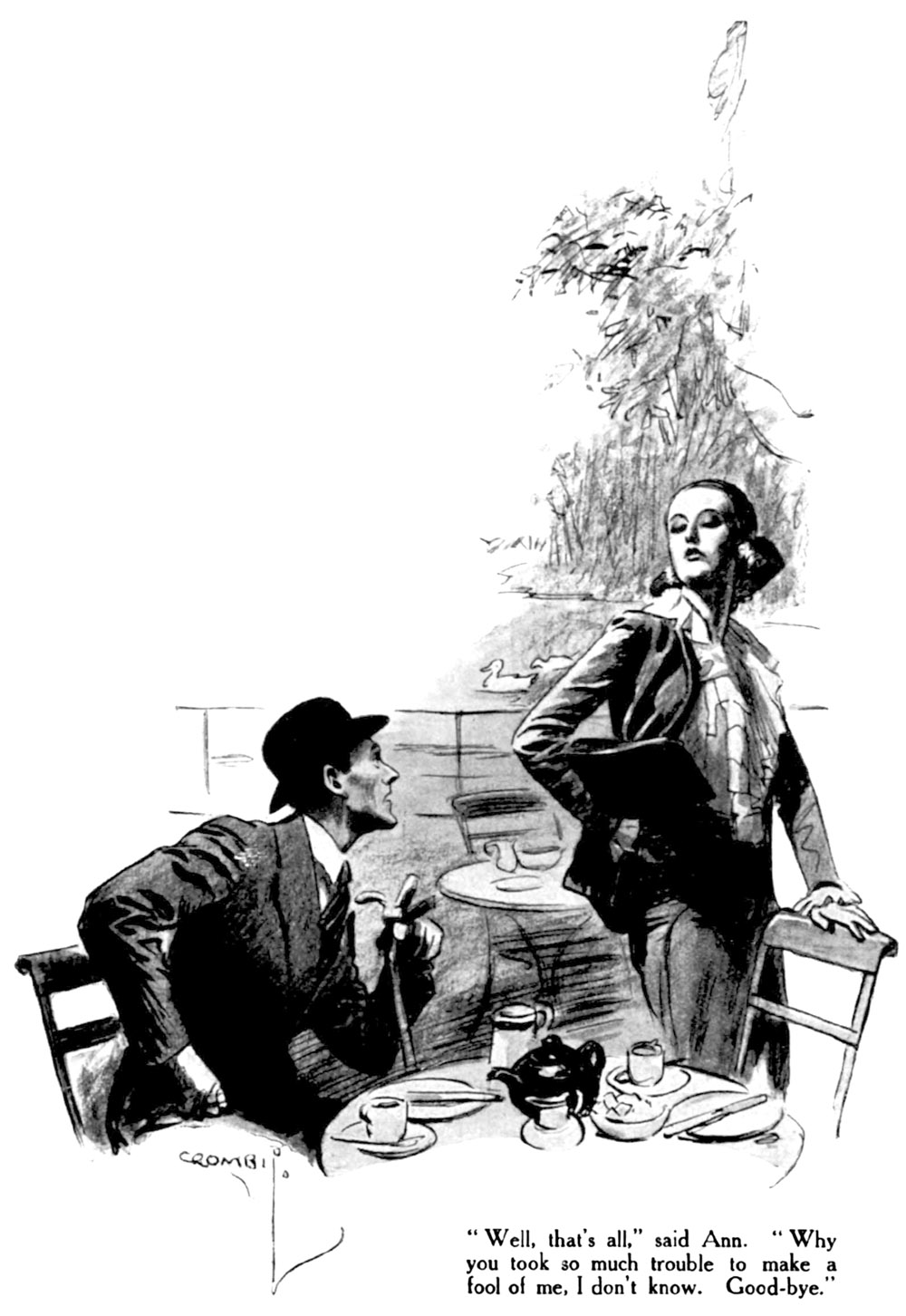 Ann continued speaking in the same low, even voice.
“She told me that you were the last person to do anything as nasty and dangerous as that, because you had always been so quiet and steady and respectable. She told me that you were my uncle’s secretary, and had never done anything adventurous or exciting in your life. She told me that you wore flannel next your skin and bed-socks in winter. And,” said Ann, “she told me that that scar on your temple was not caused by a bullet, but that you got it when you were six years old by falling against the hat-stand in the hall because you forgot to scratch the soles of your new shoes.”
She rose abruptly.
“Well, that’s all,” she said. “Why you took so much trouble to make a fool of me, I don’t know. Good-bye.”
She was walking away—walking out of his life—and still Berry found himself unable to move. Then, as she disappeared round the angle of the Tea House, he seemed to come out of his trance. He sprang to his feet, and was hurrying after her to explain, to plead, to give her the old oil, to clear himself at least of the charge of wearing bed-socks, when a voice arrested him.
“Jer want your bill, sir?”
It was the waitress, grim and suspicious. She disapproved of customers who developed a sudden activity before they had discharged their financial obligations.
“Oh!” Berry blinked. The waitress sniffed. “I was forgetting,” said Berry.
He found money, handed it over, waved away the change. But the delay, though brief, had been fatal.
He vaulted the railings and stood peering about him. Hyde Park basked in the summer sunshine, green and spacious. The dogs were there. The loafers were there. The paper bags were there. But Ann had gone.
The ducks in the Serpentine quacked on, unfed.
iii.
IN the smoking-room of the low and seedy club which was his haunt, Captain Kelly was listening with an expressionless face to an agitated Mr. Hoke.
“He said he knew your secret?”
“Yes.”
J. B. Hoke mopped his forehead. Emotion, coupled with the four double brandies which he had taken to restore himself after the shock of his recent interview with the Biscuit, had made him more soluble than ever. He had become virtually fluid.
“Which secret?” asked the Captain.
“About The Dream Come True, of course.”
“Why of course? You must have a hundred, each shadier than the other.”
Mr. Hoke was not to be consoled by this kindly suggestion. He shook his head.
“This fellow’s a friend of young Conway. He lives next door to Conway. He was lunching with Conway. They were talking about The Dream Come True. Conway told me so. I thought right from the start that Conway had been listening at the door that day, and I was right.”
The Captain considered.
“Maybe,” he said. “On the other hand, this red-headed chap may have been bluffing you.”
“I’m not so easy to bluff,” said Mr. Hoke, bridling despite his concern.
“No?” said Captain Kelly. He smiled a twisted smile. “Well, you were easy enough for me to bluff. You took in that story of mine about the gorillas without blinking. And you signed away half your cash on the strength of it.”
A hideous suspicion shot through Mr. Hoke. He trembled visibly.
“The gorillas?” he gasped. “Do you mean to say——”
“Of course I do. Gorillas! There aren’t any gorillas. What would I be doing spending my money on gorillas? I made them up. It flashed into my mind. Just like that. You know how things flash.”
Mr. Hoke was breathing stertorously. It was as if this revelation of a friend’s duplicity had stunned him.
“And you fell for it,” said Captain Kelly with relish. “I’d never have thought it of you. Going to cost you a lot, that is.”
Mr. Hoke recovered. He spoke venomously.
“Is it?” he said. “You think you’re on to a good thing, do you?”
“I know it.”
“Well, let me tell you something,” said Mr. Hoke. “Do you know how many shares of Horned Toad Copper I hold at the present moment?”
“How many?”
“Not one. Not a single solitary darned one. That’s how many.”
The Captain’s face stiffened.
“What are you talking about?”
“I’ll tell you what I’m talking about. I sold all my holdings at four, and I was going to buy them back when I felt they’d gone low enough. And then we would have spilled the info’ about the new reef, and everything would have been fine. But now where are we? What is to prevent that red-headed young hound getting together some money and starting buying directly the market opens? What’s to prevent him buying up all the shares there are?”
Something of his companion’s concern was reflected on Captain Kelly’s face.
“H’m!” he said. He paused thoughtfully. “You really think he knows?”
“Of course he knows. He said ‘I know your secret.’ And I said ‘What secret?’ And he said ‘Ah!’ And I said ‘About The Dream Come True?’ And he said ‘That’s the one.’ ”
Captain Kelly eyed his friend unpleasantly.
“And you said you weren’t easy to bluff! I wish I’d been there.”
“What would you have done?”
“I’d have soaked you with a chair before you could start talking. Can’t you see he didn’t really know anything?”
“Well, he knows plenty now,” said Mr. Hoke sullenly. Recalling the scene, he sat amazed at his simplicity. He could not believe that it was he, J. B. Hoke, who had behaved like that. He put it down to the fact that those phantom gorillas had been preying on his mind to such an extent that he had become incapable of clear thought.
“What are you going to do about it?” asked Captain Kelly.
Mr. Hoke regarded him with cold reproach.
“What can I do about it?” he said. “I’ll tell you what I was going to do about it, if you like. I came here to ask you to send those two gorillas of yours down to Valley Fields, where this guy lives, and attend to him.”
“Cosh him?”
“There wouldn’t have been any need to cosh him. All that’s necessary is to keep Conway and that red-haired bird away from the market long enough to let me buy back that stock. They can’t do anything to-day, because the market’s closed. But, if they aren’t stopped, they’ll be there bright and early to-morrow morning. I was going to tell you to send these gorillas down to keep them bottled up at home till I was ready to let them out. They could have flashed a gun at them, and made them stay put. I only need a couple of hours to-morrow to clean up that stock. But what’s the use of talking about it now?” said Mr. Hoke, disgustedly. “There aren’t any gorillas.”
He brooded disconsolately on this shortage. Captain Kelly was also brooding, but his thoughts had taken a different turn.
“It’s a good idea,” he said, at length. “I wouldn’t have expected you to think of it.”
“What’s a good idea?”
“Bottling these fellows up.”
“Yeah?” said Mr. Hoke. “And how’s it going to be done?”
Captain Kelly smiled one of his infrequent smiles.
“We’ll do it.”
“Who’ll do it?”
“You and I’ll do it. We’ll go down there and do it to-night.”
Mr. Hoke stared. His potations had to a certain extent dulled his mental faculties, but he could still understand speech as plain as this.
“Me?” he said, incredulously. “You think I’m going to horn into folks’ homes with a gat in my hand?”
“Ah!” said Captain Kelly.
“I won’t.”
“You will,” said the Captain. “Or would you rather let these two chaps get away with it?”
Mr. Hoke quivered. The prospect was not a pleasant one.
“You’ve said yourself what will happen,” proceeded the Captain, “if these fellows aren’t stopped. They’ll get hold of all that stock, and somebody will suspect something, and the price will go up, and when we try to buy we’ll have to pay through the nose.”
Mr. Hoke nodded pallidly.
“I remember M.T.O. Nickel opening at ten and going to a hundred and twelve two hours later on a rumour,” he said. “That was five years ago. It’ll be the same with Horned Toad. Once start fooling around with these stocks, and you never know what won’t break.” He paused. “But go down to Valley Fields and wave gats!” he said, shaking gently like a jelly. “I can’t do it.”
“You’re going to do it,” said Captain Kelly, firmly. “Have you got a gat?”
“Of course I haven’t got a gat.”
“Then go out and buy one now,” said Captain Kelly, “and meet me here at nine o’clock.”
iv.
CAPTAIN KELLY regarded Mr. Hoke censoriously. He did not like the way his friend had just tumbled into his car. Like a self-propelling sack of coals, the Captain considered.
“Hoke,” he said, “you’re blotto!”
Mr. Hoke did not reply. He was gazing good-humouredly into the middle distance. His eyes were like the eyes of a fish not in the best of health.
“Oh, well,” said the Captain, resignedly. “Maybe the fresh air will do you good.”
He took his seat at the steering-wheel, and the car moved off. Nine o’clock struck from Big Ben.
“Got gat,” said Mr. Hoke, becoming chatty.
“Shut up,” said Captain Kelly.
Mr. Hoke laughed softly and nestled into his seat. The car slid on towards Sloane Square. Mr. Hoke nodded at the policeman on point-duty.
“Got gat,” he informed him, as one old friend to another.
Printer’s error corrected above:
Magazine, p. 322a, had “punshiment”.