The Heart of a Goof
(US: Divots)
by
P. G. Wodehouse
Literary and Cultural References
The following notes attempt to explain cultural, historical and literary allusions in Wodehouse’s text, to identify his sources, and to cross-reference similar references in the rest of the canon. This preliminary version of the document exists mainly to provide links to the original magazine texts of the short golf stories collected herein, as well as notes by Neil Midkiff to the Preface transcribed on this site.
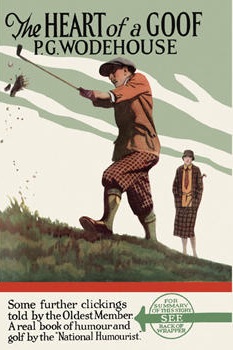
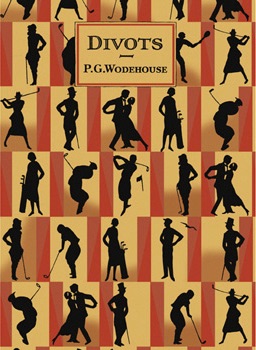 The Heart of a Goof was published by Herbert Jenkins, London, on 15 April 1926. The US edition, under the title Divots, was published by George H. Doran, New York, on 4 May 1927.
There are a number of slight differences between the two editions, chiefly as regards the names of places, golfers and the like, which were adapted to suit the intended readership. Until this document is fleshed out with annotations, see Neil Midkiff’s page of data on the short stories for remarks on the different versions of the stories. Note also that each of the stories is annotated in the form of end notes to one of the individual magazine transcriptions, as noted below for each story.
Preface
Page references in the Preface refer to the 1926 Herbert Jenkins edition.
See also the Preface as transcribed on this site.
nine-hole course (p. v)
A subtle way of describing the nine short stories in this collection.
The Clicking of Cuthbert (p. v)
Note that both the UK and USA editions of this book refer to the previous collection by its British title The Clicking of Cuthbert.
James Braid, John Henry Taylor (p. v)
Horace Hutchinson (p. v)
Horatio (“Horace”) Hutchinson (1859–1932): British amateur golfer, Amateur Champion 1886 and 1887; author of several books on golf.
Publius Syrius (p. v)
Quoted as Maxim 767 in the traditional English translation of this ancient Roman poet, enslaved during the first century bce. Newer sources give his name as Publilius Syrus.
“Be of good cheer. I see land” (p. v)
Though Google’s AI results claim that this is a joke coined by Wodehouse as a parody of Xenophon’s ten thousand Greeks crying “Thalassa!” (“The sea!”), the Internet Archive shows earlier identical quotations attributed to Diogenes from 1906 and 1922. I initially questioned whether Diogenes the Cynic or Diogenes Laertius ever said anything like this, but it was clear that the literary attribution was already in circulation when Wodehouse wrote this Preface.
Diego Seguí assures us that the quotation is genuine and involves both of these ancients, as it comes from Laertius’ Lives of Eminent Philosophers, VI.38, in the biography of the Cynic, right after his most famous saying to Alexander the Great: “Stand out of my light”:
μακρά τινος ἀναγινώσκοντος καὶ πρὸς τῷ τέλει τοῦ βιβλίου ἄγραφόν τι παραδείξαντος “θαρρεῖτε,” ἔφη, “ἄνδρες‧ γῆν ὁρῶ.”
Some one had been reading aloud for a very long time, and when he was near the end of the roll pointed to a space with no writing on it. “Cheer up, my men,” cried Diogenes; “there’s land in sight.”
[Translation by R. D. Hicks, Loeb Classical Library]
Doctor Watts (p. v–vi)
See Cocktail Time.
Chaucer … ful long spoone (p. vi)
The Canterbury Tales of course precede any attempt at standardized English spelling. The Internet Archive has an 1848 edition with an explanatory note about the proverb about eating with the Devil. For spoon in golf, see A Glossary of Golf Terminology on this site, where you can also find explanations of the Haskell rubber-cored ball and the iron clubs.
Four rogues in buckram (p. vi)
Shakespeare: spoken by Falstaff, from King Henry IV, Part I, act II, scene iv. See also Shakespeare Quotations and Allusions in Wodehouse on this site.
niblick (p. vi)
See A Glossary of Golf Terminology for this and other golf jargon.
handicap in brackets (p. vii)
See A Glossary of Golf Terminology for handicap. In both the US and UK prefaces, Wodehouse uses brackets, an older British term for parentheses.
(36) (p. vii)
A handicap of 36 indicates a poor golfer, who would take on average two more strokes per hole on an eighteen-hole round than a player of professional standard.
(scr.) (p. vii)
Scratch; see A Glossary of Golf Terminology.
the spell of the great Russians (p. vii)
A sly allusion to his earlier story “The [Unexpected] Clicking of Cuthbert”.
National Links at Southampton (p. vii)
See Wikipedia for more on this course and its design of holes matching famous British courses.
Norman Murphy’s researches indicate that Wodehouse also played often at the Sound View golf club in Great Neck when he was living there in the 1920s, and modeled many of the Oldest Member’s descriptions on that club. The National Links is considerably farther east on Long Island. When the Wodehouses settled on Long Island again in 1952, their home was much closer to the National Links, which are about fifteen miles to the east of their home in Remsenburg.
medal score (p. viii)
Scoring by the total number of strokes taken during a round of eighteen holes; now the most common form of tournament play. See A Glossary of Golf Terminology.
Aiken, South Carolina (p. viii)
Described in a letter to Denis Mackail, May 20, 1923, where he “spent three months of the winter and played eighteen holes every day.” He bragged that his usual score was around 85 and once did a 79. Presumably he actually took 95 strokes and deducted his “handicap of sixteen” to achieve this figure.
Walker Cup (p. viii)
See Wikipedia.
Addington (p. viii)
See Ukridge. Wodehouse is joking here that his usual address is the sixth bunker, one of the sand traps on the course.
The Heart of a Goof
“The Heart of a Goof” was first published in September 1923 in the Red Book magazine (US) and in April 1924 in the Strand Magazine (UK). The Red Book transcription on this site has annotations to this story as end notes.
High Stakes
“High Stakes” was first published on September 19, 1925 in the Saturday Evening Post (US) and in October 1925 in the Strand Magazine (UK). The Saturday Evening Post transcription on this site has annotations to this story as end notes.
Keeping In with Vosper
“Keeping In with Vosper” was first published in March 1926 in the Strand Magazine (UK) and on March 13, 1926 in Liberty (US). The Strand transcription on this site has annotations to this story as end notes.
Chester Forgets Himself
“Chester Forgets Himself” was first published on July 7, 1923 in the Saturday Evening Post (US) and in May 1924 in the Strand Magazine (UK). The Saturday Evening Post transcription on this site has annotations to this story as end notes.
The Magic Plus Fours
“The Magic Plus Fours” was first published in December 1922 in the Strand Magazine (UK) and, as “The Plus Fours,” in January 1923 in the Red Book magazine (US). The Red Book transcription on this site has annotations to this story as end notes.
The Awakening of Rollo Podmarsh
“The Awakening of Rollo Podmarsh” was first published in January 1923 in the Strand Magazine (UK) and, as “Rollo Podmarsh Comes To,” in March 1923 in the Red Book magazine (US). The Strand transcription on this site has annotations to this story as end notes.
Rodney Fails to Qualify
“Rodney Fails to Qualify” was first published on February 23, 1924 in the Saturday Evening Post (US) and in March 1924 in the Strand Magazine (UK). The Strand transcription on this site has annotations to this story as end notes.
Jane Gets Off the Fairway
“Jane Gets Off the Fairway” was first published on October 25, 1924 in the Saturday Evening Post (US) and in November 1924 in the Strand Magazine (UK). The Strand transcription on this site has annotations to this story as end notes.
The Purification of Rodney Spelvin
“The Purification of Rodney Spelvin” was first published on August 22, 1925 in the Saturday Evening Post (US) and in September 1925 in the Strand Magazine (UK). The Strand transcription on this site has annotations to this story as end notes.
Wodehouse’s writings are copyright © Trustees of the Wodehouse Estate in most countries;
material published prior to 1931 is in USA public domain, used here with permission of the Estate.
Our editorial commentary and other added material are copyright
© 2012–2026 www.MadamEulalie.org.